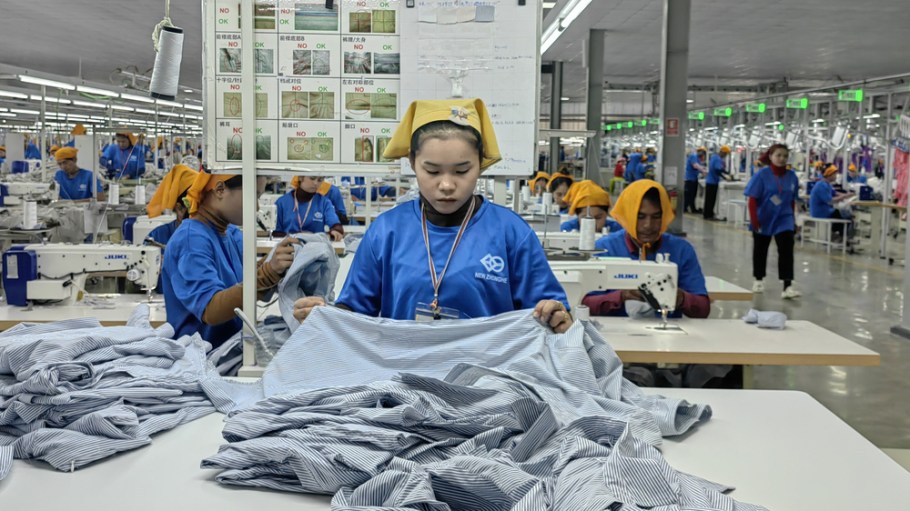
The Cambodian government has approved a new monthly minimum wage of $210 for the Southeast Asian nation’s nearly 1 million garment, footwear, textile and travel goods workers, a significant downgrade from the $232 that trade unions and civil society organizations were not only asking for, but demanding.
The announcement of the $2 pay hike on Wednesday followed the final meeting of the National Minimum Wage Council last week, during which worker and employer representatives unanimously decided against recommending a precise figure due to what they said were current labor market conditions and the potential impacts of reciprocal tariffs from the United States, now hovering at 19 percent. Employer representatives initially proposed maintaining the minimum wage at $208, which had ticked up from $204 in 2024, as a way to maintain competitiveness.
Related Stories
Labor minister Heng Sour described this year’s negotiations as “successful,” saying that both workers’ and employers’ representatives demonstrated maturity despite the economic challenges. With attendance, transport, rent and seniority bonuses, workers can expect to earn between $227 and $238 per month.
“Despite uncertainty in the global economy and the fact that many countries in the region have not raised wages, the Royal Government of Cambodia has approved an increase, whether small or large, to ease workers’ burdens and improve their livelihoods,” Sour said.
But the barely 1 percent increment won’t even cover inflation, which is expected to rise to 2.5 percent in 2025 before softening to 2.3 percent in 2026. As such, workers will be forcing themselves to work without rest in order to shoulder the intensifying weight of daily expenses, said Tharo Khun, program manager at the Center of Alliance of Labor and Human Rights, the workers’ rights group better known as CENTRAL. Workers will also have no choice but to grapple with worsening debt just to survive, he said, “eventually affecting their mental health and social well-being.”
“The question is who bears the responsibility for workers amid the rising costs and inflation,” Khun said, noting the lack of “genuine” worker representation on the National Minimum Wage Council due to what human rights defenders characterize as the government’s open repression of the labor movement, including through the adoption of laws that significantly curtail the rights to freedom of association and peaceful assembly.
“All key stakeholders are not doing enough to reduce daily expenses, stabilize prices and protect workers from the weight of inflation while the average income is based on overtime wage structures,” he added.
One of the organizations that negotiated on behalf of workers on the National Minimum Wage Council is the National Union Alliance Chamber of Cambodia, which has been referred to as “notoriously pro-ruling party.”
Reacting to the government’s announcement, Kim Chansamnang, its president, said it was pleased with the increase “even though it is small.” He said it comes at a “difficult time for the country,” urging landlords and utilities not to take advantage of workers by raising fees.
It was only earlier this month that the Business & Human Rights Resource Center, the Centre for Alliance of Labor and Human Rights Alliances, the Cambodian Alliance of Trade Unions, the Clean Clothes Campaign and others published a joint letter calling the current minimum wage ““far below the threshold of a dignified life” and describing a 10 percent boost as an “urgent necessity grounded in the real costs of survival for Cambodian workers and the demonstrated economic capacity of the country.”
They cited the Asia Floor Wage Alliance’s 2024 Consumption Survey, which found that workers spent roughly $408 on food and non-food items, or double their average income of $250. In a report that ActionAid Australia, CENTRAL and other organizations affiliated with the Clean Clothes Campaign published in 2023, 65 percent of surveyed workers said that they couldn’t make their wages stretch until the end of the month, pushing them to take on loans or add hours to their already 48-hour workweek. Some 91 percent of those interviewed, in fact, reported holding at least one current loan just to meet basic needs. Some informal loans can carry interest rates as high as 20 percent.
“This persistent wage-expenditure gap pushes workers further into debt, traps them in poverty, and forces them to compromise on food, healthcare and education,” the organizations said. “It is unacceptable that the backbone of Cambodia’s economy—the garment and footwear workers—are denied the most basic conditions for a dignified life while the sector continues to attract global investment and deliver profits for brands and employers.”
Khun said that, on a broader level, U.S. tariffs, the climate crisis, corporate realignments, geopolitical realignments and the aftershocks of the pandemic are reshaping the landscape for workers, but “mostly without their participation.”
These global economic dynamics have created “zones of compliance” with low wages and weak unions, he said, adding that growing gaps between average earnings and living costs are also driving workers to resort to precarious employment structures such as fixed-duration contracts, preventing union organizing.
Meanwhile, brands continue to be disengaged from their labor rights obligations by “hiding behind intermediaries and CSR/ESG reporting mechanisms,” Khun said. Brands that produce in Cambodia include Asos, Adidas, Nike, Gap Inc., Calvin Klein owner PVH Corp., H&M Group, Primark, Zara owner Inditex, Levi Strauss & Co., Puma and Under Armour. While some of them have signed legally binding agreements facilitated by IndustriALL Global Union to support collective bargaining agreements that enable higher wages, many haven’t.
“As production becomes more fragmented and capital more fluid, we continue to see wage depression as buyers demand lower prices with shorter lead times, increasing pressure on workers,” he added.
Cambodia’s garment, footwear, textile and travel exports grew to $7.4 billion in the first half of 2025, an increase of 22 percent from $6 billion during the same period the year before, according to the General Department of Customs and Excise. Apparel alone accounted for $5.3 billion of the figure.