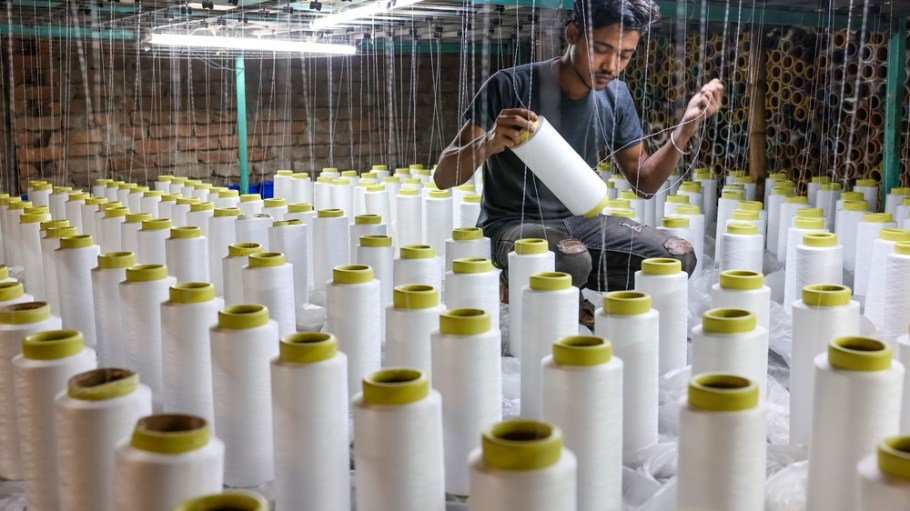
It was an ultimatum that sent ripples through Bangladesh’s garment industry: If the interim government failed to safeguard domestic yarn production by suspending duty-free yarn exports under the bonded warehouse facility, the Bangladesh Textile Mills Association warned, all mills would be indefinitely closed starting February.
“We do not have the capacity to repay bank loans,” BTMA president Showkat Aziz Russell said at a press conference in Dhaka last week. “Even if we sell off all our assets, it will not be possible to clear the debts.”
Related Stories
While the BTMA on Thursday announced a “temporary suspension” of its declaration, the move had by then provoked a standoff between textile producers and ready-made garment manufacturers, exposing long-simmering tensions between the two sectors.
For years, export-focused suppliers have relied on cotton from India and polyester from China for their lower cost and greater consistency. Imposing import duties on these inputs, the Bangladesh Garment Manufacturers and Exporters Association and the Bangladesh Knitwear Manufacturers and Exporters Association said, would be tantamount to industrial suicide, especially since factories were already struggling with muted demand from trade disputes and other geoeconomic uncertainties. The mills, for their part, cited crippling financial losses that were compounded by high borrowing costs and a worsening fuel deficit.
“More competitive pricing from Indian yarn that’s about 15-20 percent cheaper, plus higher energy costs that have almost doubled in the last two years, have caused a major slowdown in the Bangladeshi spinning industry because of the depressed domestic demand,” Munir Mashooqullah, founder and chairman of M5 Groupe, a business network whose portfolio includes Simco Spinning & Textiles, told Sourcing Journal. “A lot of these factories were already headed toward closure with mounting debts and layoffs.”
Mustafain Munir, director of Cyclo, a recycled fiber manufacturer operated by Simco, said that U.S. tariffs on Indian exports have created a surfeit of Indian cotton at even lower prices, further eroding Bangladeshi mills’ ability to compete if they don’t have value-added advantages like sustainable certifications.
Both the BGMEA and BKMEA have balked at the prospect of bonded yarn imports being withdrawn just as Bangladesh prepares to graduate from the United Nations’ Least Developed Country status this year. Removing duty-free access, they said, would hike yarn prices by nearly 37 percent, adding roughly 60 cents per kilogram to the cost of raw materials.
In 2025, Bangladesh paid $2 billion to import 700 million kilograms of cotton yarn, 78 percent of which hailed from India. The country’s semi-protectionist restriction on yarn imports from India through its land ports last April, however, has added to logistical costs and caused delays, apparel producers said.
To address their concerns—and broker a détente—senior government officials from the Ministry of Commerce held a meeting on Tuesday with the BTMA, BGMEA and BKMEA.
“As buyers, we are free to buy anywhere; there should not be any restrictions,” Faisal Samad, managing director of Surma Garments and a member of the BGMEA’s board of directors, told Sourcing Journal. “But we tried to come to a mutual understanding, based on which the government is considering increasing the incentive on domestic yarns or increasing the incentive on garments. All that is under consideration right now.”
Another meeting has been scheduled for Feb. 3, two days after the original shutdown date, at the Ministry of Finance.
Even so, the BTMA announcement should be seen as a “warning signal,” Md. Rafiqul Islam Rana, an assistant professor of retailing at the University of South Carolina, wrote in an email. Not only are local mills under “extreme pressure” from “cheap yarn dumping from India, gas shortages, and high bank loan burdens,” he said, but many of them are no longer able to operate or repay loans.
Rana also described this crisis as unfolding at a “very difficult political moment,” with most policy decisions effectively on hold by Muhammad Yunus’s caretaker leadership until the general election on Feb. 12.
“Because of this, long-standing industry requests such as duties on imported yarn or temporary incentives have not moved forward,” he said. “The industry is asking for urgent, short-term support to survive this transition period. If spinning mills shut down now, Bangladesh will become more dependent on imported yarn, which will hurt the entire apparel supply chain in the long run.”
In other words, the next elected government will need to move fast or risk permanent damage to the domestic textile base, Rana added.
For now, the BTMA is waiting—and seeing—though it reserves the right to reactivate its earlier threat.
“BTMA expresses confidence that the government will address the issues of the spinning sector in a timely, transparent and lawful manner contributing to export competitiveness, employment protection and macroeconomic stability,“ Md. Ziaur Rahman, the organization’s joint secretary general, said in a statement. “BTMA will review subsequent developments and announce its future course of action accordingly.”