“Beyond acceptable.” That’s what Senator Bernie Sanders said after a congressional investigation into Amazon’s occupational hazards found that the e-tail Goliath knowingly sacrificed employee health in the name of speed and productivity and manipulated workplace injury data to make its warehouses appear safer than they are.
Among the findings, the result of an 18-month probe by the Senate Committee on Health, Education, Labor and Pensions, which the Vermont independent chairs, was the revelation that the Everything Store’s warehouses has been obfuscating injury rates that are “significantly” higher than both the industry average and non-Amazon warehouses due to “uniquely dangerous” conditions that force workers to move at an “extremely fast and dangerous” clip, replete with harmful repetitive motions.
Related Stories
The report found, for instance, that Amazon warehouses recorded more than 30 percent more injuries than the industry baseline in 2023 despite claiming to be “nearly as safe” by cherry-picking data. Over the past seven years, workers at the nation’s largest online retailer were also nearly twice as likely to be injured compared with their counterparts at other warehouses because they regularly bypassed safety measures, such as the proper use of ladders or requesting help to lift a heavy item, to keep up with the company’s “unsustainable” quota requirements, it said.
“The shockingly dangerous working conditions at Amazon’s warehouses revealed in this 160-page report are beyond unacceptable,” Sanders said in a statement on Sunday. “Amazon’s executives repeatedly chose to put profits ahead of the health and safety of its workers by ignoring recommendations that would substantially reduce injuries.”
On Monday, Amazon pushed back at the investigation, rejecting findings that it said are “fundamentally flawed” because they are based on “outdated information that lacks context and isn’t grounded in reality.”
“We’re proud of the progress we’ve made and our commitment to continuously improving, and we were eager to share that progress with the committee,” it said in a statement. “Unfortunately, it’s now clear that this investigation wasn’t a fact-finding mission, but rather an attempt to collect information and twist it to support a false narrative.”
Amazon claimed that contrary to the Senate committee’s assertions, it’s managed to increase it delivery speeds while while decreasing injury rates across its global network, predominantly by moving products closer to customers and shortening the so-called “final mile.”
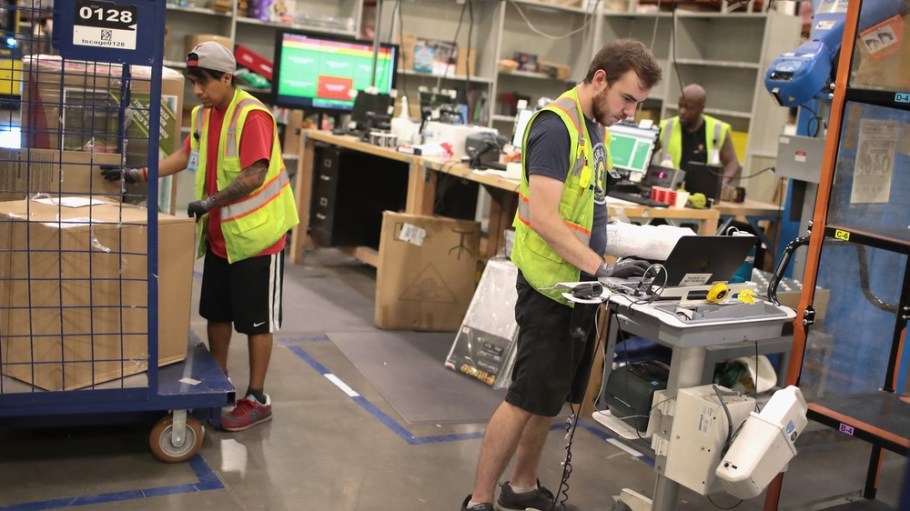
But Amazon workers, in wide-ranging interviews conducted by Sanders’s office, said that despite defined safety procedures, the company’s required rates make them “nearly impossible to follow.” As a result, they have to live with chronic pain, loss of mobility and lowered quality of life because of what they say is the Prime operator’s insistence on enforcing punishing productivity expectations and a refusal to provide adequate medical care to injured employees. It’s these concerns that underpin organizing efforts in Alabama, Florida, Missouri, New York and Kentucky.
Perhaps more damningly, the Senate committee found that despite an Amazon-launched initiative called “Project Sorteria” that found evidence of a correlation between speed and injuries, the retail juggernaut brushed aside policy-change recommendations that would have curtailed accident rates. Amazon leadership, the report said, then directed the Project Soteria team to adapt its focus from lowering injuries to finding ways to “maximize rates/productivity” without increasing injuries, referred to internally as the “injury-productivity trade-off.”
Another Amazon study, dubbed “Project Elderwand,” estimated that workers who pick items off robotic shelving units can make 1,940 repetitive movements in a 10-hour shift—the equivalent of handling roughly 216 items per hour—before they risked excessive musculoskeletal strain, yet no such limit was implemented. Instead, Amazon workers, on average, pick more than 266 items per hour.
Amazon, in its statement, said that it was “wrong” to rely on “analytically unsound” documents like the Project Soteria paper in any objective report but that Sanders and his staff chose to rely on the “debunked Soteria analysis” because it “fits the false narrative he wanted to build.” It said that Project Elderwand shows how it regularly examines its safety processes to ensure they’re as “strong as they can be—nothing more, and nothing less” and that “unverified anecdotes are not facts.”
Still, Christy Hoffman, general secretary of UNI Global Union, one of the co-organizers of the “Make Amazon Pay” movement, said that Amazon’s “abuses” will not end until it respects its workers’ right to bargain collectively in a union and takes their demands for safety and dignity “seriously.”
“As the Senate report reveals, Amazon’s relentless pursuit of speed and profit comes at a devastating cost to its workers’ health and safety. This is not just a failure of corporate responsibility; it’s a moral failing,” she said in a statement. “For years, workers have been sounding the alarm about unsafe conditions and the grueling quotas that leave them injured and unsupported, yet their voices have been dismissed.”
One Amazon worker told the Senate committee that he doesn’t even shop there anymore.
“I’d rather wait…than have some poor employee in an Amazon warehouse get battered and bruised so I can get my book within six hours,” this person said. “People don’t see that, they think it just appears by magic. But it doesn’t, it appears by blood, sweat and tears.”