The U.S. Air Force Research Laboratory (AFRL) is working on developing a new, warmer fiber for use in military grade uniforms that will keep people posted in Arctic regions warmer and dryer than they are currently while stationed in the world’s most challenging, frigid conditions.
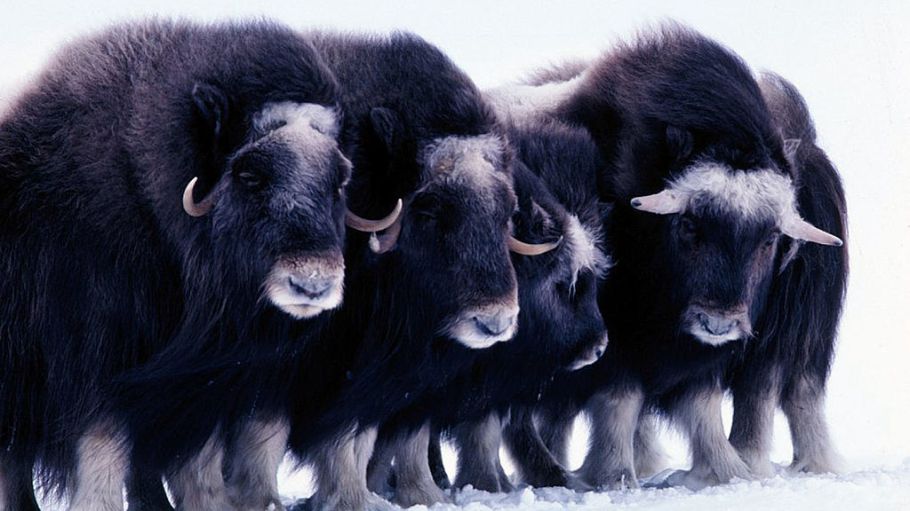
Working with the Air Force Life Cycle Management Center, Cornell University, Ohio-based contractor UES, Inc. and the Palmer Muskox Farm, Palmer, Alaska, the AFRL is exploring the development of synthetic musk ox wool keratin fibers that mimic the properties of raw musk ox wool fibers, prized for their enhanced thermal-insulating properties.
Related Stories
Musk ox are hoofed mammals more closely related to goats and sheep than oxen, although they have their own genus, Ovibos.
Based on initial research by AFRL’s Materials and Manufacturing Directorate and the 711th Human Performance Wing, the idea is to use qivuit, the indigenous term for the musk ox wool, combined with other natural or synthetic polymers such as nylon using electrospinning, to create a textile that is lighter, stronger and more environmentally sustainable than the merino wool cold weather garments traditionally worn by military members in the Arctic.
According to Dr. Nancy Kelley-Loughnane, research team lead in the biomaterials branch of the Materials and Manufacturing Directorate, there is room for improvement in materials currently being used.
“When pilots conduct cold-climate missions in Arctic spaces such as Alaska, they might need to land in water, on frozen tundra, on ice,” she said. “We need a textile that has multiple properties, something that does more than just keep us warm in the event of unplanned isolation.”
Researchers agree that a new cold weather textile would offer thermal insulation and moisture-wicking properties. It would also be lightweight if it got wet, said Dr. Mark Tyler Nelson, research biomedical engineer in the 711th Human Performance Wing.
Traditionally, merino wool and goose down have been used to insulate cold weather garments but these raise concerns about practicality and sustainability, Nelson said. Goose down is problematic if it gets wet, and merino, while common, gets too heavy when moisture creeps in. There are also ethical issues surrounding the use of goose down and the cost of merino is becoming prohibitive. Some 81 percent of it is imported to the U.S. from Australia.
Coming up with a military-grade textile that balances all the desired properties is tricky business.
It also has to be sourced and made in the United States to comply with the Berry Amendment, a provision passed by Congress in 1941 as part of the Appropriations Act which requires the Department of Defense to give priority to items produced in the United States, particularly clothing and textiles.
To use genuine musk ox wool and comply with Berry would require starting a massive farm operation to breed the animals on U.S. territory, where most of the climactically correct terrain is frozen solid most of the year.
Synthetic fiber, or a combination, is the answer and there are multiple ways to achieve it. With biology as the inspiration, researchers can recombinantly express musk ox fiber proteins in E. coli bacteria where they would ferment, then be purified and made into fiber using the electrospinning process. Fiddling with different existing polymers would bring researchers to the right pairing for the musk ox fiber.
Keratin proteins are currently being produced on a small scale in a lab but the operation is close to being broadened to industrial scale. Once that happens, the team will engage an industrial partner to produce it at scale and do so in an environmentally beneficial way.
“The way we obtain textiles, and the ways in which we currently make clothes, aren’t always very sustainable,” Kelley-Loughnane noted. “Current practices require the use of excess chemicals and petroleum-based products. We are working to find a way to change that.”
Like that of polar bears, musk ox hair is medullated, or hollow, which plays a role in keeping the animals warm. Studying polar bears has led to developments in synthetic fleece, a breakthrough scientists hope to mimic with musk ox hair.