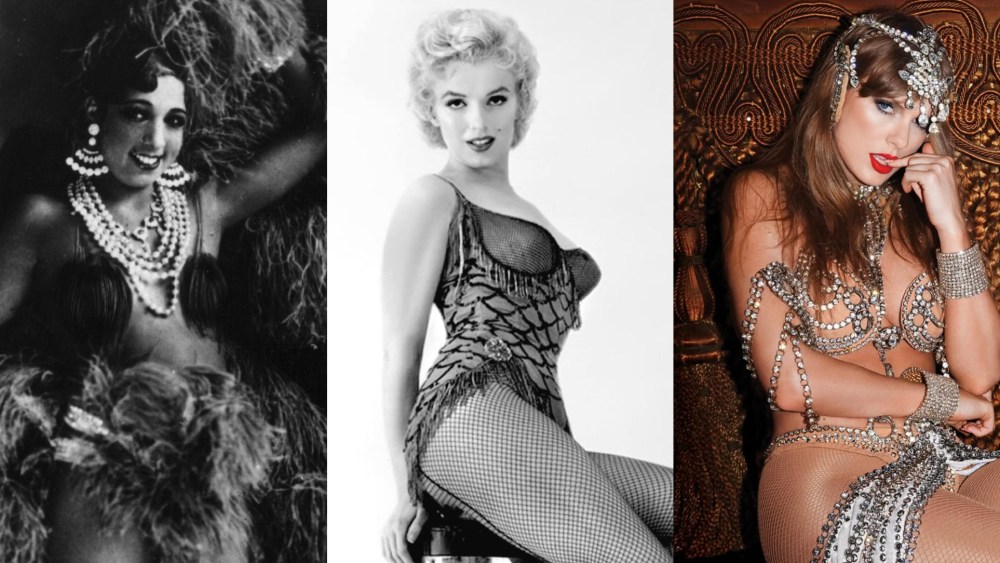
Taylor Swift announced the title and track list of her forthcoming 12th studio album, “The Life of a Showgirl,” on Wednesday. The album art and subsequent photos feature Swift in various sartorial styles and poses evocative of the iconic showgirl.
With deep roots in the late 19th and early 20th centuries, the showgirl archetype evolved over the course of the last century. The term was coined sometime in the 18th century, but was used more widely in 1800s Paris to describe the performers of various cabarets, including the iconic Moulin Rouge.
Related Articles
By 1907, America adopted the showgirl, with The Ziegfeld Follies on Broadway. Filmmaker Busby Berkeley incorporated showgirls into his 1930 films. The showgirl has also become an emblematic symbol of Las Vegas entertainment. From stage and screen, the showgirl became a glamorous symbol in entertainment, often adorned with feathers and dripping in jewels.
You May Also Like
Whether they came from the stage or popped on screen, showgirls from Josephine Baker to Marilyn Monroe left an indelible mark on popular culture. So much so, in fact, that the showgirl spawned such films as 1995 cult classic “Showgirls” and the 2024 Pamela Anderson vehicle “The Last Showgirl.”
Here, WWD looks back on some of the most famous showgirls of stage and screen and how each woman redefined the archetype.
Josephine Baker

Baker is one of the most famous showgirls of the 1920s. Originally from the U.S., the dancer and singer moved to France in 1925. She performed mostly in Paris, including the Folies Bergère revue “Un vent de folie” in 1927. Baker was known for her transgressive style, pushing boundaries on notions of race, gender and sensuality at a time when such subjects were still largely taboo. Baker was one of the most successful American entertainers working in Europe.
Baker’s impact on culture extended well into the 21st century. At the 2006 Fashion Rocks concert at New York City’s Radio City Music Hall, Beyoncé Knowles-Carter performed her own interpretation of Baker’s “banana dance” from the 1927 “Un vent de folie.”
Marlene Dietrich
German-born American starlet Marlene Dietrich toyed with conventions of gender with her fluid style and dark sensuality. Known for her alluring screen presence in such films as “The Scarlet Empress,” Dietrich’s showgirl qualities came through her wardrobe. The actress took cues from the stage, draping herself in long, flowing gowns and coats.
She also adapted menswear to her wardrobe, styling suits and top hats that served as an iconic part of her look. Dietrich was also known for doing her own makeup and designing some of her own clothes. “People are only now beginning to think of her as an image maker in and of herself. She was someone who understood photographic lighting and how to pose herself,” said Haley Kane, the curator of “Play the Part: Marlene Dietrich.”
Carmen Miranda
Carmen Miranda transcended the showgirl archetype with her distinct style and charisma. Originally from Portugal, the singer, actress and dancer made her Broadway debut in 1939, as part of Lee Shubert’s “The Streets of Paris.”
Miranda made the transition to film and became one of filmmaker Busby Berkeley’s most famous showgirls. The multihyphenate starred in the filmmaker and choreographer’s 1943 film “The Gang’s All Here,” featuring Miranda in costumes with extravagant and glamorous headpieces and playful proportions, which would become her trademark style.
Ann Miller
At the age of 13, dancer and singer Ann Miller became a showgirl in San Francisco’s Bal Tabarin. Miller allegedly lied about her age, saying she was 18, to get the job. The dancer was eventually discovered by representatives of RKO Pictures. Miller starred in supporting roles throughout the company.
Miller turned to Broadway in the late 1930s, but her singing, dancing and acting talent transferred back to the big screen. Some of her most famous roles include 1948’s “Easter Parade,” opposite Fred Astaire and Judy Garland, and “On the Town” (1949) with Gene Kelly and Frank Sinatra.
Marilyn Monroe
Monroe’s image as a Hollywood showgirl remains an indelible image of American popular culture. The actress and singer starred in a series of films from Hollywood’s classic era. Among them, Monroe played showgirls.
Monroe starred alongside Jane Russell in Howard Hawks’ 1953 movie musical “Gentlemen Prefer Blondes,” in which both Russel and Monroe play traveling showgirls looking for love. In 1957, Monroe reprised her showgirl style for “The Prince and the Showgirl” opposite Laurence Olivier. Like Miller before her, Monroe’s spin on the showgirl evolved the archetype as a multihyphenate talent.
Zizi Jeanmaire
Zizi Jeanmaire served as a muse for Yves Saint Laurent in the ’60s and ’70s. The French ballet dancer, singer and performer was famous for her rendition of the titular role in “Carmen” in 1949. Jeanmaire famously wore pieces designed by Saint Laurent during her showgirl days in the ’60s and ’70s, which went on display in 2007 as part of the “Yves Saint Laurent: Theater, Cinema, Music-Hall and Ballet” exhibition.
Jeanmaire is also the singer behind Zizi Jeanmaire’s “Mon Truc En Plumes,” which Lady Gaga performed during the opening of the 2024 Paris Olympics.
Lola Falana
Lola Falana became known as “Queen of Las Vegas” in the 1970s, one of the most famous showgirls to date. Falana even inspired the opening lyric to “Copacabana (At the Copa)” — “Her name was Lola, she was a showgirl.”
After a career on TV specials and Broadway, Falana’s own show saw major success in Las Vegas, often playing sold-out shows at The Sands, among other iconic venues.
Tina Turner
Tina Turner reinvented herself throughout her career. At certain stages, the singer did take inspiration from showgirls, especially when it came to her concert wardrobe. Extravagant outfits, featuring glittering details, feathers and other forms of appliqués, featured throughout her concert costuming.
The singer often worked with Bob Mackie, who glammed up the Queen of Rock in extravagant pieces. Turner’s stage presence and entertainment value gave the showgirl an entirely new meaning.
Cher
Like Turner, Cher also collaborated with Mackie on her showgirl-inspired looks. Through her eponymous variety show, Cher brought elements of the showgirl to audiences at home. Her over-the-top outfits and entertainment, from singing to bit sketches, gave another dimension to the showgirl of the 20th century.
Cher famously brought her showgirl style to both the 1986, featuring her voluminous feather headdress, and her 1988 sheer dress, which she wore upon winning the Oscar for best actress in “Moonstruck.”
Dita Von Teese
Dita Von Teese is a contemporary showgirl who still features in shows in Las Vegas and around the world. Merging showgirl style with elements of burlesque, Von Teese’s 2024 Dita Las Vegas show paid homage to the showgirls of yore.
“It’s burlesque-meets-showgirl revue in Vegas, and it was always my intention to just make this a great show,” Von Teese told WWD in January 2024. With inspiration from Bob Mackie’s showgirl costumes, Von Teese revived the showgirl at a time when cultural interest realigned with the entertainment archetype.