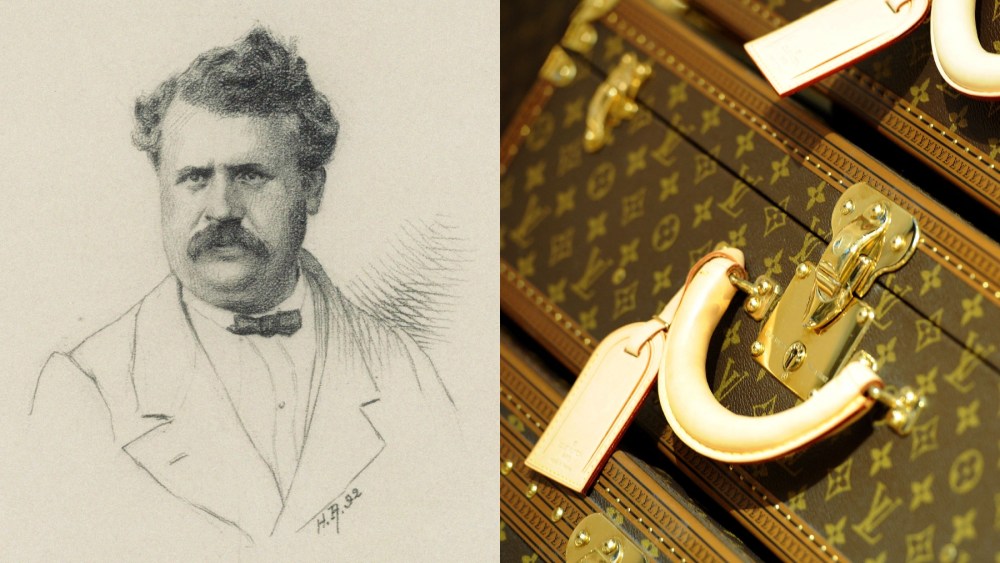
From the launch of its first trunks in the 1850s to its ready-to-wear debut in the ’90s, Louis Vuitton has remained a leading symbol of luxury for nearly 200 years. Today the company is the largest luxury brand in the world and is part of LVMH, but it began as a family-owned firm.
In 1837, a 16-year-old Louis Vuitton ventured to Paris, where he began working as an apprentice for trunk designer Monsieur Marechal. After 17 years under Marechal’s tutelage, Vuitton left to start his own business. He would soon become one of the luggage industry’s biggest innovators, creating flat-topped trunks and inventing “unpickable” locks.
Here, WWD charts the history of Louis Vuitton.
You May Also Like
Related Articles
Louis Vuitton is founded

In 1854, Vuitton launched his namesake label and opened his own workshop in Paris. Originally the brand produced boxes before getting into the trunk-making business.
Vuitton reinvents the trunk
One of Vuitton’s biggest design contributions was the invention of the flat-topped trunk. Introduced in 1858, the rectangular canvas chests were stackable, unlike their rounded predecessors.
The following year, Vuitton opened his atelier in Asnières, northeast of Paris. The workshop started with just 20 employees but would eventually expand to more than 200. No other Louis Vuitton workshops would be opened until 1977. Today there are nearly 20 across France, and the Asnières studio is now devoted to special orders.
In 1866, Louis Vuitton innovated again with the release of the “unpickable” tumbler lock. Previously many locks were able to be cracked by burglars, but Vuitton and his son, Georges, created a single lock system with two spring buckles. The design is still used in Louis Vuitton trunks today.
By the late 1880s, Vuitton launched one of his label’s most iconic canvas patterns, the checkered Damier print.
Vuitton dies
At the age of 70, Vuitton died of cancer in 1892. His son, Georges, succeeded him as the company’s head. Georges sought to make Louis Vuitton a worldwide name and in 1893 he staged a luggage exhibition at the Chicago World’s Fair. After meeting businessman John Wanamaker, Louis Vuitton was brought to the U.S. market in American department stores.
The brand debuted its signature monogram canvas in 1896. Georges created the pattern with the intention of fending off counterfeiters.
Louis Vuitton’s Paris flagship opens
Louis Vuitton opened its first flagship on the Champs-Élysées in 1913. Stores soon began popping up worldwide, with boutiques opening in London; New York; Washington, D.C.; Bombay, which is now known as Mumbai; Buenos Aires, and Alexandria, Egypt.
The introduction of the Keepall and the Speedy
Both 1924 and 1930 have been cited as the release date for the Keepall, a soft duffel that has since become a Louis Vuitton staple. 1930 also saw the release of the Express, a smaller version of the Keepall that would later be renamed the Speedy. Today, the Speedy remains one of Louis Vuitton’s bestsellers.
Georges passed away in 1936, with his son, Gaston, inheriting the company.
LVMH is founded
In 1987, Louis Vuitton merged with Moët Hennessy, creating LVMH. The new conglomerate was cofounded by Moët Hennessy CEO Alain Chevalier, Louis Vuitton president Henry Racamier and French investor Bernard Arnault. A decade earlier, Racamier had taken over the fashion house from his brother-in-law and Gaston’s son, Henry Vuitton.
Following a bitter internal feud, Arnault would successfully oust Racamier from LVMH’s board, becoming the company’s CEO and chairman in 1989.
Marc Jacobs joins Louis Vuitton
In 1997, Marc Jacobs was named artistic director of Louis Vuitton. The next year, he debuted the label’s first ready-to-wear line. Jacobs would continue to innovate at the company, launching Louis Vuitton jewelry in 2001, followed by several successful collaborations with artists including Stephen Sprouse, Takashi Murakami and Richard Prince.
Kim Jones becomes head of menswear
After shuttering his namesake label in 2008, Kim Jones succeeded Paul Helbers as men’s style director at Louis Vuitton. Notably, Jones oversaw the 2017 collaboration between Louis Vuitton and streetwear brand Supreme. The limited-edition line comprised trunks, bags, hoodies, footwear and accessories.
Nicolas Ghesquière succeeds Jacobs
In 2013, Jacobs stepped down from his post as artistic director of womenswear at Louis Vuitton. He handed the reins to Nicolas Ghesquière, who was previously the creative director of Balenciaga.
Throughout his tenure, Ghesquière has staged shows at several global landmarks including The Louvre in Paris, the Jamsugyo Bridge in Seoul and New York’s TWA Flight Center in 2019.
Virgil Abloh becomes artistic director of menswear
Jones would remain at the company until 2018, when he became the creative director of Dior Homme. That year, Off-White founder Virgil Abloh succeeded Jones as artistic director of menswear, becoming the first person of African descent to hold the position. Acclaimed artists including Playboi Carti, Steve Lacy, Dev Hynes and Kid Cudi walked the runway during Abloh’s debut Louis Vuitton presentation.
Abloh’s tenure was sadly cut short when, in 2021, he died following a private battle with cancer.
Pharrell Williams is named artistic director of menswear
After two years without a successor, Grammy-winning singer, songwriter and record producer Pharrell Williams followed in Abloh’s footsteps, becoming artistic director of menswear at Louis Vuitton in 2023. His first collection was revealed during Paris Men’s Fashion Week in June. Williams’ history with the brand dates back to the 2000s when he collaborated with Louis Vuitton on a line of sunglasses.