
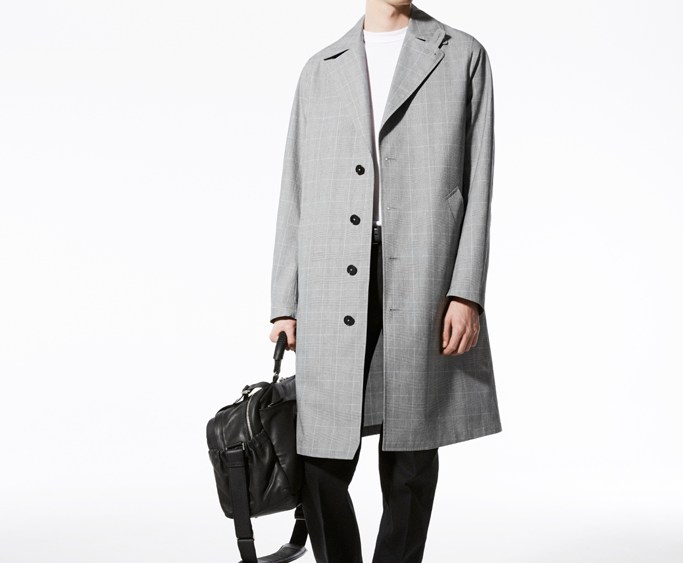
TOKYO — In bid to highlight this country’s high level of craftsmanship and lure new customers, Ermenegildo Zegna is rolling out an exclusive capsule collection made entirely in Japan by local artisans.
The 22-piece collection, labeled “Ermenegildo Zegna Couture Made in Japan”, will go on sale Saturday at Zegna’s flagship in Ginza. It will bow at the brand’s Osaka store on Oct. 1. The company plans to roll out certain pieces to other stores around the world later this year.
Zegna celebrated the collection’s launch with a cocktail party Thursday night at the recently opened Aman Tokyo hotel in the central business district of Otemachi. Stefano Pilati, Zegna’s head of design, and chief executive Gildo Zegna hosted the affair. Guests sipped champagne as they mingled in the lobby area of the hotel, where a nearly 100-foot-high ceiling creates the illusion of being inside a giant Japanese paper lantern.
Related Articles
Photographer Takashi Homma shot the capsule collection on five Japanese “key opinion leaders,” including actor Ryo Kase, who appeared in Clint Eastwood’s “Letters from Iwo Jima,” as well as a chef, a musician and an architect. Homma’s photos were on display at the party, along with a video about the project and the collection itself. Olivier Zahm, who curated the collection’s look book, was also on hand for the event.
You May Also Like
Pilati described the collection as a “little wardrobe, but complete.” It is made up of coats, jackets, broken suits, shirts, trousers, denim pieces, shoes, a leather bag and a pair of sunglasses. The collection was conceived as a part of the brand’s growth strategy in Japan, as well as to celebrate its recent store openings in the country in Ginza and Osaka. Currently Zegna has a network of 15 stores in Japan, including department store corners.
“Tokyo especially is the retail mecca, but I’m not saying just in terms of offering, which of course is true, but I’m also saying in terms of service. Everything functions, but also everything is displayed in a certain way, everything is qualified in a certain way, it’s categorized, it’s merchandized, all in a certain way. Very precise, very specific, very direct, very clear. So for me the concept of service was at the base of the attempt to seduce new customers into the Ginza store through this event,” Pilati said, adding that he wanted to create a mini-wardrobe “remade, re-seen through the use of Japanese fabrics.”
Pilati chose some of the pieces he had designed for Zegna’s fall collection, then selected Japanese materials to be used in them, and finally the Japanese tailors that would put the two together to create the final products.
Japanese fabrics, like Italian ones, are known for their high quality, but Pilati said the differences are in the finishes. For example, the capsule collection includes a woven blazer that has a textured, knitted effect that gives it a “beautiful, comfortable wearability.” There is only one loom capable of creating the fabric. There is also an eye-catching jacket in plasticized flannel with a brushed back that looks soft and plush despite an almost shiny, plastic-like finish. Other textiles featured in the range include Japanese selvage denim by famed manufacturer Kuroki, cotton micro jacquard, silk seersucker and soft wool flannel.
Both Pilati himself and Zegna as a brand have worked with Japanese manufacturers before, but most of the artisans behind the Made in Japan collection are new to the Zegna network. And Pilati said there is a possibility that the capsule collection could lead to new long-term relationships.
“With this project I created a better contact with the suppliers, so I’ve been open to [show them] some archives, they were open to develop things for me that through the classic bureaucracy between companies maybe doesn’t really happen,” Pilati said. “And so I want to believe that this is the beginning of something.”
Gildo Zegna said the company got lucky with the timing of the Made in Japan collection.
“We planned this event quite a while ago when we decided to launch our brand in Japan into a new level by unveiling two new global stores, one in Osaka and one in Ginza. You know, the planning in Japan in particular is very long. You plan now for where you want to be in three to five years. So it comes, I think, with the right timing for Japan in a moment which Japan is preparing itself for the 2020 Olympics, and I think there is a lot of positive energy going on,” Zegna said.
The executive said business at the two new stores, as well as in Japan in general, is going well. While the company expected the Ginza store to perform well and it has been going “according to plan,” Zegna has been surprised by the wide base of customers the Osaka store has attracted.
“I would say Tokyo is more international. Osaka is more local, but with the right locals,” Zegna said. “I would say that Japan is going through a relatively good moment. I would say that the fact that we have added points of sale and we have revamped, boosted our brand, I think that means that we are creating additional business. We remain positive, otherwise we would have not made this important investment.”
Zegna said that the company is experiencing double-digit growth this year, although he declined to provide specific figures. He said Japan has been and remains one of the top markets for Ermenegildo Zegna in the world. Still, he said that not all markets are performing well, and that overall 2015 has been a challenging year, particularly in regards to the recent turmoil in Asian markets.
“Surely it’s a challenging moment. So saying that [business has] not been affected would not be saying the truth. It has been affected, like all of the luxury [market], so we’re going through a transition, but we remain positive,” Zegna said. “For instance in China, in the long-term China will remain a very important market, and we believe that this is a transition moment.”
In reaction to the current challenges faces the luxury market, Zegna is balancing growth with prices and taking a “scientific approach to retailing.” This means places more of an emphasis on top-quality services and offering things that can’t be found elsewhere, he said.
“The one thing for sure is that traffic has gone down, I would say in a big part of the world,” Zegna said. “And so I think that we have to be better at attracting a new customer, and make sure that the less customers that visit you, buy.”
Zegna noted that the brand’s made-to-measure service has been particularly successful. Since it is not only offered for suits, but for sportswear as well, it allows for lots of opportunities for cross-selling, the executive said.
“I think discontinuity of the business model is the norm, and you have to adjust to the norm,” Zegna said, noting that there is a new challenge to address every week or month. “The advantage is that we are in more than 100 countries, so it’s hard to have 100 countries going all well or all bad. So then it’s the capacity to adjust the business model accordingly.”