
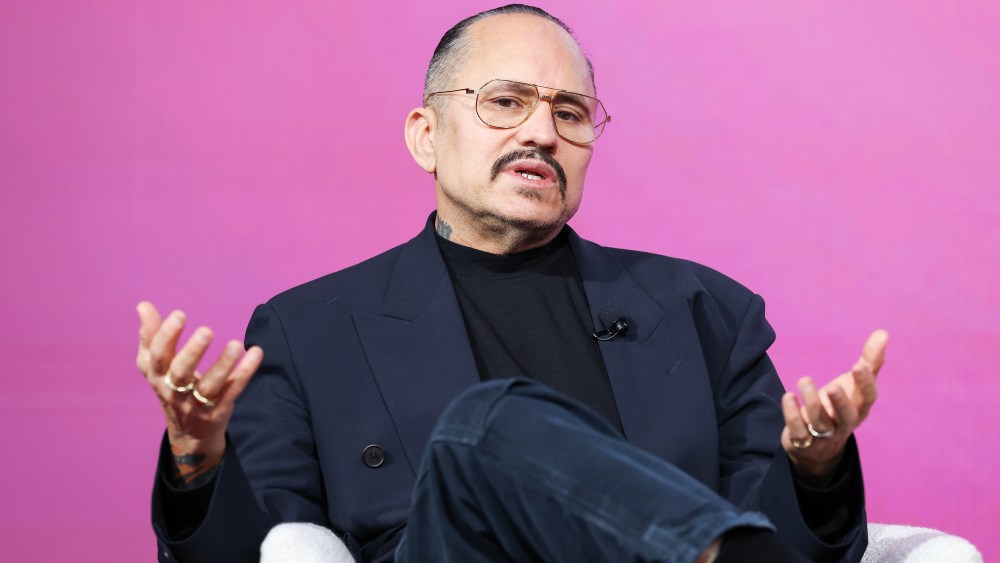
Willy Chavarria still has a lot on his to-do list.
Chavarria, who was named Menswear Designer of the Year at the WWD Apparel & Retail CEO Summit, has officially had his own eponymous brand for a decade, but it’s only been in the past couple of years that he’s broken through.
Thanks to some new investors — Chalhoub Group, a Middle East luxury retailer, and FAE Fashion Ventures — the designer has been able to invest in his business and expand his reach.
Related Articles
And the industry has taken notice. In 2023 and 2024, he was named Menswear Designer of the Year by the Council of Fashion Designers of America and he was also selected as Designer of the Year at the Latin American Fashion Awards and became the Artist Ambassador of the ACLU. And he’s shown on the official calendar in Paris for the last two seasons.
You May Also Like
Coming next, he revealed, is Big Willy, a lower-priced line he’ll be launching in January, as well as eyewear. Although he declined to provide too many details at this point, the category expansion shows how far the 58-year-old Mexican American designer has come since his days growing up in Huron, Calif.
In a conversation with style director Alex Badia, Chavarria said that by the time he launched the Willy Chavarria brand in 2015, he’d already gained a knowledge of the fashion industry by working for other companies such as Ralph Lauren, Calvin Klein and American Eagle Outfitters.
His first foray into the industry was with a retail store named Palmer Trading Co., he recalled. “It was a store, so I was really experimenting with retail. And then we started wholesaling to Japan. So I got to know the business a bit, so when I launched in 2015 I had a lot of knowledge under my belt.”
From Day One, he said, Chavarria was determined to create a brand with what he termed “a give-back component,” a brand that could be used to “lift people up.”
This determination to be a champion for social injustice was ingrained in him at a young age, he said. “I was raised by parents who were part of the civil rights movement, and I was raised in a Mexican family, so I was very aware of a lot of the racism that we face in the country,” he said. “It was just in my blood to make sure that everything I do has some positive effect.”
He said it’s been gratifying to “see the business growing with those values. Even up until about two years ago, a lot of larger companies were timid and designers were trying to stay away from any kind of controversy for fear it would impact impact sales.”
But Chavarria took the opposite approach.
“My first show in 2017 was very political,” he recalled. “It was during the first Trump election, and it was about the kids in cages. So many people, even in my own camp, were saying, ‘You cannot do that. Anna’s [Wintour of Vogue] not ever going to meet with you.’ But they were wrong, and it turned out to be the opposite, because people felt like they were being seen and heard and touched. They recognized that I wasn’t trying to ignore the world, but tell a story about how we can fit in and be our best in the world that we are in.”
He said that while he believed the world was dangerous back then, it’s even worse today. “I started getting more afraid when I saw that the administration is specifically attacking arts and entertainment,” he said, pointing to the Stephen Colbert controversy as an example.
He said he believes that through his work — and by partnering with “other large performers, musicians and filmmakers, we can create narratives or projects that tell really big, impactful stories and activate people in a way that is positive and in resistance.”
The message apparently has connected since Chavarria said his sales have been doubling every season and he’s attracted two sets of investors. He said he was surprised at how easy it actually was to find like-minded companies willing to help bankroll him.
“It’s actually not as hard as I thought,” he said. “I’m very clear about what I want. And the company has been growing, which is fantastic, given the climate that we’re in. But I need the capital to keep it going. But I’m not just looking for money. I’m looking for people who know how to open stores, for example. Chalhoub is a great partner, because they know how to open stores. They’re a blue chip investor, and they also have a good heart at the core of it all. They were very much in line with my own philosophies, and they also believed in my ability to grow a business, and still have the core ideals of human dignity.”
Looking to the future, Chavarria said he would hope one day to have a business like Ralph Lauren’s. “I see a lot of similarities between his path and my path,” he said. “I love how his brand has been able to protect its luxury side, still selling the dream and the $15,000 gown, but also selling the $40 polo. That’s the mentality that I would really like to have, and that’s the way I’m growing my business.”
But as his business grows, will it change him or his messaging?
“To me, it’s always easy to be an underdog,” he said. “People love and support the underdog. But often, those people that support you when you’re the underdog want to take you down when you’re successful because you’re held to a higher standard. I really compare it to people who succeed in music. Take Kendrick Lamar for example. He’s someone I love and admire, and he is incredibly successful, but he hasn’t compromised his message at all. He sings music that supports trans lives. He sings music that is in support of Black and brown communities everywhere. And he does it with such grace and such cool that people still love him.”
Chavarria hopes he will be able to chart a similar path as he works to further grow his business.
During his last Paris show, he said he wasn’t planning to make a political statement, but a conversation with his family in California made him switch gears at the 11th hour. “My last show was a political statement about ICE and I didn’t actually plan to do it until two or three days before the show,” he said. It was then that he heard agents were roaming through his hometown searching for illegal aliens to deport, and his aunts and uncles were hiding people in their homes.
“So many people in Paris didn’t realize how bad it was in California,” he said, adding that the show got “a lot of press.”
Closer to home — and less controversial — in September during New York Fashion Week, he held a women’s show at Printemps that was more of a “sales event,” he said. Customers were invited to view the collection up close and then place orders.
Womenswear is a fairly new category for Chavarria even though much of his core collection can be worn by either gender. Going forward he said he’d like to expand his women’s collection and also move into a variety of categories including makeup, fragrance, candles and other products.
“I have a tendency to get excited and want to do everything. So I built this team around me who can help me navigate in a smart way and focus,” he said of his husband who serves as chief operating officer as well as a newly appointed chief marketing officer and others on the design team. “So we’re going into bags — we started this last season with a small bag drop, but in January/February, we’ll have more.”
In addition, the eyewear and Big Willy are also in the works for early next year. He described Big Willy as similar to his collaboration with Adidas, which is sold at a more accessible price point. “That’s part of the ethos of the brand,” he said. “To offer high-tier luxury and then something more democratic.”
To him, “inclusivity is the new exclusivity,” he said. “I want to be able to touch everybody. And Big Willy will allow us to do that. It’ll be a DTC-focused thing so we can have good margins and still sell at a lower price point.”
Inviting more people into his world will also involve moving beyond strictly fashion design, he said. “I’m looking at ways to overlap film, entertainment and music with fashion. People may not be able to shell out a few hundred dollars for a bag, but they will definitely want to buy a song or watch a movie, and I can still tell those fashion stories or luxury stories through other mediums.”
So what does Chavarria hope will be his legacy? “I want to have an impact on fashion that can really make other companies see the value in diversity and having a human approach,” he said. “It’s so important and it makes the business better, and I think that that is what I want my legacy to be.”