
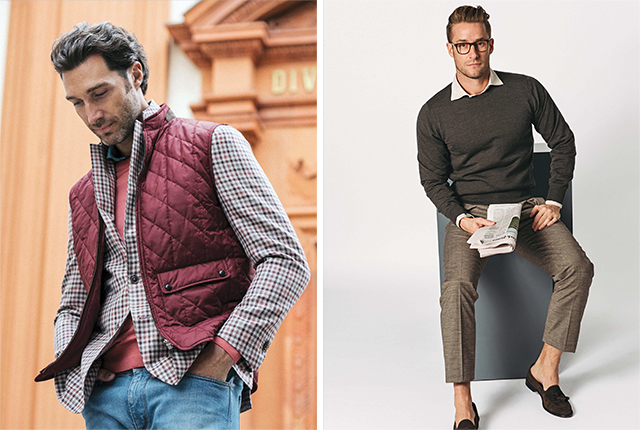
When Tengram Capital Partners purchased the majority stake in Luciano Barbera in October 2014, the private equity firm saw the brand as a dia-mond in the rough.
Although the label was well respected and had been around since the mid-Sixties, it had a small presence — particularly in the U.S. Its biggest customers were European specialty stores seeking luxury sportswear with a focus on knits.
But over the past 2 1/2 years, Tengram has built teams in New York and Milan to completely revamp the brand, touching everything from the product design and the marketing while expanding its wholesale and own-retail presence.
“We’ve created a playbook for the company,” said Todd Barrato, who joined Barbera as global chief executive officer when Tengram bought its controlling stake. Barrato was formerly the ceo of North American operations for Brioni. He’s also the son of former Brioni chief Joe Barrato.
Related Articles
“The brand was stagnant,” Barrato said. “It had a great name that was never jeopardized, but the family was not capable of taking it to the next level.”
You May Also Like
Luciano Barbera, the man, was considered to be among the most elegant gentlemen in the world. His family owned the Carlo Barbera fabric mill in Biella, Italy. According to company lore, when Murray Pearlstein of Louis Boston was visiting the mill, he was so taken by Luciano Barbera’s style that he prompted him to create his own collection. That was in 1971.
The business thrived for a while, but like many other small businesses, the brand had struggled To grow in recent times. In 2010, the family sold a controlling stake in the Carlo Barbera mill to Kiton, the Neapolitan tailored-clothing company. But it retained ownership of the Luciano Barbera brand of sportswear, outerwear, knitwear and cut-and- sewn shirts until 2014. At that time, sources said, the Luciano Barbera brand had worldwide sales of around $50 million.
According to William Sweedler, co-founder and general partner of Tengram, “Men’s wear has been challenged for the past 1 1⁄2 years, but Todd has been able to double the top-line business in Luciano Barbera and bring Zanella back from its troubled path.”
In June 2015, the Westport, Conn.-based Ten- gram also signed a definitive agreement to acquire the Zanella luxury men’s trouser brand. Although the two brands are being run separately, Barrato oversees both.
“He [Todd] continues to bullishly plan to build the businesses to significant growth levels,” Sweedler continued, “not only in the U.S. distribu- tion channels, but also the Middle East and Russia and now the Far East.”
He declined to provide a current volume figure, saying that as a private company, Tengram doesn’t “tout metrics, but the top line has doubled from historic levels at Luciano Barbera, and with Zanella, we’re nowhere near the historic high, but we’ve provided the tools to refresh and innovate the brand and our hope and plan is that the business will grow as well.”
Barrato said that although 2016 was challeng- ing for the industry, Barbera still managed to post 25 percent growth, a gain he attributed to correcting the brand’s poor delivery history, inconsistent fit and production. A new web site will be launched in the first quarter and the brand is putting more emphasis on social media, where it currently counts over 20,000 followers. Not bad for a brand whose core customer is in his late 40s or early 50s.
Barbera also opened new showrooms in Rocke- feller Center in New York and in Milan. And last January, one block from the showroom, the first Luciano Barbera store opened on Via Gesu in Milan, joining Caruso, Brioni, Kiton, Uman and others on the men’s wear street. “It’s important for the visibility of the brand,” he said. “We’re on the street with all the big boys.”
He said the company is currently looking for a retail location in New York City that will hopefully open in the second or third quarter of this year. “A small retail rollout is part of the playbook,” he said, adding that he hopes to open “three to four stores in the right markets.”
Boston is also high on the list because of the company’s history with Louis and the fact that the brand still has “a nice business” in that city.
Shop-in-shops are also a strategy. The brand recently opened one in Tsum in Moscow and will open another in DLT department store in St. Petersburg, Russia, this month. “We’re looking to roll out this concept,” Barrato said.
In the U.S., there is a shop in Wilkes Bashford and the company plans to open around six “soft pads” in American specialty stores this year.
Additionally, pricing has also been rejiggered, bringing Barbera from the “Kiton/Brioni price point to position us closer to Isaia, Zegna and Ralph Lauren Purple Label,” he said. “We didn’t change the quality and it’s still 100 percent made in Italy, but we’re in a zone where we can offer greater value.”
Cut-and-sewn shirts now retail for $295 to $350, down from $400-plus. Soft jackets are now $1,495 to $2,495, where “the real volume driver before was well over $2,500,” he said, and suits are $1,995 to $2,695. A similar pricing strategy was applied to all classifications, he said.
The expansion of the product offering and the lower prices are designed to appeal to a younger man, which it showcases in its catalog and other direct marketing pieces by using models in their 30s.
Building wholesale is also tops on the list, he said. The brand is sold at Barneys New York and Saks Fifth Avenue as well as some high-end specialty retailers, but “there’s still a lot of expansion opportunity,” he said, both in the U.S. and internationally.
E-commerce is also a focus and expanding through licenses would also make sense, he said, noting that the brand currently has no licensed business.
Turning to Zanella, Barrato said the brand was mismanaged by its former owners and while it had “great name recognition in the trouser industry, it had lost a lot of market share.”
The product was stagnant and it had no web site, social media presence or e-commerce — all of which he changed after the brand was acquired.
The bulk of the trousers retail for $345 to $550 and are all made in Vincenza, Italy, but the colors, patterns and labels have all been updated. In addition to dress trousers — which account for over 95 percent of the business — five-pocket models have also been added. And the plan is to eventually extend the offering beyond pants into a true lifestyle offering. “The next step is cut-and- sewns,” he said.
Sweedler said Tengram is a “long-term investor” and a “patient partner, but we’re process oriented. We want to know that the team is all focused on the same goal.”