
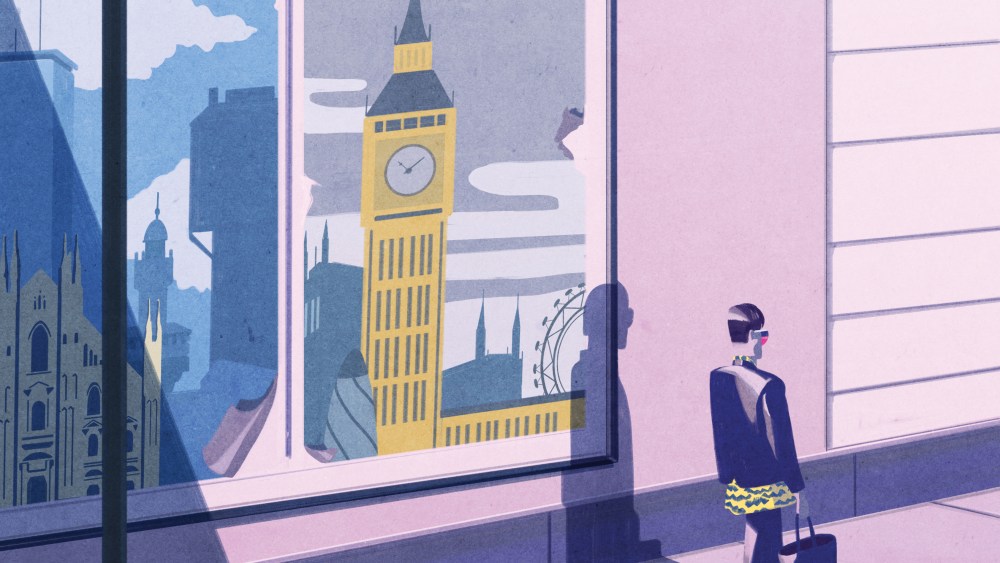
Change is good.
At least that’s the attitude being taken by the Camera Nazionale della Moda Italiana and the British Fashion Council as they see their men’s fashion week schedules shape-shift drastically. It’s due to the upheaval sweeping the industry, from new designers at key houses to the advent of coed shows and the see-now-buy-now trend.
A handful of Milan’s usual stalwarts are sitting out the June edition, including Bottega Veneta and Ermenegildo Zegna. Gucci, meanwhile, is set to unite its men’s and women’s shows on the runway next year, although it has yet to say whether it will hold the combined show in January, during men’s fashion week, or in February, during the women’s shows.
Related Articles
The changes in Milan come as there were major gaps at London Collections: Men last week, with Burberry, Alexander McQueen, Moschino, Pringle and Gieves & Hawkes skipping the season for varying reasons.
You May Also Like
Despite the changes, show organizers remain upbeat, arguing that it’s a time of flux in the industry overall and that both Milan and London schedules remain packed with enough talent to satisfy buyers and press.
Carlo Capasa, president of the Camera Nazionale della Moda Italiana, said he believes the transformation sweeping over Milan’s Men’s Fashion Week — and across several of Italy’s designer brands — can only be positive.
“There’s a lot of energy here, as there always is when there’s a desire to explore and challenge oneself,” said Capasa, claiming Milan is “cool again” because of its research and promotion of novelty. “We were once criticized for being static, but that’s not the case anymore.”
Ahead of the Milan men’s shows, which run from June 17 to 21, kicking off with Ports 1961 and Dsquared2 and ending with Giorgio Armani, Capasa pointed out that, although there are gaps in the men’s calendar this season, this is happening for “individual reasons.” Bottega Veneta, for example, is showing men’s and women’s in September, to mark the brand’s 50th anniversary. Zegna is sitting out the week as it waits for its new creative director, Alessandro Sartori, who succeeds Stefano Pilati.
Several companies are also reviewing their creative direction at the moment. In March, Massimiliano Giornetti left his top design role at Salvatore Ferragamo, which is focusing on its in-house team, as it also waits for new chief executive officer Eraldo Poletto to succeed Michele Norsa in August; Brioni will mark its first collection designed by Justin O’Shea by holding a show in Paris on July 4, during Paris Haute Couture, opting for a see-now-buy-now distribution, and Canali and Andrea Pompilio parted ways after four collections, leaving the house’s design team to present the spring season.
Even with these changes, Capasa noted there are 84 events managed by the Camera, between presentations and shows, compared with 79 last year.
On the topic of the moment, coed shows, Capasa said Italy’s fashion association plans to “preserve the men’s and women’s fashion weeks — both are important.” He also emphasized how each brand should choose individually, as this format does not work for everyone.
“In a context of a complicated market hurt by external factors, there’s been a strong selection, and we believe those companies that have invested in product, consistency and credibility without compromises are rewarded,” said Stefano Canali, general director of the family-owned Canali.
The executive proudly gave a tour of the company’s state-of-the-art, sustainable logistics center that cost more than 17 million euros, or $19 million at current exchange, near its headquarters in Sovico, a 40-minute drive from Milan. Covering 162,000 square feet, the center’s new technologies allow the company to optimize stocking and shipment of collections, while improving working conditions for employees. There is also a photography set to create images for the brand’s online store and boost that traffic and business.
Umberto Angeloni, chairman and ceo of Caruso, also highlighted the need to focus on the “evolution, not revolution” of product.
“‘The Good Italian’ is our guiding light — the priority is to have the ideal consumer in mind.”
He pointed to the “tiny steps,” from piping to stitching, that “can become decorations” on a suit. In addition to suits made with Gobigold, a precious fabric made with fine camel hair from the Gobi Desert, Caruso is introducing suits for summer made with Camellino, a blend of Irish linen (44 percent) and camel hair (56 percent). “We must work on the product. There is an overabundance of normal product,” claimed Angeloni.
Paolo Roviera, ceo of Pal Zileri, conceded there is “a lot of confusion” in men’s wear as some fashion groups have been trying to replicate the success of women’s wear. “If style and retail execution worked for women’s wear, why should they not work for men’s wear” was the general thinking, he said, followed by a big-name creative director and a runway show.
However, said Roviera, “very few men buy out of desire. Cars are bought under impulse, clothes more out of necessity.” Also, as they don’t really enjoy shopping, “men need very strong merchandising. The added value of a creative director is very limited. They change volumes and colors, but they don’t go crazy,” he said.
With creative director Mauro Ravizza Krieger, Pal Zileri, which is controlled by Qatar-based Mayhoola for Investments, will launch a made-to-measure customization service in the fall. The company will hold a show for the Pal Zileri brand in Milan but will also be at Pitti Uomo to present the Lab collection, defined as “more contemporary and accessible.”
Sales of the fall Pal Zileri line were up 18 percent compared with the same season in the previous year. For 2016, Roviera forecast revenues of 80 million euros, or $89.1 million, and single-digit growth but on a different parameter, he said, citing the company’s streamlining of stores. To succeed in the current economic environment, “it’s a must to move and explore markets that have not been explored before, with products that were not there before,” he said.
Lardini, for example, has inked an agreement with Shinsegae International to expand in Korea. The company’s first boutique has opened in Seoul’s Gangnam district, and chairman Andrea Lardini said the plan is to open 11 stores in five years with Shinsegae.
The executive also said the brand’s first store in Milan will open before Christmas, in the area near other men’s stores, between Via Verri and luxury-shopping street Via Montenapoleone.
While Milan aims to build on the success it has seen in the past few years, London faces some additional challenges beyond the change in its schedule: A city with a relatively new men’s fashion week — it launched four years ago — it’s not the place where most buyers sit and write orders. Most of them wait to do that in Paris, a full two weeks or more after London ends, giving some British brands reason to show at Pitti Uomo or abandon a runway presentation altogether and take a showroom in Paris, where the money is.
Indeed, Sibling has decided to wholesale its men’s and women’s collections side-by-side in Paris in January and June, put its pre-collections on ice and cancel “all activity” during the September fashion-week season. Sibling said the changes reflect “a pragmatic rethinking” of how to manage the demands of the “disjointed men’s wear and women’s wear calendars” for emerging brands that are active in both markets.
Still, the London men’s season that just ended showed the British typically taking the changes in stride, and even making some tweaks of its own. At the event’s kickoff, the British Fashion Council revealed that London Collections: Men will now be known as London Fashion Week Men’s. Organizers argued that the biannual showcase, now in its ninth season, is longer — four days instead of the original two — and that the new name is more consumer-friendly.
While the week rolled ahead minus many of the big names that helped to cement the British capital’s status on the international fashion calendar, a host of labels took the opportunity to show — and in some cases launch — women’s collections on their men’s catwalks in a bid to expand business, consolidate expenses and get a jump on orders. Sibling, Bobby Abley, Casely-Hayford, Astrid Andersen, Christopher Raeburn, Agi & Sam and Belstaff were among them.
Attendance figures were up, and there were more shows than last year — 32 versus 29 — but U.S. stores and press were thin on the ground, with the absentees including teams from GQ, Esquire, Men’s Health, Barneys New York and Neiman Marcus.
Ken Downing, fashion director and senior vice president of stores for Neiman’s, said he didn’t attend the London men’s shows because he was already spread thin, having to be in the women’s and men’s resort market before flying to the men’s shows in Milan and Paris.
Bruce Pask, men’s fashion director at Bergdorf Goodman, was in London, as were teams from Saks Fifth Avenue, Lord & Taylor and Hudson’s Bay Co. As the London showcase came to a close on Monday, Pask said his schedule was packed — and was unequivocally upbeat about the week.
“I have attended LC:M since its first edition and have always, always found it an inspiring fashion week. While runway shows certainly provide the framework for the schedule, there are plenty of brands important to Goodman’s that I view on appointments, new designers I’ve scouted and accessory companies we partner with,” he told WWD.
“London has a particular strength in the balance presented here between established companies with long histories in men’s wear and young talent that is just emerging, and graduates just out of school with fascinating perspectives,” he added. “Fashion East has served as a tremendous incubator to these young designers, and I always look forward to their presentation. I have had a very successful trip to London this season, and I look forward to the next LC:M.”
Eric Jennings, vice president and fashion director of men’s wear, home and beauty at Saks, was also positive. “It’s a precarious time for men’s fashion weeks, and how they evolve going forward is anyone’s guess,” he admitted. “The British Fashion Council has done a great job by delivering excitement with a promising lineup of emerging talent. Despite the departure of some of the heritage brands, London welcomed exciting new faces such as Maison Mihara Yasuhiro, Aitor Throup and Wales Bonner, to name but a few.”
Many designers remain committed to London: Jonathan Anderson said he plans to remain on the calendar, while Alexander McQueen will be back next season, when creative director Sarah Burton returns from maternity leave.
Burberry, meanwhile, will unveil its first see-now-buy-now coed show in London in September. In anticipation, wholesale clients (as well as long-lead press) have been signing nondisclosure agreements as they see and buy the brand’s men’s and women’s collections now — off of digital images — or in the London showroom.
There was certainly no lack of buzz over the past few days: Tommy Hilfiger hosted his annual LC:M party with GQ editor and LC:M chairman Dylan Jones at the new Soho House-owned outpost Cafe Monico, while Sabrina Fung and her family welcomed industry guests to dinner at Mark’s Club in Mayfair on the first night of the shows.
On Thursday evening, Paul Smith hosted a party to mark the 40th anniversary of punk, while on Friday designers such as Matthew Miller, Katie Eary, Henry Holland, Bobby Abley, Liam Hodges and Sibling’s Cozette McCreery attended a party to kick off the shows.
The annual One for the Boys charity ball at the Victoria and Albert Museum took place once again with guests including Samuel L. Jackson, Kylie Minogue, Eva Herzigova, Stanley Tucci and Toby Huntington-Whiteley, while many stores were doing a robust trade.
Sean Dixon, the founder and managing director of Richard James, said the brand’s store on Savile Row notched one of its best sales periods the day before the spring 2017 presentation unfolded.
Which shows that, even with all the changes, Milan and London are likely to remain must-stops for the industry.
Caroline Rush, ceo of the British Fashion Council, said there were more catwalk shows this season than last — 30 in all — while attendance figures, including the number of buyers, were up.
“We’re fully behind the changes. This is about businesses continuing to do well and doing what they need to do,” said Rush, adding that people continue to be interested in the “breadth of businesses” in London.
Besides, as Jones said, no one is clear how the men’s schedules will evolve.
“What’s happening in the men’s wear industry is fascinating, and it’s manifesting itself in the fashion weeks. So much is up in the air, and I wouldn’t be surprised to see more women’s wear brands showing during the men’s wear months of January and June. We might even end up with two fashion weeks during those months.”