Pierre Yovanovitch — who has been creating haute couture interiors through a meticulous eye for design, drama and history — has a devoted following in France, where his client base includes Kering chief François-Henri Pinault and Christian Louboutin.
But since the interior architect launched his furniture line, Pierre Yovanovitch Mobilier, in 2021, the U.S. has emerged as his largest retail market. Beginning Friday, Yovanovitch will have a physical space in which to display his meticulous interior choreography. Housed on the top floor of a prewar brick building on West 25th Street in Manhattan’s Chelsea neighborhood, the new salon, with 10,000 square feet of space, includes 80 pieces (furniture and lighting) as well as a selection of paintings and sculpture from an array of contemporary artists including Francesco Clemente, Richard Serra and Suzan Frecon.
Related Articles
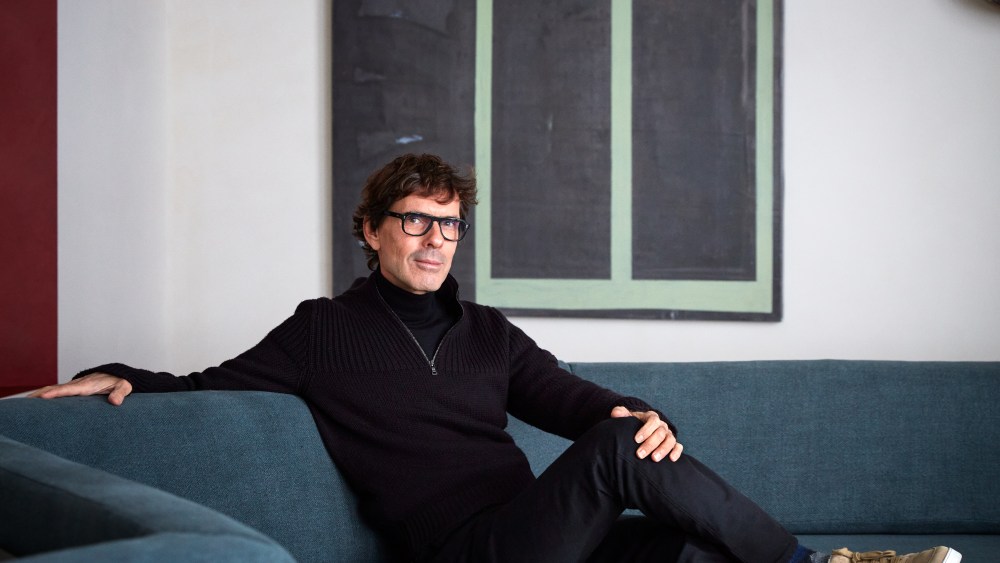
One day before the opening, electricians were feverishly working to finish wiring the space, which Yovanovitch conceived as a series of discreet living spaces. Crates of Veuve Clicquot were stacked in the kitchen in anticipation of the preopening reception. And Yovanovitch huddled with his chief executive officer Cédric Morisset, while a photographer tested the lighting for Yovanovitch’s portrait, which was shot as Yovanovitch lounged on his Stanley sofa, a geometric wonder made of stacked, hand-planed solid ash.
You May Also Like
The concept is more art gallery than furniture showroom. Yovanovitch and his team intentionally sought out a space that was not on the street level; the penthouse is on the sixth floor and includes a roof deck. It was conceived as a series of immersive vignettes so that visitors can experience Yovanovitch’s designs within a residential context.
“We were looking for a place that could serve as a destination…with a lot of character and soul,” he said.

The neighborhood was also a consideration. The building’s location — it’s nestled in the city’s gallery district near the High Line — was also important to Yovanovitch. Similarly, his Paris gallery, which opened in October 2023, is in the Marais, the city’s artistic heart, near the Centre Pompidou.
“This through line in terms of location was an important element to me as well,” he said.
The new location will also include office space for the company’s U.S. staff, which numbers about a dozen. (There are about 100 employees in all with the rest based in Paris.)
Yovanovitch’s specialty — a minimalist aesthetic without veering into austerity — is underpinned by his meticulous attention to craftsmanship and tireless sourcing of the finest materials. Wood is sourced from regenerative forests in France; ceramic pieces are made from natural clay, much of it sourced from Iraq; rugs are hand-knotted in Nepal; embroidery work is done by the Lesage Interiors, glass pieces are sourced from Germany and crafted in Switzerland by glassworkers specializing in the Murano technique.
Many of the items will be familiar to Yovanovitch aficionados, including the popular Mrs. and Mr. Oops chairs, the Rochefort dining table and the Asymmetry armchair, now available in varying sizes (XS for Paris apartments, and M for American living rooms) and with an ottoman.
But there are also several one-of-a-kind pieces; a Mindy armchair features an embroidered seat back created as an homage to the trees and forest around Yovanovitch’s Provencal retreat in Fabrègues. (Yovanovitch names many of his pieces after people, and the Mindy collection, which also includes a sofa, is named for a client in the Hamptons for whom Yovanovitch first created the pieces. The chair featured a maritime scene in keeping with New York’s seaside enclave.)
There are also new versions of existing pieces, including the Callas table lamp and Lexie chandelier, now with a terra cotta metal canopy and stem.
All of Yovanovitch’s pieces have a unique and involved origin story. The Clam chair, for instance, took two years to come to fruition as Yovanovitch and his team worked to find just the right angle for the bivalve-shaped chair.
“I loved this idea of the shape of an opened clam being the perfect silhouette for a chair,” he says. “To realize this shape out of a solid oak base actually took a substantial amount of time to develop.”
And artists are frequent collaborators and inspiration for much of Yovanovitch’s work. He is a collector, but also regularly commissions site-specific installations for interior projects from artists including Claire Tabouret, Alicja Kwade, Matthieu Cossé, Tadashi Kawamata, Johan Creten, Alexandre Rochegaussen, Giulia Andreani and Adel Abdessemed.
“For me, art is inseparable from a harmonious project,” he says. “Contemporary art, compared to classical art, has elements of radicalism, controversy and meaning that change everything in the room.”
Tabouret, a French painter living in Los Angeles, painted an immersive fresco on the walls of the chapel at his 17th-century chateau Fabrègues. (One of her paintings hangs in the New York gallery). And Berlin-based sculptor Kwade created a large outdoor sculpture for the gardens.
“Like the planets they symbolize, the stones each have a different look, composition and backstory,” he says of Kwade’s work. “I love how commandeering their presence is while at the same time they have an ethereal, transient quality to them.”
Yovanovitch segued into interior architecture after a career as a menswear designer for Pierre Cardin. In 2017, he launched his debut furniture collection, Oops, with an exhibit at the R & Company gallery in TriBeCa that features his Bear chairs (Papa, Mama and Baby).
Oops marked Yovanovitch’s entrée into scenography; the now-iconic Miss Oops chair actually made its debut in his work at the Design Parade Toulon festival in France in 2018. In 2019, he expanded on the concept with Love, transforming the R & Company gallery into a series of domestic scenes starring Miss Oops. His iconic white Bear chairs were embroidered with red arms so the chairs look like they’re being hugged; Mrs. and Mr. Oops chair backs were embroidered with faces; “Catherine” has tendrils in shades of red, orange and yellow, and “Gerard” has a curling, imperial mustache in shades of blue and green.
Yovanovitch characterized these shows as “a big turning point” for his practice.
“It was the first public showcase of my furniture work and my first public show in the U.S., an exhilarating departure from the private interiors projects I’ve worked on around the world,” he says. “The success of these two shows really propelled me to create my own dedicated furniture brand and solidified my interest in bringing my furniture designs to a wider audience beyond my interior architecture work. It was also an opportunity to showcase my pieces with a creative carte blanche, creating my own storyline through an immersive scenography. It was liberating to see my furniture outside the context of an interior architecture project and to think of the works as stand-alone pieces coming together to tell a larger story.”
With his New York gallery, Yovanovitch again has complete creative freedom to tell more stories through craft, materials and artistry.