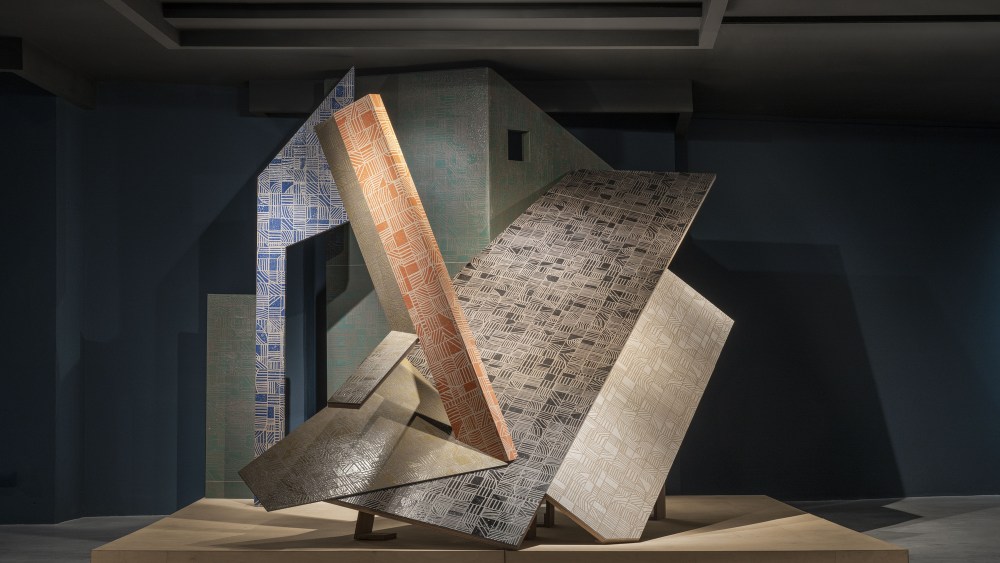
MILAN — Italian artist and photographer Brigitte Niedermair went all out for ceramics-maker Mutina’s 20th birthday.
In an exhibit tiled “Being Mutina,” Niedermair designed evocative rooms in tribute to select Mutina collaborators. Among them are Spanish architect and designer Patricia Urquiola, Belgian designer Vincent Van Duysen, French designer Ronan Bouroullec, French artist Nathalie du Pasquier, who was a founding member of the Memphis movement, and Cypriot-born, London-based designer Michael Anastassiades — all design stars by unknown on a personal level to Niedermair. The rooms were crafted with tiles created for Mutina by the designers over the years and were later shot by Niedermair with a large-format camera.
Related Articles
“I tell the set designers all the time what set they have to build for me and I also build sets for one thing or another, so I already had this ability, but I never thought that I could amplify this on such a vast scale,” Niedermair said.
You May Also Like
Ornately designed tiles by Urquiola were arranged in a cubist display of unexpected geometric forms, while Van Duysen’s Kosei tiles were built into a concrete spac, infused with an emotional element of glow and shadows. Anastassiades’ fringe tiles were arranged like a pitched roof house within a structure aglow from within, inviting the viewer to step inside and contemplate. Niedermair also highlighted a conflict between what is photographed and what the objects really are. “You have this dialogue between reality and fantasy, it’s somehow conceptual but it’s also very emotional,” she said, adding her arrangements give new meaning and vision to the tiles.

The exhibit was curated by Helen Nonini, who started on it two and a half years ago. It will run through Sunday at Casa Mutina and Spazio Cernaia in Milan, while the Casa Mutina installation will be open for visits by appointment until November.
“Being Mutina” is billed as cultural journey that intertwines past and future, underscoring the experimental nature of the Mutina world.
“I deeply loved this project because Brigitte Niedermair envisioned it through the lens of an interior designer,” Mutina chief executive officer Massimo Orsini said. “Looking at her images, I did not think about the 20 years of work already behind us. It was as if she had left a message saying: ‘This is Mutina. A powerful energy charge, thinking about the work we’ll be doing in the years to come.”’
Nonini said her aim was to create a cultural experience that emphasized the community that has grown around Modena-based Mutina. In 2019, Nonini worked with Niedermair and Italian designer Martino Gamper on a project for the 40th anniversary of textile-maker Dedar.
It was Nonini who put Niedermair and Orsini together. “We pondered how the company could distinguish itself because when you are best in class then you are obviously copied from every point of view. We needed to create something that would completely set us apart from the rest of the market and we imagined these evocative, imaginary rooms,” she asserted.
For Orsini, it’s very much a tribute to each designer who has not only been part of Mutina’s 20-year history but of the larger design world.
“Twenty years ago, I aimed to connect with designers, collaborate and create a dialogue around industrial ceramics. Many projects stem from small artisan companies where in-depth research is possible, but in this industry, it’s harder due to large-scale production challenges,” he said. “The goal was to work with designers who were experimental and selective — not just to say I collaborate with designers, but to foster deep, meaningful relationships.”
Niedermair is known for her abstract subjects and forms. The book “Photography: Christian Dior by Brigitte Niedermair” published by Rizzoli New York, explored a decade of her photography for the French house.