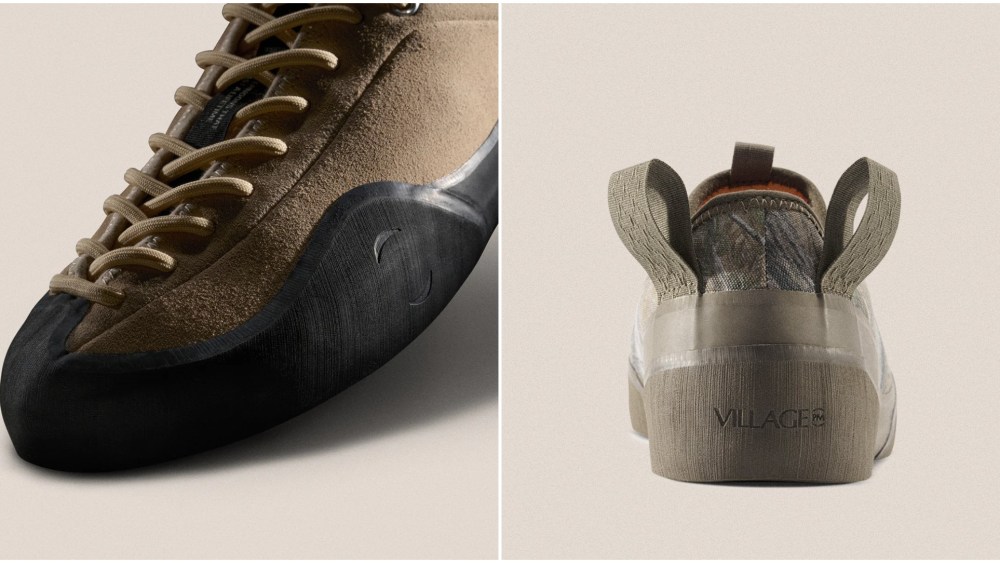
If Basile Lapray, co-founder of Parisian upstart Village PM, has his way, the skateboarding shoes that end up defining the 2020s could look vastly different than the pairs that came before.
Skateboarding shoes can traditionally be grouped into one of two categories. There are the slim-profile, canvas-and-suede vulcanized sole styles introduced by Vans in the 1970s, looks which would go on to be mimicked by countless companies looking for a piece of the action sports business. Decades later, in the 2000s, blockier shoes, with puffed-up proportions and technical overlays, took over the skate landscape. These bulkier builds were made popular by brands such as DC Shoes, És, Globe and Osiris and have seen a resurgence in recent years as Y2K fodder continues to trend.
Related Stories
And there are, of course, some outliers — models like Nike’s skate-repurposed 1980s basketball shoe, the SB Dunk, falls somewhere in the middle of the two silhouettes — but on the whole, these two varieties have dominated the skateboarding footwear scene.
You May Also Like
Founded in 2024, Village PM’s footwear doesn’t fit neatly into any of the aforementioned groups. The line, which borrows from Lapray’s outdoor background, including stints at companies like Salomon, gets its signature aesthetic from the warped-and-wrapped rubber soles of climbing shoes. It’s a striking design choice that not only gives Village PM a unique aesthetic in a market consisting of many similar-looking shoes, but adds a new level of functionality and repairability to the skate category.
Lapray told Footwear News that the inspiration to start Village PM came when he and his co-founder, Bram De Cleen, noticed that skateboarders had stopped wearing their skate shoes in everyday lifestyle scenarios. Their peers would often lace up sneakers to skate in, but later swap into a different pair for casual use. This presented an opportunity to shake up the market.

“Ourselves as skateboarders and our friends, nobody was really wearing skate shoes anymore besides for the activity of skateboarding,” Lapray told Footwear News. “Skateboarding shoes changed from a cultural identity product to like a piece of equipment that people would wear only to skate. And then when the session is over, they would switch to their regular daily shoes. Sneakers, derbies, whatever. With Bram, my cofounder, we said, okay, if even skateboarders are not wearing skate shoes anymore, it means that there’s probably something else to offer.”
Louis Handler, founder of Charlottesville, Virginia-based skate shop Cinema, has also noticed skaters gravitating away from skate-specific shoes and sees potential in a brand that’s able to appeal to both the lifestyle and skate crowds.
“Skateboard fashion and imagery is all about juxtaposition,” Handler tells FN. “Looking ‘non-skater’ becomes counter culture. That’s why skaters have been wearing the outdoor brands, like Keen and Merrell, the last several years. They become hard to pin down aesthetically.”
And Handler says it’s not only about not looking like a skater, as the bulk of his sales come from customers who don’t actually skateboard. For a potential crossover label like Village, winning over the skate store shopper who’s buying product for casual use could prove beneficial to the brand and retailers alike.
“If skaters ask for it, then shops will carry it,” Handler says. “If non-skaters ask for it, then even better.”
Seeking to freshen up what they believed to be a stale skate shoe landscape, Lapray and De Cleen looked not to the past, but to the mountains. The Village PM founders realized that elements of rock climbing shoes could be transferred to skateboarding sneakers through a functionality-first approach. The shoes would need to be durable and tough enough for repeated thrashings, but simultaneously flexible so the comfort would be suitable for daily walking. Proper grip was also paramount, as skaters aren’t going to embrace a shoe they can’t actually perform in. To achieve this, Village PM developed their own rubber compound and outsole technology.
Rather than a traditional vulcanized outsole or cupsole, Village PM uses what it calls Rubber Glove Technology, which is featured on its flagship 1PM model. The brand describes it as a soft, sticky rubber intended for a quick break-in which, with its asymmetrical foot-wrap design, also provides a long-lasting snug fit that Village PM says will withstand through the shoe’s full lifespan. But in the event something on the shoes happens to fail, they’re designed to be repairable — yet another takeaway from the founder’s background in the outdoor industry.
“It’s kind of the same thing where people would go to local cobblers or climbing shoe repair shops,” Lapray says. “They will be able to [fix the shoes] either with our own spare parts that we will provide, or with some generic rubber sheets those shops have. And we find it even more cool, because then the shoe really has a second life with another kind of rubber with maybe different properties, but it’s unique.”
The Village PM 1PM retails for $120 and is a sleek low-top sneaker with offset full-foot lacing that extends all the way to the toe, dual embroidered heel tabs to easily pull the shoe on, breathable mesh tongues and the brand’s signature Rubber Glove construction. Thus far, it’s been offered in canvas, leather and suede materials in earthy browns, vibrant blues and tonal black and white styles along with an on-trend camouflage colorway. The brand also offers a more stripped-down 1.30PM variation at $95. In March, a mid-top variation of the 1PM will be introduced, followed later by a sporty 2PM sequel.
The brand’s shoes are available from the brand’s e-commerce store and a host of other stockists, many of which are not traditional skate shops. Along with those shops, Village PM is stocked alongside labels like Comme des Garçons, Prada and Saint Laurent at retailers including Dover Street Market, The Broken Arm and Trés Bien.
“We went to Dover Street Market and the Broken Arm in one single day,” Lapray says. “We just managed to get in with our little suitcase and just say, ‘Hey, we have something to show you.’ I think the full thing made sense to them. The product, the positioning in terms of price. The brand positioning as well, being a core skateboarding brand, being independent. We were lucky that they backed us since the first season because it’s really helped us establish ourselves.”
Lapray declined to provide sales figures, but noted that Village PM’s “ramp up has been fast.” In March, the brand, which currently has a staff of five employees, will be introduced to the Japanese and Canadian markets followed by a U.S. debut in September.
With a presence at Paris Fashion Week and on store shelves next to some of the world’s top brands, one can’t help but wonder if a fashion collaboration is next for Village PM. Lapray said the team has received interest from different brands he admires, but that they’ve been quick not to rush into anything. “We had some really interesting propositions, but we’re happy establishing ourselves first,” Lapray says.
His dream collaborator? Fellow Parisian label Hermés. And while the proposition of a budding skate brand working with one of the most iconic luxury goods companies may seem far-fetched, it’s this idea of polarity that has helped Village PM get off to a strong start.