Veja, which means “look” in Portuguese, was founded in 2004 by childhood friends Sébastien Kopp and François-Ghislain Morillion. However, the French footwear and accessories brand originally began as a project.
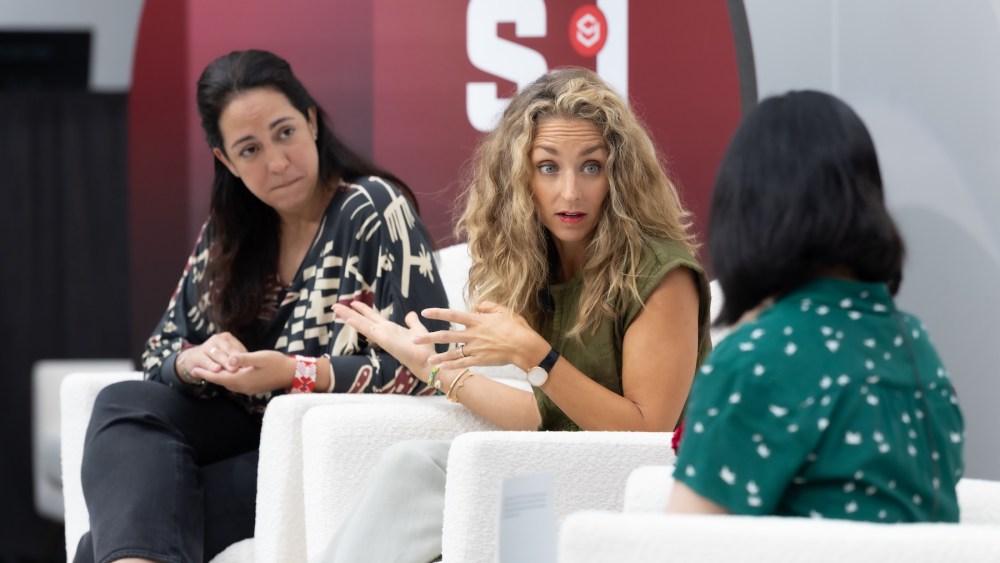
“When Seb and Francois started 20 years ago, they didn’t know anything about anything,” said Tara Gilson, Veja’s North America CEO, during Sourcing Journal’s Fall Summit. “But they did know two things: that people wore sneakers and that sneakers are inherently an inclusive product; everyone can wear sneakers.”
Related Stories

That leads into the company’s other aspect, Gilson continued, which considered the “amazing opportunity to reinvent the way sneakers are made.” By focusing on sustainable practices—like working directly with families for materials like cotton, wild rubber and leather—the sneaker brand has maintained its unique supply chain in Brazil for two decades. But why Brazil, you ask?
You May Also Like
“Brazil has an immense supply chain, most notably cotton and wild rubber—that’s where it started,” Gilson said. “So rather than say, we want this type of product or this type of thing, it was a bit in reverse. It was we want to do sneakers differently, and then it’s going to go ground up.”
All is to say, Veja began with the actual materials, then the supply chain. The company also has a vast network of farmers and rubber tappers as well as cooperatives that act as intermediaries, working directly with the teams on the ground.
The people-first approach is maintained through and through, as the goal from day one has been to pay producers what’s warranted, not dictated by the commodities market. It’s why the company refers to its supply chains as “projects.”
“We know everyone that works in our supply chain; at the end of the day, we are building and keeping relationships with more than 5,000 families that we work with because we not only recognize the work that they’re doing but also value the social environmental service they’re doing as well,” said Luciana Batista Pereira, Veja’s director of human resources and sourcing, listing the four “projects” currently underway.
The first is the organic and agroecological cotton project, involving small communities in Peru and the northeast of Brazil. The second is for wild rubber, which consists of working with some 3,000 families that live in the middle of the Amazon forest. The third encompasses the leather project in Uruguay. In contrast, the final project sees Veja working with 200 women who gather plastic bottles from the street, which Veja then buys directly from them.
“In Asia every year, we have meetings with the comparatives to talk about the price: what’s the meaning of a fair price? How can we build this together, so we don’t follow the commodity market,” Pereira said. “Of course, we build this together in considering our economic health but also understanding the challenge of the reality and besides the fair price, we are also paying the for the premium for the social economic service that they are doing so.”
When it recently faced a 50 percent tariff from the United States, Veja was prompted to take a more “cautious approach” to pricing.
“In the end, Veja is a business, right? A project and a business; we’re always toeing that line, but it’s a project first—and it is expensive,” Gilson said, adding that “no one will tell you otherwise that it’s very expensive to maintain and to invest.”
In fact, Veja’s cost of goods is three times higher than that of comparable products due to this ethical sourcing.
“We are very aware of our pricing and where we want to sit in the market; when you have this target price—and then you have our cost of goods and then you want to have a margin for a business—there’s not much else in between,” Gilson said. “And so that was the decision from the beginning, was to forego a large advertising budget to ensure our cost of goods and our supply chain remained the same.”
And while the brand avoids gifting kicks to influencers or managing a marketing budget—relying on wholesale partners and “slow, steady growth” instead—the approach worked out well. When Meghan Markle, the Duchess of Sussex, donned a pair of Veja’s V-10 shoes at the 2018 Invictus Games in Sydney, Australia, the ensuing attention nearly crashed its website.
“I will say, you know, those things we’re obviously incredibly grateful for, you know, it’s amazing and it helps business,” Gilson said. “We know that, right? That it helps business. But that happened on its own. We’re very fortunate that those things do happen organically—no pun intended.”