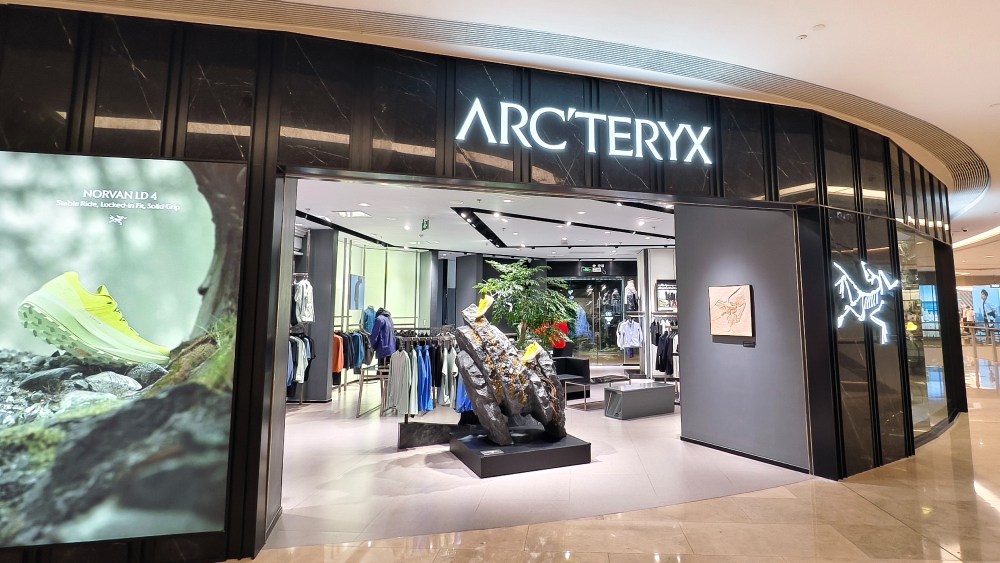
Amer Sports Inc. has high hopes for its Arc’teryx brand — and Wall Street approves of its star-power status.
The parent of Arc’teryx, Salomon and Wilson Sports, among other brands, held its first Investor Day meeting last week since its initial public offering where chief executive officer Jie Zheng said Amer is expected to “deliver another very strong third quarter results across all three segments, led by continued exceptional growth from Salomon Softgoods and an Arc’teryx acceleration.”
Related Stories

While the company in 2024 doubled the size of its overall business to over $5 billion, helped by direct-to-consumer (DTC) channels that represent about 50 percent of Amer’s business, versus just 15 percent in 2020. Also a contributing factor has been the acceleration of Amer’s business in the China markets. But the brand with star power is Arc’teryx, which reached $2 billion in sales last year. While Salomon is “becoming the fastest-growing outdoor sneaker brand in China right now, Zheng said “Arc’teryx has become the No. 1 outdoor brand in China markets since 2024.”
“Arc’teryx is special,” the brand’s CEO Stuart C. Haselden told investors. “We do not see a direct competitor for Arc’teryx in how we’re positioned. We span three distinct market segments. We are the pinnacle of the outdoor market. We compete and win share in the luxury and premium outerwear segment.
You May Also Like
Haselden said Arc’teryx has a very large total addressable market, with the potential for the brand reaching a target of “$5 billion [in five years] in top-line sales by 2030. The potential of this brand is well beyond that. It’s a compelling growth story.”
He said the building blocks for the brand’s business over the next few years are “across channels, geographies and categories.” The brand’s focus is on the mountain athlete in climb, snow and trail sports.
“The world does not need Arc’teryx to make athleisure products. The appeal of our brand is that we are focused in a disciplined way, in a committed way, to making these performance products. And we have expanded aggressively in China,” Haselden said, noting that the brand’s performance products appeal to the Chinese consumer the same way as in North America, Europe and other parts of Asia. That means not just the mountain climber, but also to consumers who want the same “bulletproof hard shell jacket just to keep them dry as they work their way across mid-town traffic.”
Arc’teryx’s CEO said the brand has ended Phase 2, the vertical and direct-to-consumer transformation — this phase took the brand from 80 percent wholesale distribution to 80 percent DTC — to turning its attention to the global stage, with investments in infrastructure, supply chain and technology, as well as culture and leadership.
In addition to footwear, the business is also planning for growth in the fast-growing women’s apparel category — the brand’s chief creative officer Katie Becker said the global women’s addressable market is $256 billion with the outdoor segment at $48 billion — as well as in Veilance, the Arc’teryx premier line of technical performance outerwear and apparel.
HSBC equity analyst Erwan Rambourg maintained his “Buy” rating on shares of Amer Sports, with a share target price of $50. Shares of Amer were trading in the $35.50 a share range on Monday.
“Most of our coverage in sporting goods consists of mainstream brands that are trying to sell everything to everyone. This of course gives them a bigger total addressable market but also makes them more vulnerable to changing consumer behavior and fashion trends,” Rambourg wrote in a note. “In this regard, Amer Sports particularly stands out to us as their brand portfolio continues to benefit from premium positioning within the niche outdoor sports category. Group’s core asset Arc’teryx is uniquely placed between the luxury and mass market pyramid.”
He noted that investor pushback has typically been due to the overdependence on the Arc’teryx brand in China, but said that “this is changing.” In addition, Salomon soft goods is accelerating, adding another layer of growth for the company. He did cite geopolitical tensions as a possible risk since Amer is primarily a Chinese-owned and controlled firm. One risk is the potential for a boycott of products made in China due to the Better Cotton Initiative, with others including the strengthening of the U.S. dollar, as well as tariffs.
Amer’s CFO Andrew Page said in May when the firm reported first-quarter results that it thought it will be able to offset higher import tariffs through pricing, vendor renegotiation and supply chain maneuvers.
UBS softlines analyst Jay Sole also has a “Buy” rating on share of Amer, with a $52 target price. “Amer remains one of the best growth stocks in softlines,” he said, noting that the company has invested in technical innovation and successfully developed a brand-led go-to-market strategy. “These factors have enhanced Amer’s brands’ authentic appeal and market position, marking a big unlock of its growth potential,” Sole said.
He cited management’s expectation that North America and China should be about the “same size by 2030, close to $2 billion each.” Moreover, the brand’s growth plans for women’s will increase to 30 percent of sales by 2030 from an anticipated 25 percent in 2025. “Artc’teryx is also targeting footwear penetration of 13 percent by 2030, up from 8 percent in 2025,” the UBS analyst noted. And with core franchises remaining key to Arc’teryx’s growth, that will see 20 percent of its products generating 70 percent of revenues with the core maintaining their share of the brand’s revenues over the next five years. Another avenue for growth are plans to operate 290 stores by 2030, up from 170 in 2025.
Renée Augustine, the general manager of Arc’teryx footwear, said during the company presentation that the brand’s shoe offerings, launched just 18 months ago, has thus far “driven over $250 million revenue. And for the past three quarters, footwear has delivered the highest growth rate across the brand, with this last quarter delivering plus 43 percent.”
Augustine also noted that trail-running participation is on the rise, with a five-year average annual growth rate reaching 8 percent in the U.S. He also said the global trail running market is projected to reach over $12 billion by 2023, representing a “clear signal of consumer engagement and growth.”
With mountain footwear engineered to go “faster, further, harder and higher,” Augustine said the brand will accelerate product innovation, with engineering designed for the “full spectrum of mountain terrain from valley to summit.” In 2024, the brand introduced three models: Sylan for fast propulsive mountain running, Vertex Alpine as a lightweight shoe for fast approaches from valley to summit, and Kragg for crag or cliffside climbing access. In spring 2025, the Norvan LD 4 mountain running shoe was launched for mixed terrain, along with Vertex Speed, a shoe that’s geared for running and climbing.
He said fall 2025 includes the Konseal, an approach shoe for long technical missions, and the Norvan Novalis, a winterized Norvan LD 4 for high-performance running in cold conditions. In addition to innovative shoes, Augustine said the brand is also focused on building scalable franchises representing high-impact products that drive growth and brand strength. “Our top 10 models account for approximately 80 percent of total footwear revenue, underscoring the strength of our core franchises,” he said. Norvan is the brand’s largest volume driving franchise. Also reaching a level of consumer pull is Konseal, with plans to go from “two to four brand-defining franchises in the next 18 months,” Augustine said.
“Wholesale will be a powerful accelerator for our business. We’re scaling with intention, building credibility through specialty and premium outdoor partners. Over the next 5 years, we plan to add more than 2,000 wholesale doors globally,” Augustine said. He said the response from sporting goods partners has been “incredibly encouraging,” noting that early previews of the fall ’26 product line have sparked a surge of demand. “It’s a clear signal that our vision is resonating and marks the beginning of a powerful shift in how the market sees Arc’teryx and footwear,” he added.
Also on the agenda is the prioritization of epicenters in “key mountain towns, places where our consumers live, train and explore. Here, we’ll build a more pronounced on-the-ground community and service model for footwear, deepening our connection with athletes, retailers and communities and reinforcing our commitment to mountain terrain,” Augustine said of retail expansion plans. That strategy will be global in nature, he added.
The footwear general manager also spoke about the brand’s April launch of its dedicated footwear business unit, based in Portland, Ore. Because that is the epicententer of global footwear innovation, the locations “gives us access to the industry’s top talent,” he said.
“Footwear is projected as the highest growth product category over the next 5 years, with contribution to total revenue projected to rise from 8 percent to 13 percent annually. And we’ll do this by delivering more innovation,” Augustine said. “We’ve built a strong product pipeline, and we’re poised to accelerate performance innovation, solving real problems for the mountain athlete and unlocking new opportunities for growth.”
The company also raised its third quarter revenue growth to the high 20’s percentage range. When Amer posted second quarter results last month, its projection then was for third quarter revenue to rise 20 percent.