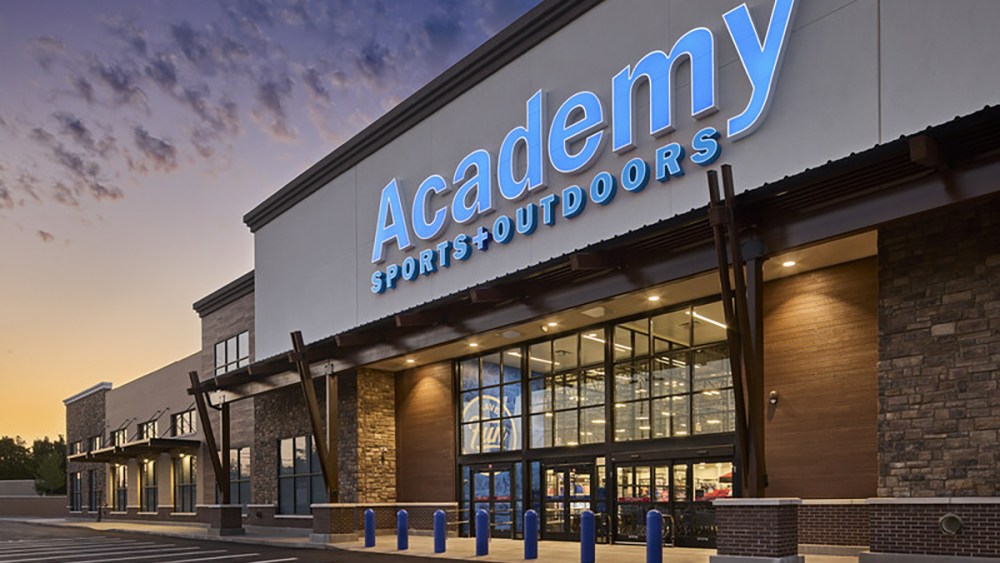
The trade-down consumer continues to grow at Academy Sports + Outdoors. Still, the specialty retailer on Tuesday posted first quarter earnings results that missed Wall Street’s expectations. Wall Street was estimating adjusted diluted earnings per share (EPS) at 89 cents on revenue of $1.37 billion.
For the three months ended May 3, Academy reported a 39.7 percent decline in net income to $46.1 million, or 68 cents a diluted share, from net income of 76.5 million, or $1.01, in the same year-ago quarter. Adjusted diluted EPS were 76 cents. Net sales slipped 0.9 percent to $1.35 billion from $1.64 billion, while comparable sales fell 3.7 percent. E-commerce sales rose 10.2 percent, and new stores continued to comp positive low single digits, the company said.
You May Also Like
Related Stories

“During the first quarter we saw continued progress across our strategic initiatives, including the opening of five new stores, and the biggest brand launch in the company’s history with the addition of the Jordan Brand,” Steve Lawrence, Academy’s CEO, said in a statement. “We saw sequential improvement across each month of the quarter, despite a choppy macro-economic backdrop, which resulted in a positive comp in April.”
Looking ahead, he said that the company is widening its annual comp sales guidance range to between “up 1 percent “down 4 percent to up 1 percent,” in anticipation of potential inflationary pressure for the balance of 2025. Lawrence also said the company has done extensive work to mitigate tariff pressures at current levels and will remain nimble as the situation evolves.
That work includes pulling forward domestic inventory receipts of evergreen product at pre-tariff prices and reducing inventory receipts to “maintain flexibility” as tariffs and consumer spend evolves over the back half. Generally, this usually means in retail that the retailer has pulled back on some orders, will wait to see what consumers are buying, and then chase sales for categories or products that are doing well.
The company has diversified its supply chain over the past several years, reducing its exposure to China. It now has arrangements with its trusted suppliers in other countries, a move that reduced its cost exposure to 9 percent of total cost of goods sold directly related to China for its private label business. Academy said it plans to further reduce this cost exposure to 6 percent by the end of fiscal 2025.
There was one point of good news connected with the consumer. “We continue to see strong growth in traffic from higher income consumers, and we believe our focus on remaining the value player in our space will allow us to continue to take market share as we move through the year,” the CEO said.
Academy opened five new stores in the quarter, including an expansion into two new states, Pennsylvania and Maryland. The company now operates 303 locations across 21 states. The retailer still expected to open a total of 20 to 25 new doors in fiscal 2025, versus the 16 it opened in 2024.
Academy is expecting net sales to range from $5.97 billion to $6.27 billion, down from its March estimates of $6.09 billion to $6.27 billion. Diluted EPS is projected to range from $5.10 to $5.90, versus prior guidance of between $5.40 to $5.85.
The company said its current actions have “effectively mitigated the cost of tariffs at different levels, while minimizing the impacts to customers.” It also plans to leverage its private brand portfolio, currently 23 percent of merchandise sales, to offer “differentiated, high-margin options to the customer.” The company-owned brands are BCG, Magellan Outdoors, R.O.W. and Freely.