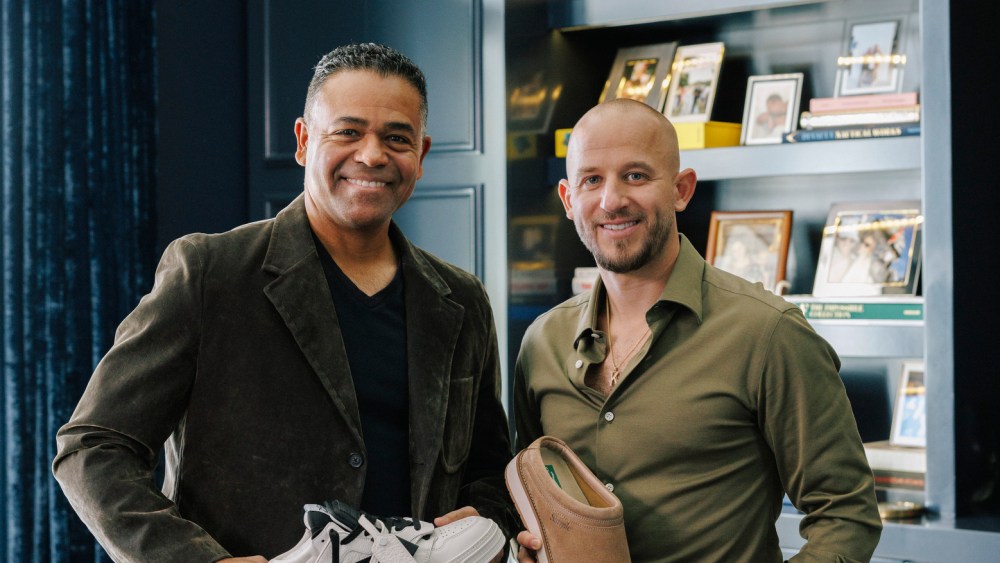
It’s a sunny October morning in Miami Beach and the water in Biscayne Bay is unusually choppy. In the living room of his art-filled home,
BBC International corporate president Seth Campbell poses alongside chief executive Josue Solano for an FN cover shoot to celebrate the 50th anniversary of the company founded by his father, Bob Campbell.
These footwear leaders are valiantly ignoring the alerts on their phones about the latest tariff upheaval, which has been one of the biggest challenges for the industry in 2025.
Related Stories
Campbell and Solano are certainly not immune to choppiness, but they are staying focused on their highly ambitious plans, which have been taking shape since they took the helm five years ago, following Bob Campbell’s death.
You May Also Like
“[It was] right when COVID happened,” Seth recalls. “From Day One, we’ve been faced with these macroeconomic outside factors of our business, and that hasn’t ended, with the transportation crisis, tariffs. So we face them. We almost plan within our business that things can happen, and we have to be flexible enough to adjust.”
That flexibility has served the two leaders well over the past five years, as they’ve steadily expanded the footwear company through numerous acquisitions and licensing partnerships.

Bob Campbell established BBC in 1975 and, along with partner Donald Wilborn, gained fame as a kids’ footwear specialist, starting with big wins like “The Smurfs” license. He was also the first to see the potential for putting lights in shoes and helped make Heelys’ wheeled sneakers a global phenomenon.
Bob Campbell’s presence is still felt here in his son’s home, in the form of a commissioned portrait by artist Julian Schnabel that hangs in the library. And within BBC, his core values of communication and respect remain at the heart of the organization. However, the company itself has changed significantly under its new leadership duo.
As corporate president, Seth Campbell said he’s passionate about business development. James Jackman/Footwear News
Most notable: BBC is now split almost evenly between the kids’ and adult businesses. “We’re well on our way to being a more balanced footwear company, with many different categories as well, not just sneakers or casual athletic footwear,” said Seth Campbell.
BBC’s portfolio consists of six owned footwear brands (though the executives said they are primarily focused on DVS, Simple and Heelys) and roughly 20 licensed brands across the entertainment, fashion lifestyle, athletic and luxury categories.
In just the past five years, the company has added several character licenses, as well as the Michael Kors and Keds children’s lines, plus partnerships with New Balance, DC Shoes, Ed Hardy, Umbro and Off-White.
Solano said those licensing relationships are built on deep respect. “We take the privilege of being able to work with these brands so seriously. We see ourselves as stewards of the brand,” he said. “But aside from [that], we’re trying to add value to those brands and help them grow. With our infrastructure, we’re able to scale up or scale down, give them dedicated resources where necessary. It’s a working formula for us.”
Josue Solano joined BBC International in 2003 and brings a deep expertise in sourcing. James Jackman/Footwear News
As for BBC’s retail partners, they applaud the company’s ingenuity and reliability over the years.
“Their partnership is second to none,” said Todd Kirssin, chief executive officer of DTLR. “They make incredible shoes, at lightning speed, and the end product is always a diamond.”
John Mersho, president and CEO of Shoe Palace, added, “What I admire most about the BBC team is their eagerness to go above and beyond in creating memorable marketing events. Their innovation and creativity in these initiatives have always impressed me.”
Here, Campbell and Solano pull back the curtain on the private company’s recent growth and explain how BBC’s past continues to shape its culture.
BBC has been a giant in the kids’ shoe industry, but about a decade ago you moved into the adult market. What was that transition like?
Seth Campbell: When Josue and I started working together about 10 years ago, we were drawn to each other and had this natural affinity, and we both saw the opportunity to venture outside of kids for the growth of the company. The first brand that we did that with was Champion, and that was while Bob was still here, and from there, obviously, we’ve taken it to new heights.
Josue Solano: We changed the paradigm a little bit. We said to ourselves, what do we want to be 10 years from now, and it certainly wasn’t just a kids’ company. We realized that within our supply chain, we had the ability to make any type of shoe, from a basic flip-flop all the way to a performance snowboard boot, and we had the ability to expand beyond children into additional markets.
Using its skate expertise, BBC is helping DC Shoes tap new audiences. Courtesy of BBC
Why was it so important to diversify?
JS: Just look at all we’ve been through in the past six years, whether it be COVID, the transportation crisis, tariff wars, on and on. When you have diversification within your portfolio, you’re able to weather those storms. If consumer confidence is low and people don’t want to spend on luxury goods, well, we have our price point business to lean on. Conversely, when luxury goods are more in demand, we are in that market as well.
What internal changes did you have to make to support this new direction?
JS: When you enter a new category, sometimes you have to bring in a different type of shoe technician. You need to bring in expertise in a particular category that maybe you don’t have. But the core infrastructure of what we do and what we focus on — great products, telling emotional stories, focusing on fit, price, proper styling, focusing on the consumer and what they want — that part never changes.
SC: It’s still very much a people industry, and we believe in our people, so finding the right talent to support our strategy has been crucial.
What is the new BBC capable of?
JS: Over the past six years, the entire industry has been on a roller-coaster ride, and we’ve been on that ride as well. There were a couple of years there where the industry spiked because there was a lack of supply in the market, so it forced us to test the parameters of what we can and cannot do. We showed ourselves that we can scale this business two, three, four times with the infrastructure that we currently have in place. We are both young, we’re both very aggressive. We love what we do, and we want to take this company as high as it can possibly be. We really don’t see a ceiling for our business. We have the energy, we have the people, we have the infrastructure and we’re ready.
SC: What we want is a portfolio of brands that don’t cannibalize each other. So between licensed and owned, domestic business and international business, kids’ business and adult business, we want it to be well rounded. I don’t think there’s any ceiling to that well roundedness. Like, we just ventured [further] into the luxury space with our new license acquisition of Off-White.
That was a major move on your part. What will you be doing for Off-White?
SC: [We’re part of] a joint venture that manages the operating company for Off-White. There are two apparel partners and an accessories partner, and we’re the partner for footwear. We came together with the IP owners, Bluestar Alliance, and we’re incredibly excited about what that brand can be. What Virgil Abloh did is probably one of the most iconic things ever done in this industry, creating streetwear and then bridging that gap with luxury. The consumer still loves the brand, and we want to continue to be authentic to his voice. And the most exciting part is that footwear is such a big piece of that business, so we see big opportunity.
BBC delved further into luxury this year with its Off-White license. Courtesy of BBC
How do you juggle this rapidly growing portfolio?
SC: Our brands are our lifeblood. We ask ourselves, what is the max effort we can put into each brand to drive the DNA and represent it in a proud way. We then staff our team of experts around them and mandate them to focus. Josue and I can’t do it all, but we are there at the most important moments, ensuring we are the best for the brands we have the privilege of representing.
What is the partnership like between the two of you?
JS: Seth and I are very different people. Even though we connect and have this affinity for each other, we’re wired differently, and that’s good for the business, because there are aspects of the business that he absolutely loves, and it’s just natural for him. And there are aspects that I love, and it’s natural for me. So we went through the entire organizational structure, and we divvied it up. That’s worked well for us. We don’t always stay in our lanes because we overlap in a lot of things as well, but we bring each other into our respective divisions, and we make each other stronger. Our people get a different point of view. That difference of thought, [coupled with] the alignment in decision-making and strategy, is the secret sauce for the company.
SC: That’s one of the many things we learned from my father and his partner, Don Wilborn, that checks and balances in the business are valuable.
What are the biggest macro issues affecting your business now?
JS: The way the consumer has shifted their expectations is the single biggest macroeconomic factor that we’ve faced. Consumers want it all. They want value, quality, price. They want to buy it anywhere. They want to be able to return it anywhere. They want shipping for free. Think about what Amazon’s done to our industry in terms of how they’ve reset the table. You also had fast fashion, then the advent of social media and how young people want to look different in every single picture. We’re trying to stay ahead of it as an industry, and BBC is no different, because we service all price points, from $2 all the way up to $600. Then, when you have the geopolitical stuff, that makes it difficult for any company to properly service those consumers who have those high expectations.
Since taking over leadership, you’ve about doubled your portfolio of owned brands. Do you want to acquire more labels?
JS: If a brand is right for our portfolio and it’s the proper time for us to buy it, then yes, but we’re also cognizant of the fact that you can’t buy too many brands too quickly, because then you’re not giving any of them the proper attention that they need. When we’re in a licensing partnership, the licensor has certain things that they do for their brand, and then we do certain parts. But when you own the brand, you own 100 percent of it, and it’s a different game.
Social media star Tara Yummy was the face of the Ed Hardy x Heelys collab. Courtesy of BBC
You have a large licensing portfolio. Are you focused on any specific ones right now?
SC: To me, they’re all our babies. Not only wouldn’t it be fair, but it’s not even true to say one has more focus than the other. They all get their deserving share of resources and all have a plan. And just naturally, some are on a different growth trajectory than others. Some are on an elevation journey, some want to drive volume, some want to expand categories or price points or retail distribution. Josue and I have to be conscious of each of those. Our partners are long-term, valuable partners. It’s very rare for us to say, oh, this is a two-year strategy. One might be on a faster pace for two years, so has X more resources against it right now, but they all get equal love and tender care.
Are there any white spaces where you see opportunity?
JS: There’s been such a shake-up in our industry over the past four to five years. A lot of brands are suffering and going out of business because of all the turmoil. Some are coming into the market that maybe started in apparel and want to now get into footwear. There’s a lot of activity. Brands are really fighting and spending a lot of dollars to remain relevant with the consumer. We see all this turmoil as opportunity. We have our eyes open and when the category presents itself, or the brand presents itself that’s right for us, that’s where we’ll step in.
How else has BBC evolved under your leadership?
JS: Since we took over about five or six years ago, we have been laser-focused on our culture in the company and focusing on giving our employees the best experience that they could have. Seth and I spend a lot of time focusing on that, making sure that our behaviors match that, so everybody else’s behaviors will follow along, and it’s really working. Once you align your culture to your strategy, you start to build this momentum and excitement within the company. We’ve been feeling that for a couple of years. It’s why we’ve been able to retain our key employees. It’s why people like to come to work.
What defines that new culture?
JS: We were trying to find the sweet spot between corporate America, which can be very rigid, and a family-owned business, where it [can lack] process and some core stability that makes you feel comfortable where you work. So we looked at that spectrum and asked ourselves, where do we want to be on that line? And once we drew that line in the sand, Seth and I worked with our executive team to build our core values, our vision and mission statement around that, and we communicate that constantly to our employees.
Seth, your father was a legend in the shoe industry. How does his legacy live on at BBC?
SC: In many ways. We still have a lot of employees who worked with or for my father, so there’s a huge connection still there. A lot of his values are in our core values. He used to preach communication and respect, and those are two of our five core values. Also, Josue worked closely with him for at least 10 years of the business, so we both were very connected to him and how he’d work and how he’d see things. I think he lives on, not only in his energy, his values, his work ethic, but also through Josue and me, and that translates to the business today.