
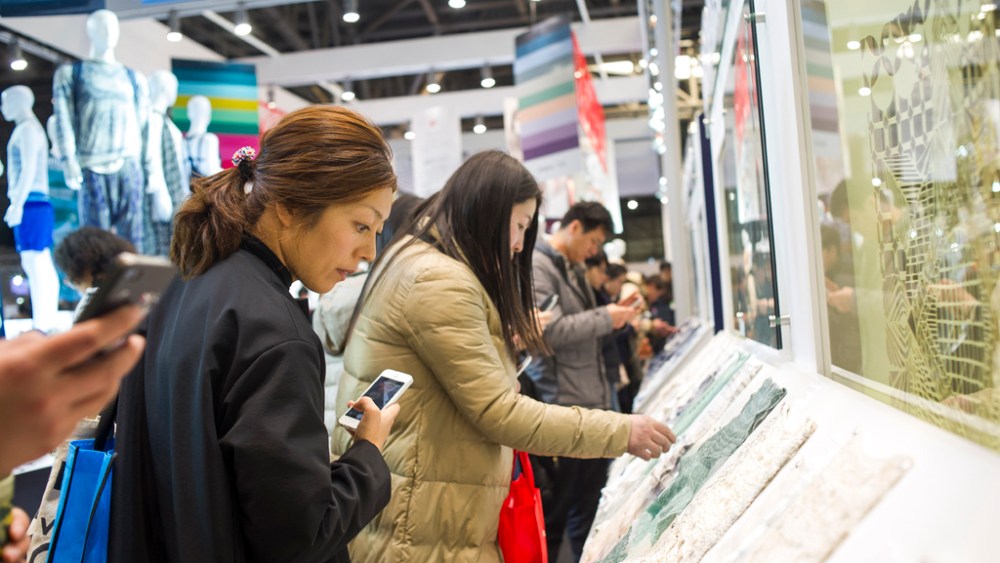
SHANGHAI — Chinese brands dominated, while buyers took advantage of reduced-price Italian yarn at the 25th edition of the Spin Expo yarn fair.
The three-day show, which ended March 11, hosted 150 exhibitors from nine countries, about 20 percent fewer than last year. According to organizers, a stricter entry policy had been introduced to ensure brand and product quality across the show.
Two-thirds of companies this year came from mainland China and 13 percent from Italy. This represented a dramatic shift in demographics since the show launched 12 years ago. According to show organizer Karine Van Tassel, at the inaugural fair in 2003, 10 percent of exhibitors were Chinese, 20 percent were Japanese and 70 percent were Italian.
Related Articles
“Now the tables have turned,” said Van Tassel. “The Japanese brands have either closed or scaled back. Those who worked with cashmere have downgraded to acrylic and sell by the kilo.”
You May Also Like
This year’s show guide listed only three Japanese companies.
“China is achieving its goal to be the world leader in textiles because they own every component of the supply chain, from the raw materials to the transport and logistics,” added the founder.
This year’s spring 2016 showcase focused on activewear using innovative machinery. Beijing-based Dutch designer Eva de Laat and fellow Dutchman ByBorre worked on the show’s “active display” area, in collaboration with knit specialist Santoni.
“This year is all about lightweight clothing, keeping yourself cool or warm, and finding the right combination of textiles,” said de Laat. “It’s about pushing innovation, good collaboration, stretching boundaries.”
Other highlights at the show included the “Going Deeper” trend and research area that analyzed the latest yarns, fabrics and garment styles. Trend director of Spin Expo Sophie Steller said: “We feel celebrity culture and celebrity fashion are putting fashion on a glib, superficial level and that people want to look deeper and see more.”
Key seasonal trends included hybrid yarns; mixes of yarns, knitwear, weaving and jersey; technical fabrics such a neoprene, and green — the color, themes of ecology and green technologies.
On the floor, suppliers discussed the impact of China’s reduced rate of economic growth and the rising cost of manufacturing on the Mainland.
“Labor costs [on the Mainland] are rising around 10 to 15 percent year-over-year. The political environment is also an issue,” said Jacky Chen, chief executive officer of Yarns & Colors, one of Taiwan’s largest integrated yarn suppliers.
In response to rising labor costs, some companies are moving operations to surrounding countries, such as Bangladesh, Vietnam, Thailand and Myanmar, where wages are still relatively low. However, Chen said this was not a real long-term industry solution, especially when offset against the cost of relocating the business. He is exploring the use of robotics to improve production line efficiency.
The ceo also cited the impact of the Chinese currency exchange rate falling.
“The price of Italian yarn is going down,” he said. “I have seen prices drop by as much as 20 percent from two years ago. The Italian companies are selling more and buying less.”
The latest innovation from Yarns & Colors includes color-changing knitwear that uses specially treated yarn that allows a garment to change colors in response to different temperatures. The yarn and garment specialist reported consumer sentiment leaning toward bold colors.
“Spin Expo gives you the opportunity to meet with Italian mills if you missed [Italian textile and clothing fair] Pitti Filati in January,” said Amelia Moss of the Newtimes Group, Hong Kong. “The lower exchange rates have had a huge impact. Italian mills, such as Filpucci, have partnered with Chinese companies. It’s an interesting partnership because you get all the Italian design knowledge combined with the cost benefits of local sourcing. I’ve seen a lot of [fall] colors and trends here, even though this is technically a spring [show].”