
Through a Lens
Journalist and designer Anna Laub is hoping that Prism, her new line of chic glasses, will elevate spectacles’ status from a necessary evil to covetable accessory. “I was simply looking for a great pair of glasses that added to my look, rather than detracting from it,” says Laub, whose first collection hit Browns in London this month. Taking inspiration from the Bauhaus buildings she’d seen on trips to Tel Aviv and Mexico, Laub has designed four simple styles of curved and square frames, in colors that run from clear acetate and light tortoiseshell to matte black and midnight blue. The acetate designs are hand-finished at a factory in Treviso, Italy, and all retail for 205 pounds, or $332 at current exchange. The collection will also be sold online at prismlondon.com.
Related Articles
— Nina Jones
You May Also Like
High-tech Specs
Supersturdy? Check. Ultralightweight? Check. Flexible fit? Check. Today, it’s not enough that eyewear be good looking. It has to be high-tech, too. More and more consumers are looking for sunglasses that combine function with fashion and manufacturers are taking note. Ray-Ban recently launched Ray-Ban Tech, a new collection made with enhanced materials. Its first offering, the Carbon Fibre, features frames made of this extremely durable and ultralightweight material. The style retails for $179 for nonpolarized lenses or $229 for the olarized model. Fiat scion Lapo Elkann’s brand Italia Independent also features carbon-fiber technology in its eyewear and is looking to further advance the brand into the technological eyewear field. “At the moment we are going to market a modular system based on the use of a dynema hollow — usually used for sailing and parachuting — that allows us to change the shape of frames, colors and lenses,” says Elkann. Italia Independent eyewear retails from 157 euros ($220 at current exchange) to 1,007 euros ($1,412). Mykita, a five-year-old eyewear brand out of Germany, is also moving forward with eyewear innovation, offering stainless steel shades designed with a more linear building structure that molds directly to the wearer’s face. Mykita retails from $425 to $529. “It took time for people to get used to the look, our eyewear is very flat but they have different advantages,” says Philipp Haffmans, co-founder of Mykita. “They are very light and adjust to the face, they’re extremely bendable.”
— Caroline Tell
Alter Eco
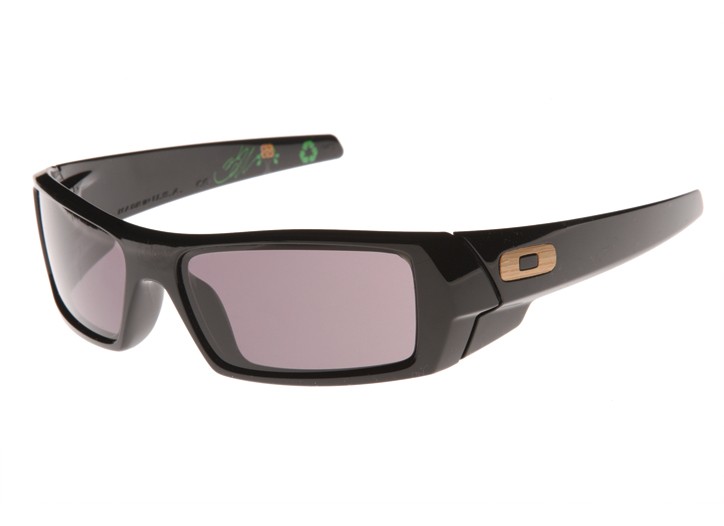
Oakley is no stranger to the green movement. The California-based company already forks over its excess lens material to be refashioned into screwdriver handles by a local manufacturer. But this month, the firm launches its first pair of recycled eyewear, the Bob Burnquist Gascan collection, with frames made entirely of leftover scraps from its production plants. The sunglasses, priced at $100, are an updated take on Oakley’s classic Gascan style done in conjunction with pro skateboarder Burnquist. Features include logo embellishments and a storage bag made from organic bamboo. The packaging, meanwhile, is recycled and uses eco-friendly inks. Proceeds from the collection will go toward the Action Sports Environmental Coalition, cofounded by Burnquist in 2001 to raise awareness of green issues.
— Venessa Lau