
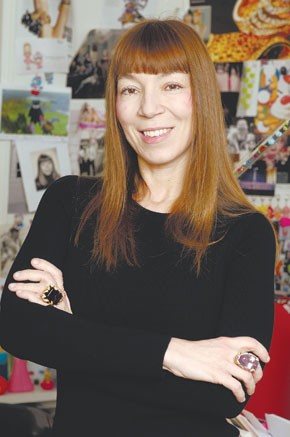
Carnivorous plants, Cinderella’s slippers and blood-seeking vampires might not be typical themes in the fine jewelry game, but since Victoire de Castellane arrived at Dior nine years ago, she’s been busy shaking things up.
Dior poached de Castellane from Chanel, where she had served as the head of costume jewelry since Karl Lagerfeld’s arrival in 1983 — a recruitment that provoked some vitriol from Lagerfeld at the time. (The two have since reconciled.) De Castellane’s arrival at Dior marked the house’s first venture into fine jewelry. Christian Dior himself liked to use costume jewelry, made by houses such as Gripoix, Kramer and Mitchell Maer, to accessorize his looks, a legacy that was embraced by Gianfranco Ferré, who was known for his baroque-style necklaces and earrings, and brought to a crescendo by John Galliano upon his arrival in the late Nineties. At the time, retailers credited Galliano’s cascading chokers and earrings with having sparked a newfound demand for costume jewelry.
But the house sought a personality to stake out new territory on the fine jewelry map — and de Castellane was willing to take on the challenge.
“It’s much easier not to have to step into someone’s shoes,” said the designer, reflecting on her first day of work — Jan. 1, 1998, a blank page of sorts.
“There was nothing, no stones, no boutiques. I had to build it all,” recalled de Castellane, who spent her first year creating the house’s fine jewelry structure and familiarizing herself with the house codes.
“Whereas Chanel was all about a woman designing men’s clothes for women, here was the universe of a man who cultivated absolute femininity,” she pointed out.
One thing de Castellane brought over from Chanel, however, was a more frenetic pace for fine jewelry collections to echo the rhythm of the house’s clothing lines. What she terms as her “ready-to-wear” collections is presented in the spring and fall, and a “haute joaillerie” line is issued roughly every two years. Add to that de Castellane’s Le Coffret de Victoire, featuring one-off stones sourced throughout the year, a permanent made-to-measure service and a limited-edition series that comes out every March.
“I introduced new laws for jewelry,” asserted de Castellane.
Related Articles
You May Also Like
Despite having built her career crafting fake rocks for Chanel, de Castellane was no stranger to the real thing. As a child, growing up in Paris’ 16th arrondissement, she was first exposed to exuberant jewels worn by her grandmother, Sylvia Hennessy, and her society friends.
One black-and-white shot that sits in de Castellane’s office pays homage to the impact of these ladies’ style on her future career. The photo depicts Barbara Hutton in her garden in Tangier, sporting a giant emerald tiara and earrings. “That was her daywear,” said de Castellane with a laugh, adding she could remember the sensation, when she was knee-high, of wanting to reach out and touch them. At the time, her own jewelry box contained heaps of gold plastic and fake rings set with vivid colored stones, another factor that would influence her future career.
De Castellane’s first fine jewelry commissions, some years later when she was installed at Chanel, were for herself. “I would use my pocket money to make these giant rings,” she said, recalling how she would have religious medals melted down into globular rings, then have them melted into a new shape a year later.
It was a precursor of what was to become her first significant collection for Dior in 1999: the “Incroyables et Merveilleuses” line featuring sizable candy-hued stones crawling with salamanders, lily of the valley and butterflies. Inspired by the excessive use of fabric in Dior’s New Look silhouettes, the rings were to set new volumes for fine jewelry. “At the time, people were incredulous, questioning who would wear such creations,” recalled de Castellane. “But for me, it was about breaking rules, while retaining the quality found in traditional jewelry houses.”
De Castellane fixed the eccentric “mood” that Galliano had created, as well as the essence of the house’s founder, as her creative goalposts. “I imagined what Christian Dior would have created if he had designed jewelry and not clothing,” said de Castellane. “I had to know the house, but sensed it was important not to be suffocated by its heritage; to respect its codes while inventing others.”
De Castellane initially spent months plowing through the house’s archives and puttering about Dior’s garden and house in Granville. But, like Dior, she also set about creating new ideas, which she would scribble on Post-it Notes in the middle of the night, or when stopped at traffic lights in her Volkswagen Beetle.
At a time when most traditional jewelers were sticking to a classic quartet of stones — diamonds, rubies, emeralds and sapphires — de Castellane sought to inject new color into the scene. Nostalgic for the vivid, “bonbon-like” hues that had decorated her rings as a child, she set about sourcing alternative stones, such as amethysts, tourmalines and opals. “The idea is that when you put it in your mouth, it has to have a flavor,” said de Castellane.
Childhood references, the fruit of the designer’s untamed imagination, trickle across her collections. Her Diorette line, for example, included rings crammed with hand-painted enamel ladybugs and flowers that recall the Technicolor imagery of an old Walt Disney cartoon.
“Every lady has a certain nostalgia for that [dime-store] daisy ring she once had as a child,” said de Castellane, whose current high-jewelry collection, Belladone Island, features rings in the form of wild, trifid-like carnivorous plants.
Cadillac paint was used on certain pieces to capture, once again, the iridescent hues of fake stones she’d savored as a girl. A fine spray of diamonds settled across a carapace of leaves folding across one ring is referred to as “Cinderella’s dust.”
To think that such playful and often wildly creative pieces come with a price tag of over $1 million must surely bring on the odd heart tremor at the drawing board. “It’s not because it’s real jewelry that it has to be boring,” the designer argued.
De Castellane’s promotional events are renowned for their same offbeat sense of playful abandon. For the opening of the Dior fine jewelry boutique in Harrods in May 2002, for example, she had guests fish jewelry prizes from a fish pond. And last year in Paris, she unveiled her collection on ring-bedecked live hands in a series of quirky setups, painting their nails, say; writing a diary, or nervously drumming fingers waiting for a phone to ring.
“It’s important to have fun, and just hearing executives pronounce [silly] names such as ‘Mimioui’ makes me crack up,” said de Castellane, with a whoop.
It doesn’t seem to have hurt business. Since the debut of Dior’s fine jewelry flagship in Place Vendôme in 2001, replete with a mini replica of the house’s couture salons, the company has opened seven fine jewelry boutiques in total, and fine jewelry is featured in 60 of the brand’s clothing stores. De Castellane’s creations have also garnered a star-studded clientele, including Sofia Coppola, who sports a Mimioui bracelet; Catherine Deneuve; Juliette Binoche, and Madonna and her daughter, Lourdes.
The designer claims she’s never been afraid of following her wildest whims. “If Dior chose me, it’s because they knew my tastes,” said de Castellane, adding that seeing the unbridled, exaggerated energy of Galliano was one of the factors that convinced her to take the post in the first place. “I saw it was a house that was free.”