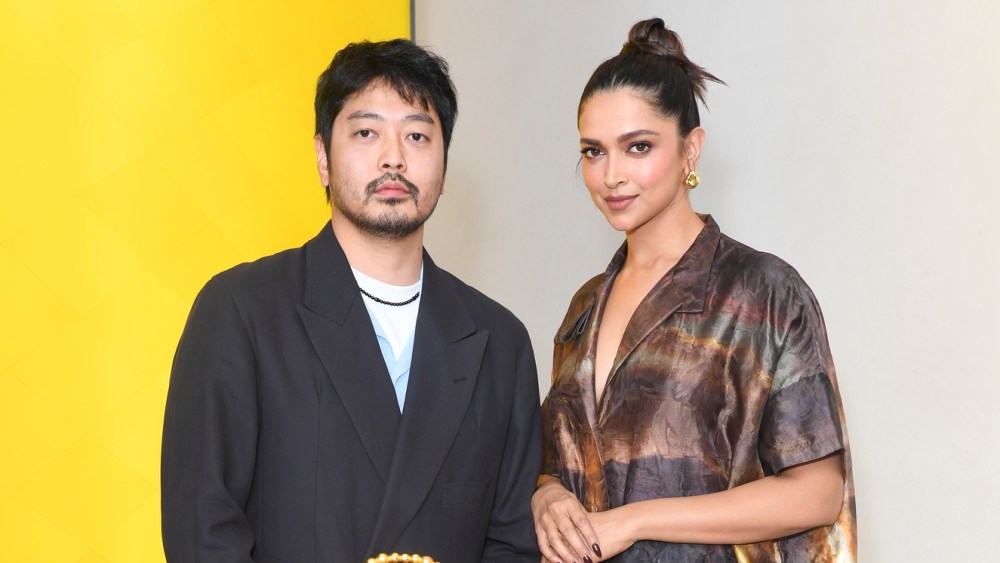
PARIS — Soshiotsuki by Japanese designer Soshi Otsuki on Wednesday won the LVMH Prize for Young Designers, capping an edition that saw designers from across the globe challenge the menswear status quo with creations rooted in local heritage.
The Tokyo-based designer beat more than 2,300 applicants from 115 nationalities to walk away with a grand prize of 400,000 euros, plus a year of coaching from experts at luxury giant LVMH Moët Hennessy Louis Vuitton, parent of brands including Vuitton, Guerlain, Dom Pérignon and Sephora.
Related Articles
Otsuki, who has gained cult status for his oversize suits inspired by ‘80s-era Giorgio Armani, received the prize from Indian actress and Louis Vuitton brand ambassador Deepika Padukone in a ceremony at the Fondation Louis Vuitton.
You May Also Like

“This award celebrates talent, creativity and resilience, the very qualities that I would like to believe have guided my own journey as an artist,” Padukone said. “It’s a reminder that true success is not only about what you create, but also about the courage to stay authentic and the persistence to keep going.”
Speaking through an interpreter, Otsuki said he planned to spend the prize money on building out his team, and hopes to eventually fund his own factory. But first he wanted to celebrate with his favorite tipple, a cocktail named The Godfather that’s a blend of Scotch whisky and amaretto.
A graduate of Bunka Fashion College, Otsuki also attended Coconogacco, the private fashion school that is producing some of Japan’s most exciting new talents. Shortly after launching Soshiotsuki in 2015, he was short-listed for the 2016 LVMH Prize.
Since then he has refined his signature blend of Japanese and Western menswear codes. Suit linings are slashed in reference to kimono sleeves, while some jackets are wrapped like karate uniforms. Otsuki cited influences as diverse as Japanese “salarymen” and “Gung Ho,” the 1986 culture-clash comedy starring Michael Keaton.
Despite the language barrier, Nicolas Ghesquière, artistic director of women’s collections at Vuitton, said the jury was conquered by his presentation.
“We were impressed by his ability to cut clothes and the beautiful, undeniably neoclassical fabrics, and he was also very articulate about the technical construction of his clothes, so it was pretty unanimous,” he said.
“I love his passion about the craft of tailoring — the way that he’s made everything feel very stripped back and soft, and his use of fabric,” chimed in Sarah Burton, who joined the jury for the first time this year after taking the creative reins at Givenchy.
“It has an elegance and a beauty to it, and he just has a very pure vision and it’s his own language, so it was beautiful. And it’s his nod to tradition, yet it talks to today,” she added.
When A$AP Rocky wore Otsuki’s designs on the cover of niche magazine The Travel Almanac last year, the designer’s e-commerce sales spiked.
The Right Balance
Delphine Arnault, the force behind the prize and a key talent scout at LVMH, noted that Soshiotsuki strikes the right balance between creativity and commercial appeal. “At the end of the day, that’s what we want: a brand that also finds a customer at the end,” she said.
The LVMH Prize showroom in March heralded the arrival of menswear from new cultural horizons, with the 20 short-listed brands including for the first time candidates hailing from Egypt, Ghana and Saudi Arabia. Arnault said this had helped to bring new energy to the men’s category.
“I remember fashion week a couple of years ago wasn’t as exciting as today. Now menswear fashion week is super exciting, so there’s a lot more creativity in menswear,” she added. “Men dare a little bit more in the way they dress, and I think that having designers who have a different perspective on menswear has also helped that.”
Steve O Smith, whose made-to-order garments are 3D interpretations of his original sketches, was the winner of the runner-up Karl Lagerfeld Special Jury Prize, presented by Japanese actress and singer Anna Sawai, an ambassador for Dior.
It is worth 200,000 euros and also includes one year of advice on topics covering sustainable development, communication, copyright and corporate legal aspects, marketing, manufacturing and the financial management of a brand.
“What was very interesting to me was hearing his story about creating drawings first and then literally making that into his garments,” Sawai told WWD. “I’ve never really seen anything like it.”
Ghesquière said the approach stood out as fashion grapples with the advances of new technologies. “In this moment of artificial intelligence, it’s interesting to see this approach that is closer to couture,” he noted.
Smith, who is about to move into a new studio space, said he planned to spend the money on material like a steam iron and dress forms, and hopes to hire his two seamstresses full-time. “Right now, we have more orders than we have capability to make them, so we really need to address that bottleneck,” he said.
Winning the Karl Lagerfeld prize was especially meaningful to the Central Saint Martins graduate, who’s inspired by the late couturier’s prolific sketching.
“There’s an irony as well, because he had a lot of opinions about people calling fashion art. That’s a thing that I come across a lot,” Smith said. “He had a sense of humor, right? So he maybe would have found that quite funny.”
Eschewing wholesale has allowed him to grow sustainably, and his label has been cash-positive for a year. In lieu of runway shows, Smith has leveraged red carpet events, for instance dressing Eddie Redmayne and his wife Hannah Bagshawe for last year’s Met Gala. “The Met Gala is the equivalent, if not more, than a show,” he opined.
Recently, the designer saw a spike in demand after the Victoria & Albert Museum acquired one of his pieces, which go for upwards of 10,000 pounds. Now he’s looking to build his clientele beyond London. “I think I could really benefit from mentorship in the client-facing aspect of couture, because so much of it’s so personal,” he said.
Dare to Dream
Camille Cottin, also a face of Dior, presented the Savoir-Faire Prize to Torishéju Dumi. Aimed at promoting the transmission of skills, it comes with a grant of 200,000 euros and a one-year mentorship as well.
Dumi, the British-Nigerian-Brazilian designer behind the Torishéju label, burst into tears, prompting Padukone to give her a hug mid-speech.
“We were all moved by her emotion,” Cottin said afterward, noting that the star-studded affair must feel “overwhelming” for an emerging designer.
In addition to Ghesquière and Burton, and one-off member Padukone, the jury featured Jonathan Anderson, Stella McCartney, Nigo, Phoebe Philo, Silvia Venturini Fendi and Pharrell Williams. Marc Jacobs took part remotely, having attended the premiere of Sofia Coppola’s documentary “Marc by Sofia” at the Venice Film Festival.
Rounding off the panel were Delphine Arnault, chairman and chief executive officer of Dior; Sidney Toledano, an adviser to LVMH chairman and CEO Bernard Arnault, and Jean-Paul Claverie, also an adviser to Arnault, and director of patronage at LVMH.
The annual design prize has helped propel the careers of such talents as Marine Serre, Nensi Dojaka, Thebe Magugu, Simon Porte Jacquemus and Grace Wales Bonner. Last year’s winner was Swedish designer Ellen Hodakova Larsson, whose sustainable designs have won her fans including Cate Blanchett.
Toledano said LVMH’s mentoring has become even more crucial as the luxury sector struggles with a global slowdown in sales. The finalists brought up challenges ranging from manufacturing to navigating wholesale, amid a vendor payment crisis at some department stores.
“They are very realistic, even during their presentation. You almost want to say to them, ‘Well, dream a little,’” Toledano said. “But that’s the reality, because they want to succeed. They feel the market, they feel the customer.”
Dumi, whose brand is sold at Dover Street Market and has been worn by celebrities like Zendaya, said that while she is keenly aware of market realities, designers these days need to be world builders, not just business brains.
“There’s so much competition out there. Every other day there’s a new fashion brand opening. You need to be clear with your message, what you are saying,” said the designer, who graduated from the MA menswear program at Central Saint Martins, where she was an Alexander McQueen-Sarabande Foundation scholar.
The approach has served her well so far. For her splashy Paris runway debut in 2023, she drafted a dream team: Naomi Campbell on the runway, Gabriella Karefa-Johnson styling and Charlie Le Mindu doing hair.
“This year has just been a whole whirlwind,” she said. “This was a dream, and now I’ve accomplished this dream, so now I’m rejigging the whole dream process.”