
BARCELONA — TWO MAJOR HAPPENINGS — The demise of Bread & Butter Berlin and the case against Madrid’s superthin models, the so-called “skinnies” — have changed the landscape of Spain’s fashion trade events.
Remaining shows now take on increased importance as attendees and organizers wonder how the model ban will affect future runway shows.
The cancellation of the Berlin edition of Bread & Butter, announced late last month, will catapult B&B Barcelona, which runs Jan. 17 to 19, into an even brighter international spotlight, predicted managing director Karl-Heinz Müller.
In July, the Berlin-organized contemporary
apparel and sportswear show flooded the Catalan capital’s fairgrounds with 53,774 visitors from 95 countries, compared with 45,000 in July 2005. Thirty-four percent came from Spain and Portugal, Müller said, 18 percent from Italy, and Germany, the Benelux countries, the U.K. and Ireland each contributed 8 percent of visitors.
Müller said the January show will attract more than 900 vendors. “We expect a growing number of exhibitors and visitors in Barcelona because now a clear decision for one event can be made.”
Custodio Dalmau, co-owner (with brother David) of Custo Barcelona, a major local brand and key exhibitor at both B&Bs, is pleased with the change. “I love this fair, but it was a little confusing, like having two heads — which one do you listen to? Berlin out of the running can only benefit the Barcelona edition,” Dalmau said. “These [German] guys have done Barcelona a big favor, and I’m happy about it.”
Ambitious expansion plans for B&B Barcelona announced by Müller for the coming year have been modified. For instance, the “designer concept” — showcasing higher-priced international collections and upmarket brands by staging runway shows throughout the city under the banner Fashion Week Europe — has been pushed back to July 2007.
In addition, B&B Barcelona is redefining present exhibition space “to consolidate the profile of every area,” according to a spokeswoman. For instance, premium denim, rumored to be expanding to a larger pavilion, remains in Hall 8, while “Superior Women,” an eclectic group of better-to-bridge
Related Articles
You May Also Like
apparel and accessories categories in Hall 2, replaces “Milk and Honey.”
B&B Barcelona’s contract with the fairgrounds organization has been extended. Originally for three years, then five, currently it is indefinite.
Passarel.la Barcelona — the fledgling catwalk shows that replaced Barcelona Fashion Week earlier this year — will continue to pump up interest in established Spanish names and newcomers, according to president José Maria Donat, managing director of TCN, a high-end Barcelona-based lingerie firm.
Details are scarce, but Donat said some 25 designers will be participating in the January shows.
The runway roster will be similar to the July edition, when local designers Custo Barcelona, Antonio Miró, Armand Basi, Guillermina Baeza and Josep Abril drew 18,000 visitors. There is no commercial trade event connected to the fashion shows.
Dates for the Passarel.la are Jan. 16 to 18, to coincide with Bread & Butter. It will be held in Barcelona’s Teatre Musical on the hilltop of Montjüic.
Barcelona Bridal Week, held annually, includes Pasarela Gaudí Novias runway presentations and the Noviaespaña trade fair. Next year’s show will run May 30 to June 3 in Barcelona’s Montjuïc 2 fairgrounds — a change from its traditional venue. According to fair organizer Flaqué Internacional, roughly 130 vendors representing 200 brands are expected to cover 237,000 square feet of floor space. The numbers are about the same as last June.
Runway presentations feature Spanish designers who are strong in bridal, but the week’s highlight is Pronovias’ evening catwalk show with a pared-down international stable made up of Valentino and Elie Saab. The event, with its global turnout of press and retailers, is organized by Barcelona-based Pronovias, the world’s largest bridalwear manufacturer.
In general, Madrid’s trade shows are attracting fewer exhibitors than last year. Although Spain’s domestic market has increased its purchasing power, local brands are being squeezed by economic uncertainties and Asian imports, according to vendors at the SIMM apparel fair and Modacalzado, the Madrid-based footwear show.
Pola Iglesias, director of IFEMA, organizer of Madrid’s fashion-related trade fairs, attributed the slump to “the crisis that clings to Europe because of the Asian threat and coinciding dates with major French trade shows.” In addition, some regular exhibitors have switched loyalties to Bread & Butter, she said.
Vendor participation at the September edition of SIMM dropped 13 percent over the previous year, to 877, and at Modacalzado, held Sept. 29 to Oct. 1, the exhibitor count slipped to 645, down 5 percent from last year.
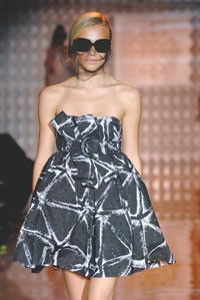
September’s Pasarela Cibeles catwalk shows, which ran in Retiro Park, featured 31 designers and up-and-coming talents — and a batch of local models that didn’t look much chubbier than previous seasons. It was generally agreed Madrid’s regional government, which subsidizes the catwalk presentations, did not do the industry here a favor by banning superthin models.
“Standardized sizing gets complicated,” said a government spokeswoman, “so the new reference, which is based on recommendations from nutritional experts, is body mass,” meaning a 5-foot, 8-inch model can weigh no less than 121 pounds.
Sources said the hoopla was Spain’s big chance to promote a fairly unknown product — and it blew it.
“We’re the laughingstock of the international fashion world,” said Carlos García-Calvo, fashion editor of El Mundo newspaper. He called the season’s hastily improvised selection “bargain-basement models from the B list.”
But, in all likelihood, the issue of the “skinnies” is here to stay, at least through the coming Pasarela Cibeles shows, scheduled Feb. 12 to 16, Iglesias said. The location has yet to be confirmed, but it’s likely Cibeles will return to Retiro Park, according to a spokeswoman.
Iglesias said IFEMA is readying an Asia-only fair to include apparel and footwear classifications for the end of May. “We are a public institution offering a commercial service,” she said by way of explanation. In addition, a radical change in visual presentation, layout and exhibition space is under way for SIMM’s September 2007 edition, she confirmed. Details are not yet available.
According to official figures, Modacalzado and Iberpiel leather goods shows, which run in tandem, drew 19,871 trade visitors in September, down marginally over last year.
Dates for the two shows — known collectively as SIPIEL or International Leather Week — have been adjusted to consolidate their position on the European trade fair circuit. The new dates are March 23 to 25, one week earlier than originally planned.
To adapt to the new calendar, SIPIEL will change location ever so slightly — from the even-numbered side of the Madrid fairgrounds to the odd-numbered side. The interior layout of the halls will remain the same.