
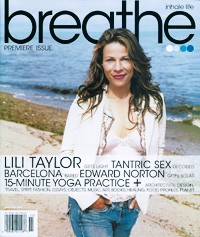
NEW YORK — Yoga, spa treatments and healthy living are all the rage these days, and the growing popularity of these pursuits has led to a new crop of women’s well-being and fitness magazines.
Some are from publishing giants. Women’s Health, for instance, is a spin-off of Rodale’s Men’s Health. Others, including Breathe, Her Sports, Dandelion and Balanced Living, are from niche media groups aiming to tap into this lucrative and fast-growing arena.
Magazine executives and industry observers attribute the growth in this category to broader lifestyle shifts evidenced by trends like the quick rise of Whole Foods and the upswing in yoga. There are an estimated 15 million Americans who practice yoga, a jump of 28.5 percent compared with the previous year, based on a 2003 survey commissioned by Yoga Journal.
Spas are also opening at a rapid rate: There are now about 12,000 spas in the U.S., a 25 percent increase from 2002, according to the International Spa Association.
“Fitness for fitness’ sake is kind of passé now,” said Deanna Brown, co-founder and publisher of Breathe, which hit newsstands at the end of September. “There is a cultural shift happening. People are interested in living a balanced and meaningful life.”
Carolyn Bekkedahl, president of American Media’s Active Lifestyle and Entertainment Group, which publishes Shape, Natural Health and Men’s Fitness, among others, said: “It’s not just about going to the gym anymore. There is a focus now on overall lifestyle and everything you do to take care of yourself.”
Most of the new magazines take a lifestyle approach to fitness and well-being, giving them more freedom when it comes to their editorial content and the advertisers they target. By packaging themselves as lifestyle publications, these books are likely trying to avoid the fate of two former high-profile sports-specific magazines: Condé Nast’s Women’s Sports & Fitness, which folded in 2000, and Time Inc.’s Sports Illustrated for Women, which shut down in 2002 after failing to reach sales and circulation goals. The newcomers are going up against an already crowded field that includes such titles as Self, Shape and Fitness, as well as Natural Health and Organic Style and to a lesser extent, Real Simple and Oprah.
Related Articles
You May Also Like
Samir A. Husni, a University of Mississippi journalism professor and publishing consultant who specializes in launches, said there’s room for newbies, especially smaller magazines, since they have less pressure to be successful at their outset than do new titles from the big publishing companies.
“We are seeing a return of magazines focusing on everyday women, not the professional athlete,” Husni noted.
The new titles each have a slightly different spin. Women’s Health, which landed last month, has the requisite stories on nutrition and fitness, as well as stories such as “Instant Sexpert: How to Have Hotter Sex Tonight” and a profile of “Apprentice” star Carolyn Kepcher.
“We are a lifestyle magazine that is rooted in fitness and health,” said editorial director Bill Stump. “We are offering a broad-based understanding of how to live the life you imagine, including information on healthy sex and relationships, and how to connect with the people you love.”
The first issue has 138 pages, mirrors the design format of its sibling, Men’s Health, and has a newsstand-only distribution of 450,000, with a follow-up issue planned for January, one of five issues planned for 2005.
Breathe, meanwhile, is more of a general lifestyle magazine that incorporates coverage of celebrities and musicians with feature stories on health and balanced living. Intended for women and men age 35 to 54, co-founder and editorial director Lisa Haines said Breathe is targeting urban dwellers who are spiritually conscious but aware they are living in modern environments. “We don’t have to renounce the material world to live a fully abundant life,” she noted
The magazine, which will come out bimonthly starting next year, is part of an independent media company called Breathe Media and has a distribution of 165,000, of which the guaranteed rate base is 125,000, according to Brown.
Yoga Journal’s Balanced Living spin-off is positioned as a lifestyle book designed to help readers “create happier, healthier and more balanced lives.” The issue bowed this fall with a paid circulation of 310,000, with a second issue due for fall 2005.
Among the smaller entrants is Her Sports, part of Web Dog Media, a niche publisher based in St. Petersburg, Fla. “We started this because we thought there was nothing out there that spoke directly to active women,” said publisher Dawna Stone. The bimonthly title has a circulation of about 55,000, much of which is subscription.
And Dandelion is a new active women’s magazine put out in conjunction with Title IX Sports, the women’s catalogue merchant. “Our approach is that we are an outdoor adventure lifestyle magazine for women,” said publisher and editor in chief Michelle Theall, who formerly worked at Women’s Sports & Fitness. Dandelion’s circulation is 100,000, mostly paid subscribers. It is planned to come out five times next year.
These newcomers are putting even more pressure on existing books for eyeballs and advertising. Lucy Danzinger, editor in chief of Self, published by Condé Nast (like WWD, owned by Advance Magazine Group), was formerly the editor at Women’s Sports & Fitness and has closely watched the growth of this category.
“We don’t feel these magazines are a threat to us because we have been around for 25 years and we have a unique approach,” Danzinger said. “It’s healthy for everyone to have a robust category.” Self recently underwent a major redesign aimed at making it more user-friendly, with new Q&A sections and an updated approach to fashion, she said.
So far, mainstay publications seem to be holding their own, and in some cases, showing sizable gains in ad pages this year. Through November, Self carried 1,065 ad pages, a slight decrease from 1,076 a year ago, according to Media Industry Newsletter. Fitness, which is owned by Gruner + Jahr, had 931 advertising pages, up from 896 last year, while Shape carried 1,271 ad pages, up from 1,052 a year ago, according to MIN.
“When I started at Weider five years ago, Shape had a very targeted group of advertisers. Now, we have significantly increased our advertisers in areas such as beauty and automotive,” said Bekkedahl. “The woman buying these magazines is in charge of her life, and she doesn’t need her boyfriend to buy a car for her.”