
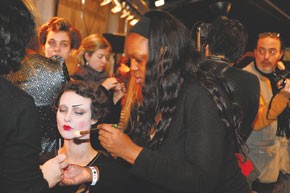
From real snakeskin glued onto eyebrows to tresses wound around shoehorns, Christian Dior’s runway makeup and hair take a wild ride from extravagant to impoverished.
Makeup maestro Pat McGrath and hair guru Orlando Pita have been working since 1999 behind the scenes at Dior fashion shows to construct looks that complete as much as complement designer John Galliano’s creations.
“There’s really nothing usual about working with them,” said Pita. “You just don’t know what to expect when you go in there for your briefing.”
He was referring to the tête-à-têtes he and McGrath have with Galliano to concoct the beauty look of each show. McGrath called them “amazing fashion history lessons,” since the designer talks about his inspirations and can bring out some of the upcoming collection’s silhouettes. Two to three days’ worth of trying looks on models and oodles of Polaroid snaps later, Galliano decides what he wants.
Generally, most fashion shows contain, at the most, a handful of beauty looks, but Dior tends to feature more. For instance, there were 11 to celebrate Christian Dior’s 100th birthday for fall 2005 and a staggering 42 for the controversial collection inspired by homeless people for the spring 2000 couture collection.
“We did the hair with objects you might find on the street — shoehorns, plungers, light bulbs,” recalled Pita, citing the homeless-theme collection as one of his many favorites at Dior. “Because what I’m asked to do goes beyond my normal day’s work, the shows each become really special.”
McGrath likewise relishes being stretched — both creatively and literally — at Dior, where she’s been known to glue petal shapes in rubber around models’ eyes or decorate faces with golden doilies.
“At the Egyptian collection, the girls were so statuesque that we had to stand on chairs to touch up the makeup,” she remembered about the spring 2004 couture. “It was a lot of fun, but also a lot of work.”
Pita recalled almost losing sleep over the dramatic square-shape Egyptian hairdos required that season.
“It took me three days to figure out how to do it,” he said, adding he finally worked it out on the eve of the show.
Related Articles
You May Also Like
Dior presentations tend to transport the audience to faraway locations, such as Egypt, Russia or Japan, but there are many nods to the early years of the house’s fashions, as well. McGrath recalled that makeup for the fall 2004 ready-to-wear show was inspired by the silver-screen divas of the Thirties and Forties, such as Marlene Dietrich and Jean Harlow, who were dressed by Dior himself. Brows made thin and curved, and set high on foreheads, were paired with thick lashes and dark lips.
“These looks were taken to the extreme, with exaggerated shapes and bright Deco colors on the eyes that completely transformed the face,” said McGrath.
For the spring 2007 couture, hair and makeup were inspired by Dior fashion in the Forties and Fifties, plus Japan and Puccini’s “Madame Butterfly.”
“It was Japanese mixed with Fifties hairdos with pin curls and waves,” said Pita. “John wanted the [hair of the] girls in the geisha section to be sprayed black, but three of the girls had bleached hair, which is very porous and would absorb the color.”
Some quick thinking and conferring went on, and then a (relatively) au naturel look was agreed upon.
“So, finally, we had a blonde geisha, and it looked really beautiful,” said Pita.
English model Erin O’Connor had another concern at that show, which — like all of Dior’s — had a somewhat surreal flavor, even backstage. (At one point, a shout of “I have a peasant, a peasant coming through,” resounded, as a model set to be morphed by McGrath and Pita into a peasant was ushered into the backstage area.)
“I’m a geisha today, but I don’t know how they’ll get rid of these eyebrows,” joked O’Connor.
“Sometimes, modeling for John is like competing in ‘The Krypton Factor,’ ” she said, referring to the British TV game show in which contestants must endure rigorous mental and physical tests. O’Connor, whose Dior runway appearances span almost a decade, described the couture show for spring 2007, when models had to wear tight corsets and huge heels and walk on a revolving platform, as a highly risky business.
“John is the only designer who could put all three of those together,” she laughed.
It’s that fun and level of creativity that motivated Alek Wek to make a 24-hour New York-to-Paris round-trip just to walk for Dior.
“John always evolves. I’m always surprised by his shows,” said the Sudan-born Wek.
Canadian model Shalom Harlow agreed. She said Dior shows were constantly “the most magnificent embodiment of fantasy. Be it a geisha or a native American princess, you know you’re going to be transported somewhere.”