
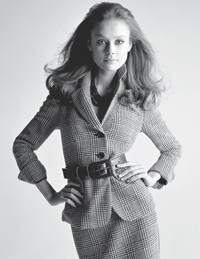
Students aren’t the only ones doing back-to-school shopping. Teachers are also hitting the stores looking for choices that balance professionalism with comfort — and that don’t bust their budgets.
According to an informal poll, several factors influence teacher choices: their age, their students’ ages and climate. For younger teachers and those who teach lower grades, the Gap and Express are favorites, and slacks with a trendy top appears to be the uniform. For those at older grade levels, or the more mature, Ann Taylor, Banana Republic and Nordstrom provide suits and business casual looks, according to those surveyed.
Teachers report they plan to spend about $1,000 on their b-t-s wardrobe this fall, but many have not started the shopping process.
Jenny Austen, a 29-year-old who teaches Spanish to sixth- and seventh-graders at the Charlotte Latin School in Charlotte, N.C. (whose school year got under way this month), made a special effort to look cute on the first day back to school, just as she had as a student. She wore gauchos, a black top and upscale flip-flops.
“I really want to convey that to be cute and sassy, you don’t need to show everything,” Austen said. “I try to teach my girls just to be sophisticated, because they do look to me as one of the younger teachers.”
Another young teacher, Wendy Metzler, said it’s tough to find clothes that are appropriate and youthful. “I have a hard time looking both cute and professional,” Metzler said. “I am a very tiny person, and sometimes I have to go to the junior section, but shirts can be too low-cut. I teach school, I don’t work a corner. Then I go to the women’s section, and that is too old looking.”
Metzler has been teaching fifth grade at Nadine Johnson Elementary School in Austin, Tex., for three years. “I am 28 and I look young, but I try to at least look like I stand apart from my students,” Metzler said. “It’s very important to maintain that distance. I am not their friend, I am their teacher.”
Since she began teaching almost 20 years ago, Mindy Trossman, assistant professor at Northwestern University’s Medill School of Journalism in Chicago, has become more casual. “When I first started teaching, I wasn’t that much older than my students and I really wanted to put some distance between myself and [them],” Trossman said. “I was coming from a law firm, so I had lots of business suits, and that helped. Now, 18 years later, I want to close the gap.”
Related Articles
You May Also Like
Trossman, who favors boutiques over department stores and quality to quantity, typically wears cashmere sweater sets and dress pants to work. This season, she is making an effort to buy more skirts and dresses. Her favorite buys so far: a suit with a tulip skirt from Nordstrom and a sweater coat from a boutique in New Buffalo, Mich., called Michigan Thyme.
Although there is no dress code for the faculty at Medill, as the director of the Medill News Service, Trossman institutes a dress code for her graduate student reporters. “They have to dress to meet sources and public officials,” she explained. “Because I am imposing a dress code on my students, I feel I have to follow the rules myself.”
Unlike student dress codes, which can inspire groans of frustration at the outlawing of the flip-flops, tank tops and miniskirts that monopolize contemporary areas, teacher dress codes often are aimed at setting an example for their students and gaining respect. Many schools have rules that include no spaghetti straps, no jeans, no flip-flops and no overly revealing clothes for teachers.
“In general, in academic settings, people are considered quite autonomous in what they say or teach or wear,” said Doriane Coleman, a professor of law at Duke University in Durham, N.C. “But we tend to be rather conventional, so they tend not to have to worry about us too much.”
As the daughter of a Swiss-trained women’s dressmaker, Coleman, 45, grew up around fashion, and her late mother made her suits for most of her life. “I am transitioning since she died,” Coleman said. “I can’t afford on my paycheck to buy the things she made for me — I got sticker shock a couple of years ago.”
Coleman has had some success with pants and tank dresses at Ann Taylor, and she will get tops at Banana Republic. She will spend up to $80 for pants and up to $200 for a tank dress with a jacket. This fall she is testing a new tailor, who is making her pencil skirts in colors and patterns that Coleman can’t find at chain retailers.
She is excited about the more fitted silhouette this season. “The Sixties look last year I ignored completely,” Coleman said. “Then there are years like this, when I love everything. This year’s trends tend to be what have always fit me the best: pencil skirts and skinny pants.”
Since she became an assistant principal at Tice Elementary School in Fort Myers, Fla., two years ago, Denise Fitzpatrick has dressed more formally. “I did dress a lot more casually as a teacher,” she said. “I really upgraded my clothes quite a bit.”
The 31-year-old Fitzpatrick describes her style today as “trendy professional.” She will wear a capri suit one day and a jean blazer over a black dress the next. Fitzpatrick typically spends $1,000 to $1,500 on b-t-s shopping and is dedicated to buying new clothes every year. This year, she has bought several capri suits, loose V-neck sweaters and big belts. She shops at Ann Taylor and on Forever 21’s Web site. “It’s important to look professional and up-to-date,” she said. “A sharp dresser portrays a sharp image.”
Sue Peppers started teaching in 1969, and today teaches 10th-grade American history and 12th-grade advanced placement American government at Scarsdale High School in Scarsdale, N.Y. Her signature look is a classic pantsuit, from Dana Buchman, Ellen Tracy or Brooks Bros. “I really want my students to look upon me as a professional,” Peppers said. “I don’t want to look like one of my students, I don’t want to look like I am trendy, I want to choose classic clothes.”
Peppers invests a couple of hundred dollars in a quality suit that she will update over time with new tops and accessories. She shops in the petite sections of Nordstrom, Saks Fifth Avenue and Brooks Bros., and finds tops at J. Crew and Banana Republic.
“I am certainly at a point in my career where budget constraints are not as much of a concern as they would be for a younger teacher,” Peppers said. “The age of a teacher has something to do with what they would choose to wear.”
Student age can be as big a factor as teacher age in choosing clothing. Teaching elementary school can be hazardous to your wardrobe, as there are constant arts and crafts projects and much sitting on the floor. Fifth-grade teacher Metzler’s answer is $20 khaki and black dress slacks from the Gap sale rack, with the understanding that they have an expiration date. She is willing to spend more, up to $30, on tops, which she buys during sales at Express, J.C. Penney and outlet malls.
“I’ve learned not to spend a lot on anything. If you care about it, it will get ruined,” Metzler said. “You cannot be attached to anything, because you never know when you are doing a science project if you will get bleach on something or when you will get marker on you.”
Sarah Wilson, 30, a third-grade teacher at Colter Elementary School in Jackson, Wyo., shops at Gap because “it’s pretty much your only choice in Jackson.” Wilson typically wears dress pants and sweaters year-round to school, due to the area’s cold weather. She will spend up to $100 on pants, but “always in the back of my head, I am aware that it has to be something I can put in the washing machine, because I know it’s going to get dirty at school,” Wilson said. “I have to get things that are durable, but not to the point that it’s just completely boring.”
In Charlotte, Austen also favors the Gap Inc. brands, from Banana Republic to Old Navy, “which is one of my best friends.” For school clothes, she spends up to $100 or $150 on a whole outfit, and she makes sure that pieces of that outfit can be worn with what she already owns. “As a teacher, you are on a budget, and you have to be able to piece it together,” Austen said.
One thing teachers are universally willing to invest in is comfortable shoes, whether they are sneakers or sensible heels. “I always wear really good shoes, and I spend a lot of money on my shoes because I am on my feet all day,” Fitzpatrick said.