
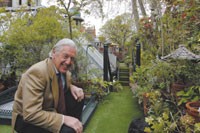
LONDON — Dapper art dealer Martin Summers may be polished right down to his matching pocket handkerchief and dark red socks, but chances are there’s a trace of dirt under his fingernails.
For decades, Summers successfully juggled a career as London’s top Impressionist art dealer with one as garden designer, simultaneously selling Monets and winning awards at the Chelsea Flower Show.
Those two passions were always related. “Gardening is painting with pots,” says Summers during a tour of his rambling rooftop garden with its wooden Buddhas, lush trellises, tinkling metal bells and kooky, onion-domed minarets. “And like painting, the shapes can be both vertical and horizontal.”
Two raven-haired, ultragroomed Pekinese pups keep watch over the mazelike garden Summers has taken 25 years to create. There are 2,500 flowerpots (it takes about two and a half hours to water them every day), serpentine passageways, black iron stairwells and even a small Victorian greenhouse.
Today Summers, 66, has the best of both worlds. After closing his famous Lefevre Gallery in Mayfair in 2002 (it’s now the site of the Stella McCartney flagship), Summers is back in the art game with a by-appointment gallery in Chelsea called Martin Summers Fine Art Ltd.
The 2,000-square-foot space opened this spring, and specializes in mid-20th-century painting. The best part is that the gallery is right next door to his Chelsea home, which he built by joining four luminous artists’ studios in the late Seventies.
“When I don’t have gallery appointments, I can be up in the garden,” says Summers, with a twinkle in his eye. “I get such a kick out of that garden every day.” Summers used to do all of the work on his own and his clients’ gardens, until his back gave out. He now employs a staff of five at Martin Summers Gardens Ltd.
Summers often relies on artistic tricks of perspective to enhance his gardens. “Put a mirror behind a tall, out-of-scale Indian door and it looks like a passageway to a secret garden. The mirror reflects the plants and doubles the depth of the space,” he says.
Art and gardening weren’t always completely entwined. Summers only discovered his love of gardening after a burglar, whom he pinned down late one night after a bungled break-in, suggested he put up trellises on the rooftop to discourage trespassers.
Related Articles
You May Also Like
“He told me thieves don’t like trellises because they wobble,” recalls Summers with a laugh. “So that’s how I started.” Soon after, he bought a potted weeping willow tree, mostly because it was 50 percent discounted, he says, dragged it up to the roof and started arranging flowerpots around it.
Summers says he likes the idea of a potted garden because it allows him more freedom. “If you have a normal garden with flower beds, you’re stuck with the placement. But with a pot garden you can move things around and put plants together which wouldn’t necessarily grow together.”
He describes his style as Oriental. “I love trellises and mirrors and the wackiness of artifacts from foreign places. And I like the fact that the artifacts are not in perfect condition — a lot of them are cheap, which means the garden doesn’t have a ‘precious’ feel.”
The interiors of the home he shares with his American-born wife, Anne, are a direct reflection of that aesthetic. There are oil paintings of flowers hanging in the sitting room, desert nomad-like tents hanging from the ceiling of the music room and piles of artifacts from his travels to Kashmir, Bali, Thailand, Japan, the Middle East and South America.
Adventure and discovery run in the family. His father, Sir Spencer Summers, was the longtime chairman of Outward Bound, the educational adventure program with branches around the world. One of Summers’ first jobs was as an Outward Bound instructor on Mount Kilimanjaro.
As for the art business, Summers says he’s happy he’s downshifted.
“In London, you don’t have to be in the West End anymore. If you have great pictures and a decent space, people will make an appointment to see you. It’s a quieter, more discreet way of doing things,” says Summers, who joined the Lefevre Gallery in 1968.
During the years that followed, he became a legend on the London arts and social circuit, hanging out with the Hollywood and music set. Jack Nicholson is his daughter Tara’s godfather; Paul Simon and Art Garfunkel used to sing lullabies to the baby in her crib, and Sir Elton John and Bob Dylan have performed during parties at his home. At his birthday party earlier this year, Dani Harrison played the guitar and Seal sang.
At the new gallery, he’s formed a partnership with the Geneva-based dealer Jan Krugier, who controls the Marina Picasso Collection. That means Summers has access to about 900 Picassos, including drawings and paintings from the Rose and Cubist periods.
Serendipitously, around the time he decided to open a new gallery, a special collection of 150 paintings by artists including Jean Dubuffet, Cy Twombly and Howard Hodgkin fell into his lap.
It was a collection owned by Peter Cochrane, Summers’ longtime mentor and friend whom he’d met during his first job at the Arthur Tooth and Sons gallery on Bruton Street. Cochrane, who died last year at the age of 91, always wanted Summers to sell off the works from the private collection he amassed during his long career.
Some of those paintings — including works by Hodgkin, Sam Francis, and Allen Jones — are now hanging on the walls of Summers’ airy gallery, with its soaring ceilings, skylights and hardwood floors.
On the ground floor, other paintings from the Cochrane collection — by Yves Klein, Frank Stella and Ellsworth Kelly — hang on the monochrome walls: There’s a black room, a yellow one, a red one and a blue one, all inspired by a color-block chair by the Dutch artist Gerrit Rietveld.
“These are the paintings I cut my teeth on as a young man,” says Summers, who started his art dealing career in 1961 at Arthur Tooth, where Cochrane had been in charge of contemporary art. “With this new art venture, I feel like I’ve come full circle. The paintings feel like old friends.”