
NEW YORK — The blizzard of ’06 dented traffic at two hotel shows here, but buyers who managed to weather the storm sought slimming dresses, suits and even-ingwear.
Designers at the Essex House and American + International Designers at Swissotel the Drake both reported dips in attendance because many retailers were stranded in airports. Still, there was business to be had as buyers shopped for customers who are not necessarily hung up about costs.
Shopping at the Essex House, Arlene Tift said she was in the hunt for well-fitting and more relaxed-looking special occasion and cocktail dresses for her family’s business, Clifford Michael Design. She said she is always intent on finding items that work for a variety of body types for shoppers at the company’s store here and at the one in Boston. Catherine Regehr, Kevan Hall and Lourdes Chavez were some of the collections she planned to review.
“I’m funny about fashion,” Tift said. “I’m very practical. I always wonder what something is going to do for a woman’s figure. Beyond wanting to look good, we need to make our bodies look better.”
For winter, longer styles are still popular at Clifford Michael Design, but for summer, shorter options are more in demand. “For summer weddings, people like to wear shorter dresses,” Tift said. “There are so many destination and outdoor events. They don’t want to look so formal.”
The average shopper spends between $2,500 and $3,500 for a dress, which is consistent with years past. “With the Internet, people have more choices. They see more,” Tift said. “If a designer is oversaturated, then they’re price shopping. I definitely think they have the money. They just have to find the right thing.”
Lessie Harris, merchandise manager for Razook’s, a three-store operation based in Greenwich, Conn., said her shoppers are looking for more dresses that will accentuate their figures.
“It’s all about the pretty dress — structured but soft, feminine dresses,” she said.
More shoppers are looking for not so formal ones, since they are going to more destination weddings and are traveling more in general, she said. Shirtwaist dresses, belted models and other figure-flattering styles, including dresses with sleeves, were among her fall favorites. Zenobia, Catherine Regehr and Kevan Hall were among the collections she planned to view.
Related Articles
You May Also Like
“Our business is good, but we are a destination for special occasion and eveningwear,” Harris said.
One of the show’s exhibitors, Carter Smith, said attendance was “way off,” since many out-of-state buyers were snowed in and still hadn’t made it to New York. Those who managed to make the trip or those who live nearby liked the looks of a pair of free-flowing pants Smith designed. Each pair is made of 12 yards of fabric and about 75 percent of the women who try them on wind up buying them, he said. At trunk shows, he typically sells 20 units of the pants, which range from $500 to $1,200.
Other items that hide figure flaws, like kimono jackets and wrap tops, were key merchandise at the show. Smith attributed the interest in kimono jackets partly to the film “Memoirs of a Geisha.” All his designs are one-of-a-kind, and Smith also creates the prints, which require a week-long dyeing process. That has helped him attract a few celebrity clients like Jada Pinkett Smith, Jane Fonda and Mary Travers, as well as Oprah Winfrey’s mother, Vernita Lee.
Rosemary Jennings, a U.K.-based, Lebanon-made resource, showed at the Essex House for the first time last week. Designer Nada Gandour said the company, which her mother started 40 years ago, is trying to build U.S. sales for its eveningwear and bridal collections. The U.S. market now accounts for 5 percent of the brand’s business. The company has also targeted Spain and continues to focus on the Middle East, where shoppers buy eveningwear year-round.
Jennings’ wholesale price range of $480 to $900 was a plus with domestic buyers at the Essex House, Gandour said. “They said they liked the collection and the prices were good.”
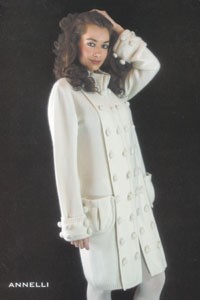
Another show resource, the Annelli Collection, saw interest in versatile, three-season pieces like a $1,176 sweater coat with pom-poms, a $811 belted sweater coat, a $465 herringbone cardigan, a $453 sweater with toggles, a $395 cashmere tuxedo jacket and a $396 cardigan with lace-like detail, said partners Stacey Bewkes and Tyrel Holston. Although the lighter-than-normal buyer turnout was a disappointment, drop-in shoppers resulted in a few new accounts.
The duo was showing Paolomela, another cashmere label, and there was a lot of buzz about a $200 scarf that carried an Italian text message that was a love letter.
At American + International Designers, Swiss designer Roberto Quaglia, who has a signature collection, said more stores are looking for pieces in lightweight fabrics with interesting details — an asymmetric collar, curved epaulets, leather accents or unusual closures. Double-faced cashmere was particularly strong. Renewed interest in leather is a good sign, he said. “Leather details are very important this season. The economy is getting better. When the economy is bad, people are afraid to buy leather.”
Quaglia picked up four or five new accounts, and no one seemed to blink at the $2,600 to $4,000 wholesale range on his suits. Outerwear was a strong point, said Quaglia, noting Bergdorf Goodman has only three left of the more than 100 coats it ordered from him this season. “Coats are coming back, but it has to be something really special,” he said, motioning toward a cashmere coat with a ruffled collar.
Quaglia, who designs his signature collection and Qui Individual, is now a retailer, too. Last fall he bought the Walter Gross store in Zurich, which sells his labels and those of other designers. He found himself ordering from Ivonne de la Vega at the Swissotel.
Another show resource, Lorcan Mullany for Bellville Sassoon, said buyers were clamoring for its $745 belted silk taffeta dress. An off-the-shoulder brown crepe dress with crystal details was a hit for $1,455, said the company’s namesake. Short dresses were particularly strong.
But in general, specialty store buyers at the show told Mullany that sales were not so hot. “They said business is not good in general,” Mullany recalled. “Before, they were the only specialty stores that did eveningwear, but now more stores are getting into it. And everyone is dressing much more casually.”
Sera B introduced an eight-piece cocktail dress collection at the show that wholesales from $400 to $650. To accommodate buyers who were running behind because of the blizzard, the company extended its show hours to 8 p.m.