
SHANGHAI — In its sophomore installment last month, the number of exhibitors at the Shanghai Mode Lingerie Fair increased 91 percent — to 145 from 21 countries — and doubled exhibition space to 4,500 square meters.
At the same time, the fair maintained the exclusive industry focus that makes it popular, although the rapid growth also drew some criticism from participants.
“In Asia, people are not used to high-quality trade shows,” said Anne-Manuele Hebert, international director of Shanghai Mode’s organizer Eurovet. “We have doubled while remaining selective, and could have tripled in size, but didn’t want to.”
While most trade fairs in China subscribe to a more is better policy, Shanghai Mode restricts access to invited industry guests, evidenced by daily crowds refused admittance outside the entrance. “We had 10 offices in Asia and Australia, which approved all contacts and called to double check,” Hebert said.
“I don’t think China is very different now, because all women in the world love fashion, and see the same television shows, films, and magazines,” said designer Chantal Thomass said during the opening show of the fair. “The Chinese have a real sensibility for lingerie, which you can see in what they’re making now with fabrics.”
The show retained about 80 percent of its 2005 participants, compared with 60 to 70 percent for most trade fairs, Hebert said. It also attracted several big names, including Kenzo, Cacharel and Chantal Thomass.
“We also have more Chinese brands this year: Gujin returned, Embry and Oleno joined us, as did a Taiwanese brand and others from Asia, which helps,” she said. “Asia’s dynamic brands come to communicate on an international platform.”
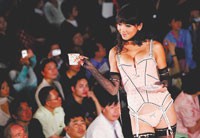
Shanghai Mode, held at the Shanghai Exhibition Center on Oct. 23 and 24, opened with two fashion shows with a Marie Antoinette theme and staged at the Shanghai Concert Hall. The exhibition attracted a total of 4,124 visitors, up 18 percent from last year. Of those, 65 percent were from mainland China; 6 percent from Hong Kong; 5 percent, Japan; 4 percent, Taiwan; 2.5 percent, France and 2 percent from the U.S.
“There is still the expectation that this is a regional show,” said Roseanne Barnet of Invista, which sponsored Shanghai Mode both years and also exhibited this year. “If it becomes more international, then it will need more service for non-Chinese attendees.”
Related Articles
You May Also Like
While Eurovet stressed that the show is already international, attendance figures and participant feedback suggested otherwise. “We support a lot of fabrics and trends shows,” Barnet continued. “This is more regional, but that’s what we need. We invented this category, so we are proud to sponsor it as it is our heritage.”
Barnet added that Shanghai Mode had “improved 1,000 percent” from 2005. “It’s more focused, with better representation of manufacturers, and more international.”
“Venue and hardware are the number-one issue,” she said. “Most shows start with the hardware, and gradually develop the software, but here they started with the software. The show can’t grow if it stays [at the Shanghai Exhibition Center]. It’s not an exhibition space, and it’s not visitor friendly. You can’t display in a professional way. If they address the venue issue, they could attract a lot more people. It has the potential to be a very important show for the industry. Also, it needs more than two days. It’s so new, as it grows it will become more smooth.”
Her complaints about the venue were echoed by a spokesman for Oleno, a high-end Chinese lingerie brand based in Nanhai. “The layout is bad, with only one entrance, it really needs two, and overall the set-up could be better,” the spokesman said. “Still, it’s really quite good for a second year, so next year should be even better. The best thing is the caliber of the buyers, they are both professional and high quality.…Customers are of a higher standard, if you’re here then you’re in the industry.” However, Oleno had several other criticisms, including the content of the forums.
“We came because it is very professional,” said Liao Zhangyi of Chinese lace producer Jinsu. Like Oleno, Jinsu participated for the first time this year but had attended as a visitor in 2005.
“We’re here looking for new customers for export,” Liao explained. “If there are a lot of foreign buyers, we consider a show good.”
She added that Jinsu focused on Southeast Asian and European markets, partly because of U.S. trade barriers. That reason was commonly cited for Shanghai Mode’s low North American participation, consisting of one Canadian exhibitor. Of the exhibition, Liao said, “Shanghai has good fairs, but there are a lot of exhibitions now so it is hard to get to them all. It’s hard to become like the Guangzhou Fair, which has a long history, while this is only in its second year.”
Oleno was one of 30 companies exhibiting in the exclusive Private Lingerie section of the fair, which was segmented into two parts, one invitation-only and another appointment-only. Oleno was in the former, and the company’s spokesman complained about being denied entrance to the latter. “It’s unfair: the foreign brands can see our booths, but we can’t see theirs.”
Hebert explained that some brands “had asked for one-to-one meetings only, [so] we organized for specific meetings for them. As you have noticed, there was less attendance in the private lingerie club because those who were accepted had scheduled meetings. There were also international brands together with the Chinese brands [in the open area].
Shanghai Mode Lingerie will next be held in October, remaining at the Shanghai Exhibition Center. In addition, Eurovet plans to launch a Hong Kong lingerie fair in March.