
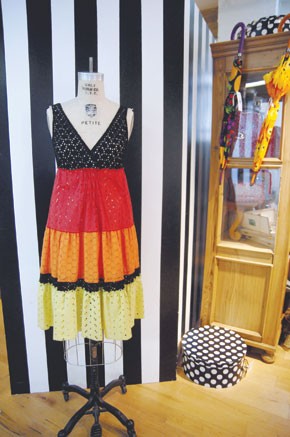
BOSTON — Designer Sara Campbell specializes in cheery frocks with flowers and polkadots, so it’s a good thing she hasn’t become cynical.
Not that Campbell hasn’t had good cause.
In the past two decades, the veteran designer, 50, has survived a $2.3 million corporate embezzlement for which her former brother-in-law was convicted, the collapse of New England’s last bastion of garment production in Fall River, Mass., and the shift in her company’s lucrative private label work to overseas factories.
Those forces combined to deflate the company’s revenues from $20 million in its Nineties heyday, when it pumped out private label dresses for Laura Ashley and others, to about $7 million.
Campbell and her partner, Peter Wheeler, who have co-owned the Sara Campbell business here for 25 years, hope to rebuild by positioning their two lines, Sara Campbell and Sara Jane, as important dress and skirt resources for boutiques. The firm opened its first New York showroom in February in an attempt to reach more buyers.
Boston, however, remains home base. None of the past turmoil is evident in Campbell’s two-story, red brick building in the South End neighborhood. The office and studio occupy the second floor; the first floor is a store that’s a girly festival of spring dresses, matching coats, striped umbrellas and chunky, Fifties-style glass jewelry. Her sensibility is part Lilly Pulitzer, part “Ya-Ya Sisterhood,” and, unsurprisingly, she has her strongest following in the South. Sitting in the office she shares with Wheeler, Campbell described herself as being on the cusp of Act Two.
She is working to brand Sara Campbell and Sara Jane through a relaunched Web site (e-commerce is planned for next year) and a newly hired marketing and public relations team.
Buoyed by the unexpected success of their store — which has flourished despite being tucked into a quasi-industrial backwater without parking — she is contemplating another location. In May, Campbell will begin Harvard University’s Owner/President Management Program, a three-year commitment during which she will spend several weeks a year living in Harvard dorms with other entrepreneurs from around the globe. She hopes the program will bring fresh ideas about how to navigate an industry increasingly split between small firms that service boutiques and big-business private label.
Related Articles
You May Also Like
“The industry is going like this,” Wheeler said, forking out his hands to illustrate the divide. “It’s very hard to do both private label and your own line well, but we need both. Private label generates cash, but there’s no security in it. As a third-party vendor, when business gets tight, you’re in the riskiest category” for cuts.
Half of company revenues, about $3.5 million, come from the private label work that Wheeler oversees. Talbots is the biggest and longest-running customer.
Both branded collections cater to an unabashedly girly shopper who likes bows on patch pockets, ruffles at the hemline and items that coordinate.
“Bows, pleats, covered buttons, piping and little clusters of detail,” Campbell said, reeling off treatments she believes add value and makes a garment feel special. She’s unswayed by the darker palette and baggier silhouettes in recent seasons.
“My customer loves color,” Campbell said. “We want to build a brand so we’re not taking our eyes off this customer.”