
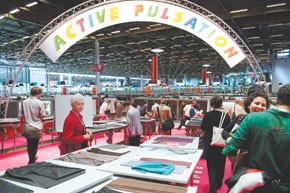
PARIS — Lower-cost fabrics from Asia might be losing their luster as textile companies turn back to higher-quality goods, said executives of the Première Vision textiles trade show, which opens Feb. 20 in the Villepinte fairground.
Textile companies that had transferred all sourcing to Asia are repositioning portions of their supply chain in traditionally more expensive countries, said Daniel Faure, president of PV. Talk among brands centered on the return to better quality sources during PV’s companion show, Première Vision Preview, in New York on Jan. 24 and 25, Faure said. Attendance at that show was another indicator of the reemergence of European mills; the number of visitors grew 14 percent compared with last year to reach 3,300, he added.
“Some companies have experienced problems of quality or nonconformity to standards,” Faure said. “The price factor is still very important, but it can lead to complications. For European suppliers, this shift is a good sign. We hope it’s going to continue and that Europe keeps its renown for very cutting-edge, very targeted fabrics.”
International preregistration for the four-day show in the Paris suburbs is up, and European preregistration is down slightly.
“From one session to the next, the number of international visitors continues to climb,” said Faure, adding that the PV preview show in New York was increasingly recruiting U.S. visitors to the larger Paris edition. “New York is very much a preview, the perfect season opener. Even more Americans are visiting Paris, which is not thanks to the dollar, but to the quality of products here.”
The latest edition of PV is expected to welcome 700 weavers; 20 of them will be new, from Italy, Spain, Japan, Brazil, Turkey and Greece.
“Italy remains a very important country, number one in the world [for high-quality fabrics], and they find international buyers at PV that they don’t find at all the salons,” Faure said.
An eco-friendly message promises to be a dominant theme among many new exhibitors.
“There is a fairly strong demand for so-called ‘responsible fabrics,'” Faure said. “While it cannot become the entire market — wool, for example, enjoys a huge image, yet only represents 2 percent of the worldwide market — there is the same evolution in terms of ecological fibers. They’re very sought after.”
Related Articles
You May Also Like
Faure suggested this was not a passing trend, since greater numbers of people are becoming interested in responsible fabrics.
“It is probably a lasting phenomenon,” he said. “You can feel it is beginning to enter into norms. Organic cotton is increasingly talked about and increasingly present. We are still a long way from all cotton being organic. That would be a big step, but perhaps we’ll get there.”
Running concurrently with PV will be Mod’Amont, where leather goods, accessories and trimmings resources are to be found, as well as Indigo for textile design and Expofil for yarn and fiber resources. Expofil is joining Mod’Amont and Indigo inside the PV exhibition space for the first time.
Rather than PV being open only to buyers on its first day, as in the past, the show will be accessible to all visitors for its entire four-day run. Another novelty this year will be a new pocket guide called “Paris by Première Vision” that highlights cultural hot spots and stores in the City of Light. These entries are organized using the same categories as the salon. A Chantal Thomass boutique, for example, will be classified as Fancy Seduction, where textiles such as silk, lace, embroidery, ribbons and fake fur are found.
“Eighty percent of our visitors are international,” Faure said. “Each season we’ll hand out a new guide for visitors coming to this immense city that is Paris so they can find something they would not have otherwise.”