
A curious thing happened on the runway this season. Amid the flurry of ruffles, precious Victoriana, pretty lace and eyelet cutouts, there was a mohawk.
A paper faux-hawk, to be exact, and it was at the Junya Watanabe show. Styled in a punkish manner, the models stomped the catwalk in black motorcycle boots and faces bound in plastic wrap. There were also hints elsewhere that this season would not be all frills: rock ‘n’ roll Ts at Balenciaga, reworked concert shirts at Undercover and a whole lot of punk rebellion at Comme des Garçons, where not a single garment was made from a pattern. Quelle revolution?
“It was a breath of fresh air,” says Julie Gilhart, vice president and fashion director at Barneys New York, of the riotous vibe that coursed, mainly, through Paris. “There need to be alternatives to make the whole thing work, and so, thank God that [these designers] were radical. They took risks and pushed an idea that was not in sync with what everybody was doing.”
Often, that rebellious yell took the form of reconstructed Ts that hewed close to rocker chic. “Everybody doesn’t want to be mainstream,” says Kal Ruttenstein, senior vice president for fashion direction at Bloomingdale’s. Adds Heatherette designer Richie Rich, “If the rules aren’t broken in fashion, then why do they exist?”
Step back from high fashion to the street, however, and this is a look kids have mined considerably of late, to the point that some retailers are already dubbing it passé.
“Have the cycles become that short?” asks Kristi Paras, owner of the Greenwich Avenue shop Zachary’s Smile, a vintage haunt with its own line of reworked garments called Zachary’s Smile Original. “For our customer, it’s completely played out. They were wearing that two years ago.”
“It just doesn’t feel current,” agrees Leslie Gardner, designer and owner of the L.A.-based Smashing Grandpa, who worked the look back in the Nineties.
But don’t think it’s a case of the designer circuit coming in a few seasons too late. There’s something to be said for a look with enduring popularity, so much so that one could almost call its roots classic.
Related Articles
You May Also Like
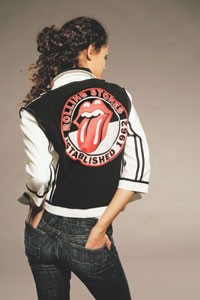
“At the end of the day, the music lives on,” explains Brad Beckerman, founder and creative director of Trunk Ltd., which holds the license for a number of rock-branded shirts, like those for the Rolling Stones. “Classic rock ‘n’ roll groups, they’re not bands, they’re brands, global brands.” Although Beckerman doesn’t delve into deconstruction, his point explains the rock undercurrent pulsing behind many a fashion season. “When are the Sex Pistols, the Rolling Stones, David Bowie going out of business?” Beckerman says. “Never. Never, never.”
“It’s something that never sort of went away,” agrees Laura Wills, owner of Screaming Mimi’s on Lafayette Street in New York. She has noticed, however, increased interest in Eighties punk styles among her staff and customers. “You started seeing it with a few kids from Europe, especially the Swedish kids, and in bands like [the German alternative rock group] Lip Service. It’s just manifested itself in different garments and different ways.” Cases in point: Alice + Olivia’s spring collection, which includes a number of sexy and shrunken blazers lined with vintage concert shirts, as well as designer Eve Chrust’s upcoming series of dresses made from vintage Grateful Dead shirts for her line Eve*Lynn.
It’s a look that’s classic, you could say, precisely because designers aren’t regurgitating the reconstructive motifs of yesterday. Yes, it’s been around, but those Paris houses, for example, worked a balance between edge and polished chic for spring. “I find them beautiful and sophisticated, not aggressive,” says retailer Linda Dresner. “It’s not a throwaway idea of what clothes can be. Those oversize T-shirt dresses [from Undercover]; I think the idea of a girl wearing that in the summer with flip-flops shows a real sweetness.”
Even Watanabe himself questions the punk label that’s been oft-applied to his recent collection. “Are the Mad Capsule Markets ‘punk’?” he asks of the Japanese rock group (frequently misnamed in the press as “Mad Capture Maggots”) that inspired his collection. “It depends on the listener to decide. What I put out there is simply what I felt at that moment.”
“You break it down and they’re great, great pieces,” Gilhart adds, citing Watanabe’s cutaway khaki trenches as one such example. “And the T-shirt dresses, they’re deconstructed but cut and fitted and made in a genius type of way — you know you’re getting a finely tailored garment. Deconstruction’s changed. It’s gotten to be more polished.”
Polished as well as de- or reconstructed? It’s no longer quite the oxymoron. “It’s not so raw anymore,” Rich says. “I think it’s good for one to always evolve.”