
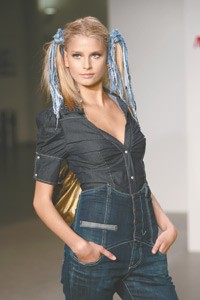
Innovations in premium denim — from low-rise and over-embellished styles to whiskering and abrasions — have been easily adapted across the broader denim spectrum, helping to propel booming sales over the last five to seven years.
This fall, however, premium players concentrated on skinny cuts and dark washes, trends less accessible and more difficult to translate to the masses. These factors, combined with a saturated market, might explain tempered sales. With looks from this season’s New York runway shows emphasizing high waists and suspenders, the premium tier’s power to energize the overall denim world might be waning.
The denim market remains potent, but the double-digit growth rates that made the segment so appealing to hundreds of brands have disappeared. Sales of women’s jeans in the U.S. this year reached a total of $4.32 billion through Aug. 31, a 1 percent decline from the $4.37 billion reported during the same period last year, according to NPD Group, the consumer and retail information company.
The department store channel was the most challenging. Sales of women’s jeans at department stores fell 12.1 percent to $671.6 million for the year through Aug. 31 from $764.1 million last year, NPD Group said. Specialty stores and online sales were the strongest, rising 5.9 percent and 13 percent, respectively. In comparison, sales of women’s sportswear — including denim — in department stores for the same period fell 4 percent to $9.32 billion from $9.7 billion.
Skinny styles presented a challenge largely because of concerns over fit, said Scott Reffsin, vice president of sales and marketing for LTB by Littlebig. As a result, the trend took longer to catch on.
“We brought in a couple of fits with skinny legs and high waists in the late summer last year,” said Reffsin, adding that those styles “sat dormant” for the last five months. “We were either early or people didn’t expect them from LTB.”
In the last two weeks, however, Reffsin said those same styles have started to sell as women have seen more people wearing skinny jeans. They’ve also become more confident that the look will be available in their size.
“Initially, they were shy because they were worried about fitting into it,” Reffsin said. “I think the woman is realizing that, even though she’s not a size 26 or 27, she can find her size. At least she can wear it, she can put a skinny jean on and put it on in her size.”
Related Articles
You May Also Like
The rising demand has forced a shift in LTB’s product assortment from its traditionally heavy focus on boot cuts and flares. Reffsin said the product range at one point was around 90 percent boot cuts, with only one straight-leg style. The brand has shifted to 30 percent skinny styles and 70 percent boot cuts, as well as launching a high-waist style and a capri at the Project trade show last month.
“Will it be a focus or a substantial part of the larger denim industry?” Reffsin said. “I don’t think so, because even for us, it will be minimal. But we are getting calls on it.”
Michael Silver, president and founder of Silver Jeans, who participates in the premium segment with his 1921 label, views dark washes, skinny cuts and high waists as three distinct trends that must be looked at independently in order to gauge their potential impact on the overall market.
Dark washes, for instance, present the least resistance in terms of consumer acceptance.
“We’re getting pounded by magazines with celebrities wearing dark skinny jeans,” Silver said. “The palatable side will be the dark style through the next six to eight months that can translate…that’s real and will have an effect on the mass [market].”
Skinny cuts have “died on the vine” outside of the premium segment, said Silver, who believes the celebrity media focus on skinny styles will have some degree of measurable impact.
“The wider bottoms are narrowing up,” Silver said. “Will it ultimately result in narrow skinny jeans being worn by the masses? I don’t think so. I think they’ll get to a straight leg and that’s where it will stop.”
The trend toward high waists is the most interesting for Silver. In much the same way that skinny cuts in premium will translate into straight-leg styles for the larger denim market, Silver feels high waists will allow manufacturers to get away from low rises. Perhaps more importantly, he believes it will give manufacturers a chance to win back a portion of the market that hasn’t been addressed for several years.
“I have a feeling that [the high-rise jean] is going to be a relief for some denim makers,” he said. “They can raise rises and get back to a certain customer that they had alienated. I think in the mainstream market you’re not going to see superhigh rise, buy you’ll see some incremental rises.”
Denim buyers and retailers have been hunting for the next trend direction for several months, according Brian Hogan, president of Modamood, the New York-based wholesale distributor for Replay jeans.
The high waist is the result of “trouser-influenced silhouettes being introduced in the denim world,” said Hogan, who believes the impact will be similar to that of the skinny jean. “The skinny was new and fresh, but it’s not for everybody. I think now we’re going to see the same thing with the high waist. Its fresh and new, but is it going to retail?”
The challenge for denim brands operating at any price level will be how best to adapt the runway looks to their customer, said Jennifer Wade, brand manager for the Lee Authentics brand. Details such as washes, embellishments and abrasions are easier to emulate, Wade noted. It also takes mass market manufacturers longer to adapt runway styles to their customers, but Wade said they always do, eventually.
“Things that are difficult to wear outside of that model body are not going to hit the masses in a typical way, but it will be there,” said Wade. “The Lee U.S. brand will tweak it to fit our customer. We’ll raise a rise here and there, we’ll bring in a boot cut. It’s not like you won’t see a skinny at Kohl’s or J.C. Penney.”
Wade said the Lee mass business has been booming and that drastic denim styles in the premium segment, such as a skinny or a high waist, actually spur sales.
“The women that shop our tier gravitate to what works for them in times like this,” Wade said. “They know they can’t pull off a superhigh waist or suspenders, so they’ll stick with what they know. Part of it is that things have gotten so trendy that people are terrified.”