
PLANO, Tex. — J.C. Penney is heating up the private label game by taking a new approach.
With unprecedented speed, and rather stealthily, the retailer last month launched the casual collection a.n.a in its more than 1,000 department stores in misses’, petites and women’s sizes. The moderately priced collection’s official coming out will take place at the Academy Awards on March 5, when Penney’s will run its first a.n.a ads, to be followed by an eight-page mailer about a week later.
Penney’s executives are confident the line has the DNA for major volume.
“This is our largest single women’s launch,” said Ken Hicks, president and chief merchandising officer, during an interview with the a.n.a team here. “A.n.a has the potential to be as large or larger than Worthington,” one of the store’s other private label brands that generates an estimated $700 million to $800 million in annual sales.
But there is plenty of competition. A.n.a will most directly go up against lower-priced chains such as Old Navy and New York & Co., and against Wal-Mart’s Metro 7 brand, launched last October, which is priced about 25 percent below a.n.a, and expects to have sales of $200 million in the first year.
Throughout the retail industry, there’s been a buildup of private label, and it’s most noticeable among Penney’s closest rivals. At Federated Department Stores, private brands account for about 20 percent of volume, excluding May Department Stores, which had about half the private label percentage and was acquired by Federated last year. This fall, Federated will begin to stock former May locations with its private brands, such as INC and Charter Club. Kohl’s has an estimated 15 percent of its sales volume in private label and is also seeking more exclusive merchandise. And Sears Holdings is building up its in-house design team and doing more direct importing for its private labels.
Customers are referring to a.n.a as Ana, though inside Penney’s a.n.a stands for “a new approach” and reflects the store’s efforts to hone its broad stable of private brands. Cycle times are being reduced to four months from seven, largely through the creation of in-house design teams, an ongoing process that started about three years ago, and also through the use of spectrophotometers, a color measuring technology that enables the home office to view and approve colors on products being manufactured overseas without having to ship samples to Plano. Also, Penney’s is using its clout to secure factory time and fabric positions early on. After conducting focus groups, Penney’s committed to launching a.n.a last July, and had it in resort locations in November and all stores last month.
Related Articles
You May Also Like
In the past, launches of Penney’s private brands never came out of the gate with chain-wide distribution, typically being restricted to at most a few hundred locations for a season or two before going national. Penney’s Bisou Bisou label, for example, started with 300 stores, and still isn’t in all the retailer’s doors. But with a.n.a’s casual approach, “We really felt that we had such a big niche for this business,” said Liz Sweney, executive vice president of women’s.
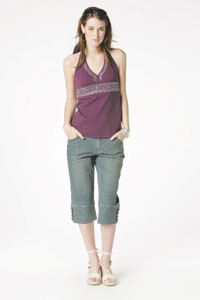
Executives described a.n.a as “modern, easy to wear and comfortable” and the casual counterpart to Worthington, which offers modern career clothes. A.n.a, which also is available in Penney’s spring-summer catalogue and on its Web site, takes a more feminine approach than the typical Penney’s presentation, with detailing and embellishment such as blouses with picot, skirts with handkerchief hems, crocheted shrugs, tunic-length tanks with lace on top, slim knits belted over wrap skirts and city shorts. Items can be mixed and matched to create outfits.
Denim, knit and woven pants, espadrilles and skirts are key components; the collection is priced from $18 to $80, with a two-piece outfit generally costing about $50. Penney’s says its “smart” prices aren’t necessarily the lowest, but offer strong value, with bottoms priced $36 and $30; tops, $36, $24 and $22 and tanks and camis $22 and $18.
Arizona, St. John’s Bay and The J.C. Penney Home Collection are Penney’s largest in-house brands, each exceeding $1 billion in annual sales. Volume for Stafford, a key Penney’s private label men’s wear collection with traditional styling and an emphasis on dress shirts, suits and sport coats, is in the same range as Worthington. Penney’s began offering private brands in 1914 and currently offers 25 of them. They account for about 40 percent of the chain’s total sales.
Penney’s private brands are being given sharper identities for “lifestyle merchandising” and executives are more confident they can deliver relevant fashion at “smart” prices. For example, St. John’s Bay, primarily for traditional looks with little embellishment, dabbled with some modern casual looks that diluted the image and confused customers. “It really didn’t have a lot of clarity to it,” Sweney said. Now with the introduction of a.n.a, St. John’s Bay has shed its casual component. “We’re not downplaying St. John’s Bay at all, but by having a brand that’s true to itself, rather than soup to nuts, we really bring it to life,” Sweney explained. “Lifestyle merchandising is somewhat of a buzzword in the industry, but we are serious about it,” she added.
With a.n.a, Penney’s now promotes four lifestyles through private brands. A.n.a is displayed in the front of the store on the left as shoppers enter, and in Penney’s larger or “A” locations, there are 30 racks, known as four-ways, displaying a.n.a in misses’ sizes and occupying about 1,500 square feet. Petites and large sizes each have six to eight four-ways, for another 800 or so square feet. The front of the presentation, or about 25 percent of the space, will be changed every month, with 12 to 16 new pieces flowing in. Considering a.n.a’s prominent footprint, the brand’s graphics lack drama and appear small, especially in light of how some of Penney’s other in-house brands, such as Nicole by Nicole Miller, are presented. However, Sweney said change is on the way. “We are adding a huge 40-inch by 60-inch lifestyle collage,” she said. “The name will be very prominent.” Also, “brand carriers” which are fixtures for graphics, will be placed on the floor.
“The way we are executing is different,” said Sweney. Aside from the flow, the photography on graphics and choice of models is different, with models depicted beside sports cars or in country club settings to emphasize a lifestyle. Whereas retailers’ private brands have a reputation for copying designer looks, according to Brian Deleu, lead designer for a.n.a, “This is truly a designed brand. We are not getting samples from Tommy [Hilfiger] and knocking off.”
Penney’s private brands are situated front and center — to the right of a.n.a at the store entrance is Worthington, and Nicole by Nicole Miller and the trendier Bisou Bisou are just behind. The company is contemplating brand extensions with its private labels, including an upcoming Miss Bisou collection for juniors.
“Will private brands be the predominance at Penney’s? Probably not,” Hicks said. However, he did say there could be significant percentage gains, but most likely not to the point where private brands represent more than half the chain’s volume. “There is no target,” for how big a piece of the business private brands should represent. Penney’s executives are confident that 80 percent of its assortment (private and national brands) is strong and see “wiggle room” in the 20 percent that’s less important and to some degree expendable.
“Private brands are a key strength for … Penney, and a.n.a is by far the largest brand launch we’ve ever undertaken right out of the box,” Myron E. Ullman 3rd, chairman and chief executive officer, said in a statement. “The line was developed based on clear feedback from our customers, who wanted a fun line of fashionable casual and weekend wear. With the strength of our design team, our worldwide sourcing organization and an industry-leading planning and allocation infrastructure, we were able to develop the right product and bring it to our customer across all of our distribution channels in record time, the fastest in J.C. Penney’s history.
“The response from customers has been outstanding,” Ullman added. “By achieving much faster cycle times, we expect to be able to keep fresh new styles on the floor at all times.”
“Customers told us they were looking for something beyond basics with more style, more fashion detailing and a modern fit,” Hicks added. “This brand is for the fashion-conscious woman who is self-confident and who keeps her wardrobe updated. She likes to see outfits pulled together in the store so it is easy for her to understand and easy to shop.”
Asked when Penney’s will decide if a.n.a will be a permanent fixture in the private brand stable, Hicks replied, “We really have to give it a couple of years to know. A brand could start slow and take off, or it could start great and slow down.”