
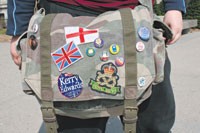
When Richard Flacks first arrived for his teaching position at the Santa Barbara campus of the University of California in 1969, he wore his hair neatly trimmed and short. Soon, however, he began lengthening the time between trips to the barber.
“I always [looked] pretty straight,” says Flacks, a professor of sociology who helped found Students for a Democratic Society while attending the University of Michigan in 1962. SDS was the largest and, arguably, the most influential activist student organization of that era. “But out here, the sense of a counterculture in terms of how you dressed was so strong. If I presented myself as a very short-haired guy, a lot of kids wouldn’t even know what to do with me. It was such a belief for a while that ideology and appearance were one thing. Later, those connections began to snap. You know, people saw that narcs could wear their hair long.”
More than three decades later, those connections have not only snapped, but, in many cases, disappeared. When it comes to the current state of sartorial rebellion, it seems that very little is black and white.
“I think our generation has grown up in this culture where subcultures have already been commodified,” says Kate Meyer, editor in chief of New York University’s daily newspaper, Washington Square News. “Whereas if you lived in the Fifties or Sixties, you really were doing your own thing…that was taken from you and sold in the mainstream. Now, you see people who, at 12 or 13, are buying Goth stuff at Hot Topic, and that’s become part of their personal experience and fashion.”
Meyer makes a valid point. On countless college campuses across the U.S., varying incarnations of past subcultures — some dating back to the Fifties — still exist. (Others are even older: At Brigham Young University, members of a student group called The Quill and the Sword dress exclusively in Medieval costume.) Along with the poetry-reading cafe-dwellers who identify with aspects of the Beat Generation, there are also the hacky sack-playing hippies, the pierced and dyed punks, the morose Goths and those who continue to carry the flannel-wrapped torch of the grunge era. More often than not, however, students pick and choose elements from various styles.
Related Articles
You May Also Like
“There’s a trend that’s been happening for quite a number of years called Multiple Identities,” explains DeeDee Gordon, founder of Look-Look, a youth-marketing company. “It refers to the ease that young people have going in and out of different identities.” This is, after all, a generation that grew up watching Madonna don and shed multifarious personae at a rapid pace.
In a similar vein, Gordon says the fusion of different styles can form hybrids, such as the preppy-punk look or the punky hip-hopper. Looking around a college campus will reveal the same: love beads paired with a college sweatshirt; a Ralph Lauren polo with popped collar worn by a girl with a tattoo. In fact, when it comes to dressing in less-than-mainstream fashion, students are not identifying with a group; they’re focusing on the cult of individuality — another trend that Gordon frequently sees.
“There’s a lot of DIY. It’s all about personalization and customization,” she says. “Being able to look fashionable and still unique.”
Take the case of Rachel Jave, a senior at the University of Minnesota. Her punk roots are evident in the tattoo of a lilac on her left arm, her dyed black hair and the chunky flashes of silver in her nose, ears and lower lip, but she hesitates to categorize herself. “My style varies from day to day,” says Jave, who on this day sports a windowpane-check shirt that she crafted from a thrift store housedress, cuffed dark jeans and preppy navy-and-white slip-on sneakers from Old Navy. “I’m not trying to make a statement.”
Perhaps because of the ease with which costumes are created, often the only common ground between decades-old subcultures and their current incarnations is the aesthetic. There is no guarantee that the long-haired girl with the flowy printed skirt and Birkenstock sandals cares a whit more about peace and love than her classmate dressed in an American Eagle hoodie and a pair of Sevens.
“The politics are out of clothes,” says Joseph Heath, an assistant professor of philosophy at the University of Toronto and co-author of the book “A Nation of Rebels: Why Counterculture Became Consumer Culture.” “Nobody thinks that how you dress has political consequences. So often you can’t guess what people’s politics are by looking at what they’re wearing.”
However, according to Heath, such a cultural twist is a good thing. “The message now is, if you want to do politics, you actually have to read a newspaper and get involved in a political party,” he says. “Forming a garage band is not politics. But that’s what people were told, that having crazy sex [and] doing drugs was all political.”
Today, it’s obvious that student activism has dropped since the campus clashes with authority during the Vietnam era, but it is by no means nonexistent. In fact, owing to the war in Iraq and last year’s presidential election, student activism is on the rise. Consider the “Deanie Babies” phenomenon of 2003 that harnessed an impressive amount of student support for Democratic presidential candidate Howard Dean on a grassroots level and counted 1,133 chapters nationwide.
Campus protests are far from passé. Students who swing both left and right make their voices heard — from the 250 Wesleyan students who stormed the college president’s office with a list of demands regarding university accounting practices to the College Republicans at the Madison campus of the University of Wisconsin who rallied against Michael Moore’s visit. In fact, much has been written about the new strain of conservatism spreading across campuses, fed by reactions to what some view as the liberal slant of the academic world.
But don’t think that you’ll be able to decipher the fledgling new right from their lefty classmates based on their outfits. Andrea Irvin, a senior at the University of California at Berkley and the president of its College Republicans, for instance, describes her style as “typically preppy,” but the rest of the group is a different story. “For every person who wears Ralph Lauren, there’s someone buying stuff from Hot Topic or a thrift store,” Irvin says. “Everyone has a different way of expressing themselves. We cater to that, and that’s what makes our organization successful.”
It’s a similar scene on the left-leaning Wesleyan campus in Middletown, Conn. “There’s a small undercurrent of Republicanism on this campus,” says junior Thomas McAteer. “But you’d have a hard time picking them out because they’re just as crazy as everyone else.”
And on the conservative Salt Lake City campus of Brigham Young University, where 98 percent of the student body is Mormon, there are diverse styles. “Vintage is definitely all the rage here. And I have a lot of friends who are punk-Goths,” says junior Megan Stoker, who also reported on the Web-based club Misfit Mormons for BYU’s newspaper, Daily Universe. Nevertheless, neither Stoker, the club, nor those on campus who sport dyed hair and piercings run contrary to the reserved teachings of the Church of Jesus Christ of Latter Day Saints. “I’d say a good 70 percent of us are very conservative,” notes Stoker. “And I’ve never had a class from a liberal professor.”
Some observers attribute the broad spectrum of “alternative” style to the general culture of acceptance and the fact that little today is shocking. Others credit modern technology. “When I was growing up in the Seventies, you had to work to get information on what was cool. And then once you had it, it was good for about six to nine months,” says author Heath. “MTV started to change that, and then the Internet blew it wide open so that, if anybody anywhere in the Western world is doing anything vaguely cool, everybody can find out about it instantaneously. It’s not possible to maintain a real counterculture anymore.”
Other WWD THE COLLEGE ISSUE articles
Students of Style
Beauty Trial
Runway 101
Math Course
From the Heartland
Operation Girl Shop
Students of Style: Extreme Makeover … Women’s Studies … Rushin’ Dressing
Closet Cases