
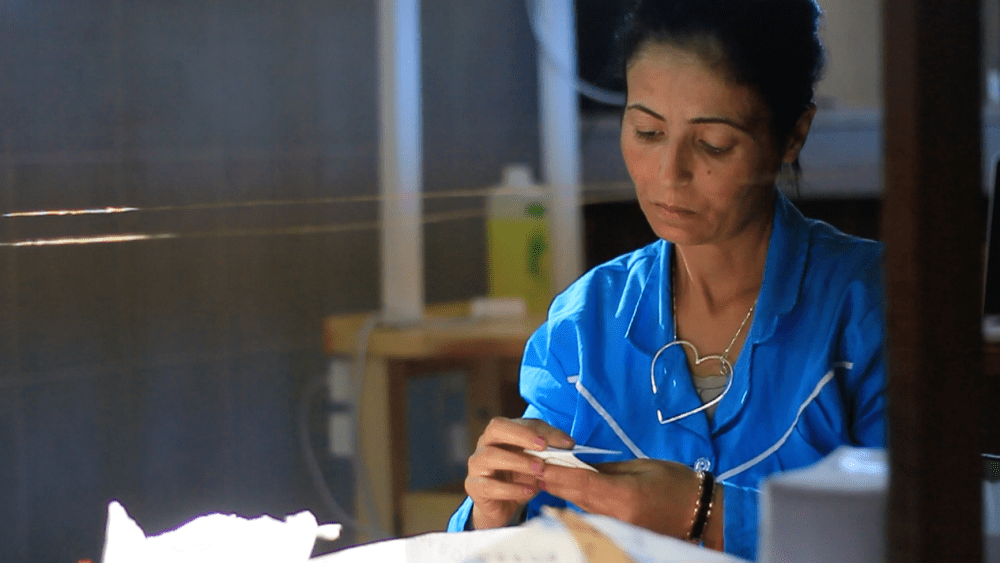
As the first designer to be supported by Fashion 4 Development’s ModaCares foundation, See Me founder Caterina Occhio aims to scale up her fair trade-certified luxury jewelry company and in the process would further sustainable employment for the domestic violence survivors who produce her goods in Tunisia.
In a joint interview Monday morning with F4D founder Evie Evangelou at the Core Club, Occhio spoke about how her 15 years as a European Union team leader who managed projects about employment strategy and gender issues in Russia, Belarus, Armenia and Uzbekistan, and other regions made her want to take a more active role in improving women’s lives. Recalling that her first European Union-run trip to Tunisia had an 85 million euro, or $93 million, budget to support the initial employment strategy, she said she asked herself, “‘What are the names of the people who will benefit from this?’ There were a lot of faces but it was [only] a number, so I decided to give a face to the numbers.'”
Related Articles
Relying on a 10-person team who live in a Tunisia women’s shelter to make her heart-shaped See Me jewelry, Occhio has sold about 3,500 units since starting her company two years ago. With distribution in Colette, Galeries Lafayette, Joyce in Hong Kong and other leading international stores, she is intent on selling See Me in the U.S. While the brand’s oversize heart-shaped items are currently made with a North African technique, she envisions introducing other products using the skills that are authentic to other regions of the world that are also made by women who have overcome violent experiences.
You May Also Like
One in three women is a victim of violence, according to the United Nations, Occhio said, even though many don’t always realize that. “When I asked women in Turkey if they were victims of violence, they said no. I said, ‘Let me rephrase that. When your husband has been drinking a lot and comes home, does he beat you up?’ And they said, ‘Yes, of course, but that’s normal.'”
Beyond providing employment, Occhio’s company has helped to get workers identification cards so that they can vote in government elections, and has assisted them in opening their first bank accounts. In one instance last year, a worker’s son was kidnapped by relatives and Occhio said “they had to move mountains to get him back. But she had to leave the workshop to return to Morocco where she was from in order to be safe.”
Evangelou said Charlize Theron recounted an incident to her at last year’s F4D luncheon in Vienna. “Charlize said that a little boy in South Africa told her,’I wouldn’t hit you because you’re a star.’ And she asked, ‘Why? Would you hit another woman?’ and he said, ‘Of course — that’s what we do.'” Evangelou said, “This was an eight-year-old boy.”
Given the widespread violence against women, she and Occhio are considering opening a workshop in the New York garment center run by women who have overcome abuse. They may call on contacts in the Obama White House and through the Clinton Global Initiative for support. “Rana Plaza [in Bangladesh] was a big wake-up call for the fashion industry. Livia Firth has also been a strong advocate [for ethically sourced and environmentally sound goods],” Occhio said. “But the consumer needs to be more involved. It’s not their fault. They have to hear and see more about it to understand it.
“They have to understand that everything they’re wearing is made by hands – by people whose life should be as good as the lives they’re leading,” Occhio said
The brand’s socially minded message, as seen on Seeme.org, has appealed to fans like Angela and Rosita Missoni and Laudomia Pucci, Occhio said. Her design consortium has also been enlisted for collaborations with Tommy Hilfiger, Karl Lagerfeld and Missoni. The Tunisian workers created ethically sourced stars for a Tommy Hilfiger show last year, a micro-crocheted capsule collection for Karl Lagerfeld and linings for Missoni dresses last year.
To underscore how fashion’s aspirational power is not solely materialistic, Occhio said that one of the women she worked with who lives in a shelter in Mersen, Turkey kept a Vogue cover posted above her bed. “It is phenomenal to think this was a reminder to her to be proud of her beauty,” Occhio said.
Evangelou agreed, “No matter what the social issues are, fashion can be a hero.”