
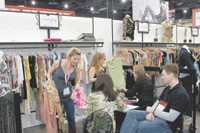
Denim will always have a place, but show exhibitors are expanding into different, more feminine looks this August.
Down the runways they’ve marched in the past two seasons — shifts by Chloé, embroidered lace frocks by Donna Karan and jabot-accented sheaths at 3.1 Phillip Lim — and interest in ladylike dressing only intensifies as designers continue to pour on the sugar and spice.
As shoppers make room in their closets for dresses and clothes that trumpet their femininity (gently pushing aside the accumulated denim), retailers and vendors attending WWDMAGIC are taking notice.
“We’re broadening our scope and taking dollars from our Gothic lines to more feminine looks…like clothes with fabrics such as satin and lace, and kimono tops and tunics,” said Oren Hayun, co-owner of Planet Funk, a 16-store chain of contemporary stores based in Los Angeles and known for its powerhouse denim labels, including Frankie B, Citizens of Humanity and True Religion. “We’ve seen strength in dress sales, such as those by Free People, and we think it will carry over into next spring.”
Hayun said he plans to devote 10 to 15 percent more dollars to the dress business for spring while scaling back denim purchases by 10 percent. Denim sales in terms of unit count at Planet Funk are flat compared with last year, he said.
The heat of competition in the denim marketplace has caused some brands to rethink their jeans strategy. Pure players are winning out over those that have flirted with the trade, and many labels are now
emphasizing their nondenim bottoms.
Los Angeles-based Single, a contemporary line known for its lively runway shows, walked away from denim last year, said co-owner Galina Sobolev. Bottoms now account for about 10 to 15 percent of the collection compared with other styles, such as skinny gabardine pants and slim cropped shorts in white denim or stretch cotton poplin that account for 40 percent of the line.
“We just didn’t think that denim is a category for us that needs to be addressed,” said Sobolev, who welcomes the design shift away from dungarees. “We’ve seen a disregard for dressing up; it’s been more of a dash-and-run attitude. It’s wonderful to see women now dressed up — not quite the ‘Dynasty’ of the Eighties, but a perfect balance of what I call ‘relaxed fashion.’”
Related Articles
You May Also Like
Single’s focus at WWDMAGIC will be on its core businesses of dresses and tops, featuring Italian cotton eyelet halter dresses, button-down shirt dresses with wide waistbands, silk chiffon dresses in scarf prints and kimono tops, which wholesale between $111 and $148. Borrowing inspiration from Biba, the hot British boutique label of the Sixties, Single will offer a short A-line dress with billowy chiffon sleeves.
Although BCBGirls isn’t reducing the amount of denim it plans to bring to WWDMAGIC, it will “definitely” increase the number of dresses it brings for spring 2007, focusing on the shirt dress, the T-shirt dress and the off-the-shoulder body, said a spokeswoman for the brand. Its sister company, To The Max, is also ramping up its dress line for spring 2007, to 25 to 30 percent of the line, up from 15 to 20 percent last year. The dresses will come in a variety of fabrics, such as heathered knits, rayon jersey and crinkled chiffon, she said.
Barbara Lesser Fibers, which wholesales from $29 to $89 and sells to specialty stores, is adding about 20 percent more dresses to its spring collection. The Los Angeles misses’ line will emphasize soft dressing in the form of jersey, Supima cotton and ribbed knit dresses incorporating artisanal touches, such as novelty-dye treatments with
botanical effects.
“There’s less room for denim, but we’re still offering important bodies, such as slim, tight, cropped looks that pair up with oversize tops,” she said.
For brands that have staked their claim on the girl who’s traded in the grungy Ashlee Simpson look for the girly Ashlee Simpson, the spring 2007 season offers validation.
“I haven’t gotten into denim over the years and it hasn’t affected my business,” said Trudy Moylan, owner of junior brand Zoe & Sage, which sells to Planet Blue in Malibu, Calif., and Buffalo Exchange in Tucson, Ariz. Manufactured in Los Angeles and India, the line will offer flowy jersey skirts; dresses in kimono, tank and slip styles, and youthful thermals with unicorn appliqués.
Kenziegirl also addresses the sartorial needs of the “good girl,” according to Lani Karls, design director of the Vancouver, British Columbia, line, which sells to department stores including Dillard’s, Macy’s and Parisian. “She’s not so concerned with being overtly sexy,” Karls said.
That means she’s mixing cuffed city shorts with soft voile tops, pairing short dresses with leggings and layering long T-shirts with skinny pants and a trapeze jacket. Dresses at Kenziegirl include halter, spaghetti-strap and tube styles with ruching, tiny buttons, color-blocking and Asian prints.
Karls said the two-year-old young contemporary line, which wholesales from $10 for T-shirts to $45 for jackets, has streamlined its denim collection by 20 percent, refocusing on other looks, including miniskirts, skinny shorts and baggy cuffed shorts. “People are jeaned out and excited to have more pant options,” Karls said.
In its second season, Vancouver-based Kersh is appearing for the first time at WWDMAGIC with a young contemporary collection of jersey dresses and long, lean knits. The trick to making the sweaters ladylike and body-friendly is the use of organic yarns in bamboo, soy and organic cotton, said Sandy Dombrowksi, Kersh’s sales director.
“We’re striving for clean lines that echo back to Donna Karan and old-school Calvin Klein,” she said. Bamboo cardigans with fly-away sleeves, soy
cut-and-sew knits for layering and organic cotton chunky hand-knit sweaters are highlights of the collection.
Cocktail gowns and evening separates, such as those in Badgley Mischka’s Platinum evening collection, which wholesales from $200 for short cocktail dresses to $600 for gowns, keep their glamorous appeal with ruching, tucking, ruffles and vivid shades.
“Spring is about a color explosion in aqua, fuchsia and turquoise. It’s a lot more bright,” said Fran Ornstein, executive vice president of modern apparel for Badgley Mischka. “The customer is not afraid to wear [color]. Women will always wear black in the city, but in the rest of the country, she loves color in good taste.”
The WWDMAGIC show floor will still house denim companies front and center. Back-to-school’s tepid start has given some veterans the jitters, but they’re not retreating from launches. Following its kickoff at the recent August market, New York-based Deja Bleu, a nine-year-old manufacturer of private label denim for Alloy.com and department stores, will bring to the show its new junior jeans label, Original Threads by Deja Bleu.“I’m hearing from all my accounts that sales are slightly below flat,” said Mark Zimmerman, president of Deja Bleu. “It’s a little nerve-wracking, for sure…but you can’t walk away from what you do well.”
Zimmerman plans to stay in step with trends by creating darker washes for nearly 50 percent of the line and skinny legs for a dressier silhouette. To diversify his pants portfolio, he plans to allocate 40 percent of the collection to nondenim styles, such as stretch corduroy, stretch canvas, twills and beach-friendly poplin in pants, capris, above-the knee skirts and Bermuda shorts.
Confidence in denim centers on price, a point emphasized by Sam Moshe, owner of Jeans City USA in Miami, which sells to about 110 stores, including New York’s Mandee, Joyce Leslie and Strawberry outlets. Jeans City offers its junior denim adorned with oversize pockets, embroidery and rhinestones at wholesale prices of $10 to $11.
“There is no slowdown because we have a very creative product at the right price,” said Moshe.