
COPENHAGEN — Scandinavian design proved itself to be popular at the CPH Vision trade fair, where buyers lauded the labels on display for their style and affordability.
The salon, held here Aug. 10-13, showcased a large number of new designers who played with shapes such as oversize dresses in somber hues worn loose or cinched at the waist. Ecological materials such as bamboo and fabrics made from recycled plastic bottles reflected the Nordic love of nature, while accessible price points were a hit with retailers.
“Buyers are in search of a fresh alternative and labels from Scandinavia offer stylish creation and a very good price level,” said Jan Busch Carlsen, the show’s organizer.
Reasonable prices had retailers, who generally said they were increasing their budgets slightly over last year, opting to do some on-the-spot spending. While the recent terror threats, which crippled London’s airports, meant only a small number of U.K. buyers made it to the show, retailers from Scandinavia, the U.S., Germany, The Netherlands and Japan were out in force.
Attendance rose 9 percent over the 2005 session to 23,704 visitors, while 293 exhibitors from Europe, the U.S. and Japan were selected for the show.
The increased interest mirrors the upswing in Denmark’s fashion industry. After several years of a gradual market penetration and an injection of adrenalin in the youth fashion scene, Denmark’s fashion market has recently claimed fourth place in the country’s exports and is ranked just before furniture and design.
“The total population in Scandinavia is only approximately 20 million, so we cannot depend on the home market,” Carlsen said. “It is essential for brands to export.”
Underscoring Denmark’s enthusiasm for fashion, the country’s Princess Mary combed through the salon’s aisles, stopping to chat with those showing their collections. She also presented an award to the winner of Designers Nest, a fashion show of selected budding designers from Scandinavia’s leading design schools.
Retailers lauded the country’s newfound fashion fervor.
“There is a noted overall improvement in quality,” said Terry Ellis, chief buyer for the London office of Tokyo’s Beams stores, who placed orders with Ann Hagen, Baum und Pferdgarten and Iben Hoj. “Fabrics are more interesting and styles have evolved.”
Related Articles
You May Also Like
Charlotte de Staël, owner of Shine, a concept store in Trondheim, Norway, said, “There is a revival in Scandinavian fashion. Brands were too typically Nordic [in the past, whereas] now they are setting trends across the globe. What was once over-the-top Bohemian chic is now much more minimalist, with somber colors and interesting forms for a much more chic graphic look.”
De Staël said skinny pants paired with voluminous blouses and dresses are key directions for next summer and placed orders with Baum und Pferdgarten, Whyred, Hope and Won Hundred. She also noted that Scandinavian accessories, especially jewelry, are favorites of Nordic fashion lovers and placed orders with Denmark’s Arena CPH, whose collection of intricate silver and gold ultrastylish pieces is carried by Scandinavia’s leading concept stores.
“Scandinavian labels are on fire,” said Jennifer Mankins, owner of Bird, a 1,000-square-foot contemporary women’s fashion boutique in Brooklyn, who placed orders with Swedish brands such as Whyred, Fifth Avenue Shoe Repair and Acne Jeans. “There is such a creative vibe with styles and very affordable prices it makes it hard to choose.”
Lehang Pedersen, owner of Danmark, a Los Angeles-based shop that offers a selection of Danish labels, said, “The style here is very different from Californian style because of minimalist looks, voluminous forms and high waists, but the [California] customers love it.”
Pedersen picked up styles from Baum und Pferdgarten, Thelin and Wings by Vadumsrum, to name a few.
Buyers agreed denim brands continue to be one of the show’s greatest lures.
“There are very strong denim labels from Scandinavia,” said Laurent Roure, co-owner of London’s Bread & Honey, which sells men and women’s contemporary fashion. “Shapely forms, such as bat-wing sleeves, is the counter balance [to] skinny jeans.”
While Sweden’s Acne and Nudie jeans booths continued to create buzz with buyers, a handful of budding denim labels also made a noteworthy appearance. Sweden’s Dr. Denim Jeansmakers, Pace and Julian Red Jeans offered cutting edge shapes, while Denmark’s Rand, Claes Göran and Keir were among new arrivals.
As skinny jeans have been a Swedish staple since 1998, fashionistas here are already on to the next big thing, such as skinny fits that soar above the navel and the “carrot fit,” a style that hangs loose at the thighs and tight around the ankles. While the “carrot” may be a hard sell for retailers outside of Scandinavia, exhibitors at the show believe that much like ultratight jeans today, the shape will one day become a wardrobe staple.
“We are always looking for interesting forms and shapes,” said Pernille Schwarz, the designer behind Won Hundred, Copenhagen’s budding contemporary denim and fashion brand.
Taking her inspiration from the film noir era, Won Hundred’s collection is made up of clean looks and avant-garde shapes. Won Hundred’s trenchcoat-cum-cape was a bestseller at the show, while Stockholm-based Hope played with variations of cotton peacoats with half hoods and exaggerated pockets paired over a denim jumpsuit averaging 120 euros, or $153 at current exchange, wholesale.
“The theme comes from workwear and old uniforms,” said Ann Ringstrand, designer and owner of Hope, which opened its first location in Stockholm in May. “Fashion is heading for a more unified look, wearing multiple pieces in the same fabric.”
Sweden’s Whyred is also expanding its retail reach with a second location in Stockholm expected to open in September. The ubercool collection is a favorite among stylish Swedes. A cropped jacket with short sleeves in a vivid blue tone that wholesales for 196 euros, or $250, was a hot seller at the show.
“Swedish brands are gaining important attention from international buyers,” said Martin Stgöberg, president of Whyred, adding the brand, which is sold worldwide including through Fred Segal in the U.S., doubled its sales at the show year-on-year.
Scandinavian knitwear novelties also dotted the floor. Sweden’s Dagmar offered intricate hand-crafted needlework, while Denmark’s Iben Høj showed a delicate array of high-end cashmere and silk knitwear creations.
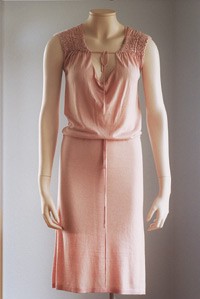
“People think of knitwear as being thick and heavy, but I work to make it delicate and weightless,” said Høj, of her eponymous label. A beige linen and viscose dress for 130 euros, or $166, at wholesale was a popular choice.
Meanwhile, Denmark’s Helle Hestehave and Rikke Baumgarten are among the country’s most popular designers. Their brand, Baum und Pferdgarten, is said to be a favorite of Princess Mary.
“We were extremely inspired by men’s [fashion], but with feminine detailing,” said Baumgarten, who presented the collection at CPH Vision, as well as on the catwalk during Copenhagen’s fashion week, which ran simultaneously with the trade show.