
Hollywood loves a good coming-of-age story. While typically such tales unfold in front of the camera, the people who make movies come of age as well.
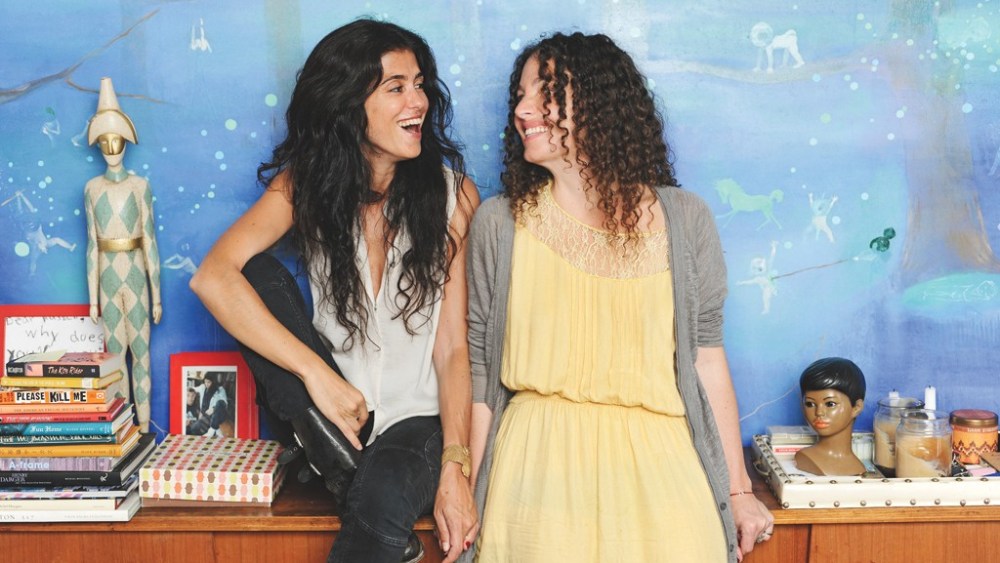
The upcoming “Tanner Hall” may prove the maturation benchmark for its novice directors, Tatiana von Furstenberg and Francesca Gregorini. Fast friends after meeting back when, as freshmen at Brown, theirs has been a 20-year relationship of constant interaction, including collaboration on some small, informally produced short films.
“Tanner Hall,” their first full-length feature, is set for limited release on Sept. 9. The directing/writing partners boast high-profile bloodlines — Tatiana, the daughter of an esteemed fashion figure who with her husband Barry Diller will host this Saturday’s screening in Southampton; the less-obviously named Gregorini, the daughter of Barbara Bach and stepdaughter of Ringo Starr. Yet it’s the sudden emergence of the film’s star into the celebrity stratosphere that helped seal a distribution deal with Anchor Bay Films for the movie shot in 2008 and shown at film festivals the following two years.
Related Articles
When cast, Rooney Mara was not yet with her dragon tattoo. As Fernanda, she anchors an ensemble that includes Georgia King, Brie Larson and Amy Ferguson as the central boarding-school quartet; Chris Kattan and Amy Sedaris as Mr. And Mrs. Middlewood, the former hot in the crotch for Larson’s Kate. Tom Everett Scott plays Gio, the married man whose attentions to Fernanda are of the requited sort, and Tara Subkoff, his pregnant wife.
You May Also Like
The primary story is of Fernanda’s sexual awakening. This plays out amidst the multileveled relationships among the students, including the good-girl/bad-girl counterpoint of Fernanda and Victoria (King), Kate’s party girl proclivities and Lucasta’s (Ferguson) could-be-a-phase, could-be-the-real-thing emerging lesbianism. Along the way, mothers are less than lovely; fathers, never mentioned; two marriages, in crisis, and the boarding school experience portrayed as the often-dark epicenter of essential epiphanies and the formation of lifelong bonds.
Von Furstenberg attended boarding school; Gregorini commuted to one. The two returned to the birthplace of their friendship, Providence, Rhode Island, to shoot the film. “When you write something, inevitably, [personal histories] are your references. So I would say the characters are consultations of different aspects of ourselves and people we knew,” says von Furstenberg. “But they’re all very fictional characters…In order to make a movie, you have to way heighten the drama, way heighten the conflict, and it has to be worthy of cinema. So it’s not true to life.”
While Mr. Middlewood’s fixation with Kate works the creepy side of comic relief, the Fernanda-Gio relationship is handled seriously. The directors determined to make her the initiator of the sex scene, so as to avoid predatory undertones.
Asked about a comment she made for the project’s press notes, that “the sex in the film isn’t riveting,” Gregorini qualifies her remark. “Whether it’s sex or accomplishment or anything, where the story lies is always in the journey. It’s never the destination,” she says. “It’s the interplay between [Gio and Fernanda] and what they’re both searching for and running from that gets them into a compromised sexual situation. The psychology behind that is what we focused on, but the actual scene is quite riveting.” Gio, she continues, “is as lost as they are in his own time and space. One thing that hopefully we achieved in this film is that it’s not a morality tale.”
Similarly, the two women sought to avoid what they consider a common foible of teen-centric films: talking down to that audience. “It doesn’t pander, and even the humor is quite elevated,” offers Gregorini. “The complexity of their emotions is portrayed to the best of our ability. It’s not reductive. The performances that everyone brought to the table were layered and complex.”
Another cliché avoided: focusing on teens’ oft-chronicled lust for stuff. “Unfortunately, teenagers — materialism [tempts them everywhere] all the time and consumes them,” von Furstenberg notes. Rather than portray the girls as obsessive label mongers, the intention was to reveal elements of their personalities in their clothing choices and the ways in which they decorated their rooms — style “from within,” she says. “It’s not through acquiring things.” This served a second, quite practical goal as well: cost containment, as many looks were sourced from von Furstenberg’s closet.
Perhaps the film’s most stunning avoidance: technology. No one tweets. No one checks Facebook, nor even sends the quick text. The directors argue that such here-and-now activity would have detracted from the essence of their story. “There’s something beautiful about being folkloric and timeless,” says von Furstenberg. “This story could happen to anybody at any time, anywhere.”
Now, about that casting. Gregorini and von Furstenberg took no physical presuppositions to the process, no parallel to searching for Scarlett O’Hara as written, with dark hair and green eyes. Their only requirement: that the girls look good individually and together. Not wanted, Gregorini declares: “a Hollywood, body-by-aerobics kind of look.” Her partner adds, “What I will say, there was nobody beautiful that couldn’t act.”
As Lucasta, Ferguson is “earnest, a little bit awkward and struggling with her sexuality,” says Gregorini. “She’s so beautiful and lanky and natural-looking, and she doesn’t even realize. She’s just earthy, poetic, you know — she’s from Ohio.”
Larson took Kate from what could have been a clichéd, obvious portrayal to, Gregorini says, “a unique take on the tease.” Adds von Furstenberg, “She makes me think of my dad — intelligent mischief. She has the most vitality of all of them, the most life force, a very funny sharpness. We literally offered her the part that day.”
Conversely, King was almost not cast as Victoria, the film’s British antagonist. King has done such highbrow fair as Rosamond in the 2006 miniseries “Jane Eyre,” and was familiar with the boarding-school genre, having played in, among other movies so set, 2008’s “Wild Child” with Emma Roberts. While on a trip to Los Angeles, the Scottish actress embraced the chance to read for the role of an American girl. The directors found her audition labored. Then she said good-bye — in her natural accent. “She was focusing so hard on keeping an American accent up that it was really impairing her acting,” Gregorini says. The directors thus decided a little linguistic diversity on campus might not be a bad thing, opening the door to what von Furstenberg calls “an incredible performance.”
It was the casting of Mara, however, that ultimately secured the film’s distribution deal. “Tanner Hall” premiered at the 2009 Toronto Festival, where it was accepted into the World Cinema Competition; in 2010, it won the Gen Art Grand Jury Award for Best Feature, but ultimately didn’t find a buyer. “We were told that we had a very commercial movie but that we didn’t have a star in our leading role,” von Furstenberg explains. “What time and luck have given us is a commercial movie with a star in the leading role.”
The filmmakers lavish praise on that star, who presented as very unstarlike when she showed up to read for Lucasta. “She seemed like a little high-schooler from New York state, really adorable,” Gregorini recalls. “And so disarming because she was so un-Hollywood. She came in these silly little sneakers and jeans.” After Mara aced her audition and won the part, the directors set out to find Fernanda — daunting, Gregorini notes, because “she’s a very internal character.” They kept coming back to Mara, and ultimately gave her the lead. “At the time, she hadn’t done many movies and wasn’t really trained. It really is all so natural,” she adds.
“She is reserved,” von Furstenberg chimes in, “but it’s filled with dignity…She’s not strategic or guarded like some actors. She’s really courageous. She’s available and open.”
As Gregorini and von Furstenberg look forward to the release of “Tanner Hall,” both are on to their next projects. Gregorini is in preproduction for “Emanuel and the Truth about Fishes,” also with Mara. Von Furstenberg is writing another screenplay. Each feel the impact of their upbringings on their work — willing or otherwise.
Gregorini learned from her mother’s career choices even as she took issue with them. “I really resented that she was an actress, because when she was working, films took a very long time to make, so she was gone from home for very long stretches,” she offers. “But I guess the exposure to the world of creativity…With my stepdad in music, having that as a backdrop, and having grown up, at least in my early years, visiting different sets, it definitely had an influence on me. As an artist, my need and desire to tell stories is the ultimate driving force.”
For her part, von Furstenberg focuses less on the creative aspect of growing up a child of fashion than on more clinical considerations. “Making a movie and being at the helm of such a big enterprise, I really realized how much I knew about making executive decisions, making them quickly, and sticking to them,” she says. “One of the greatest gifts that I got from my family is the ability to feel confident in my decision making. Just watching them be good leaders, I think that it was really helpful to me, even in times of high stress and uncertainty.
“You know,” von Furstenberg continues, “our movie came in on time and within budget.”