
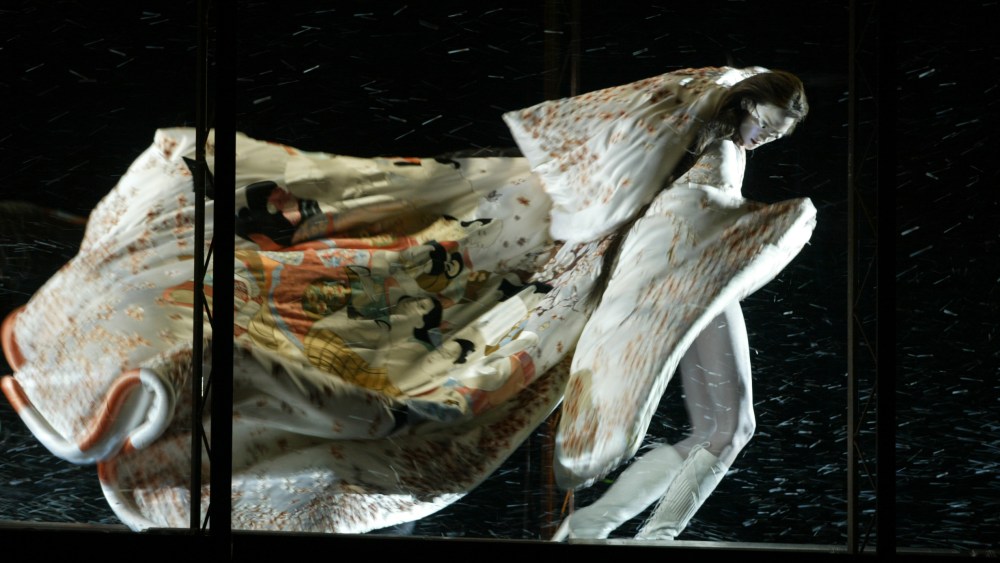
At its best, runway fashion delivers pure magic. The mid-Nineties through the Aughts were a golden age of such magic, and one of its greatest sorcerers was Lee Alexander McQueen. Season after season, McQueen would transport his audiences to places fantastical — usually exquisite, often dark, sometimes on that treacherous precipice between sanity and madness. He awed and he outraged, and always, he captivated. “So what?” was not in his repertoire.
McQueen’s brilliant body of work provides the structural foundation for the compelling documentary “McQueen.” The film, directed by Ian Bonhôte and written and co-directed by Peter Ettedgui, opens today in New York at the Angelika Film Center and Landmark at 57 West, and in Los Angeles at Landmark and Pacific Arclight Hollywood.
Related Articles
Bonhôte and Ettedgui spoke to WWD after the Tribeca Film Festival, where “McQueen” premiered to impressive reviews. “He was tabloid fodder, he remains tabloid fodder,” Ettedgui said. “So how do you tell his story in a way that is sensitive and authentic? Through the work because, as he always said, ‘My work is my life, or my autobiography.’”
You May Also Like
The filmmakers approached that work deftly. McQueen was a consummately emotional designer and genuine romantic whose lavish runway wonders exposed his state of mind at any given time. Yet rather than hammer home the connections, the film addresses them with intelligent restraint, the narrative framed around a series of shows. Bonhôte and Ettedgui knew they wanted to highlight McQueen’s first show — his stunning Saint Martins degree show, “Jack the Ripper Stalks His Victims” — about, according to Isabella Blow, “sabotage and tradition” and “beauty and violence,” and his last — Plato’s Atlantis — which predated his death by four months, and which some now view as prophetic in its otherworldliness.
Other shows the film duo found essential: Highland Rape, for its political current and grounding in McQueen’s Scottish ancestry; Search for the Golden Fleece, McQueen’s debut for Givenchy that signaled his fraught relationship with Paris; It’s a Jungle Out There, viewed as a reaction to his early experience with Paris; Voss, with its allusions to madness, and La Dame Bleue, his posthumous tribute to Issie Blow. Still more collections are not discussed specifically, but referenced in mesmerizing visual snippets: Deliverance, the dance marathon show; Sarabande; Widows of Culloden, and a fleeting image of the Girl Who Lived in the Tree.
Bonhôte and Ettedgui completed the film over the course of one very intense year, determined to get to tell the designer’s story first, in advance of various other confirmed and rumored McQueen projects. The two came to the film with considerable knowledge of their subject. Early in his career, Bonhôte found McQueen references seemingly at every turn. “All his creativity has seeped into loads of different media,” he said. “As a young filmmaker, I did a lot of short films, music videos and commercials. You’d constantly have picture references from Lee’s shows or Lee’s advertising work or anything like this. You would constantly take inspiration. So [awareness of McQueen] was always present.”
In addition, when he moved to London, Bonhôte found work doing visuals for a club in Sloane Square near McQueen’s studio, “and he was constantly around. He was in the zeitgeist.”
Ettedgui approached the project with a fashion insider’s perspective. He grew up in the industry, the son of the late Joseph Ettedgui, who, with his brothers Franklin and Maurice founded the iconic Joseph retail business out of London. Joseph was introduced to McQueen by Blow, the iconoclastic fashion editor who championed the designer early on and with whom he had a powerful, complicated relationship, chronicled in the film. (It was Blow who suggested he drop the “Lee” for professional purposes; she thought “Alexander” sounded tonier.)
“My dad loved discovering new talent,” Ettedgui recalled. “Issie Blow had taken Dad to one of Lee’s earliest shows, and as soon as Lee started producing, my father bought the McQueen fall collection for the Joseph shops.” When he joined on to write “McQueen,” Ettedgui discussed the project with Franklin, who told him, “McQueen was the most authentic and genuine person that I ever met in the fashion business.”
“Frank knew everybody. He did not suffer fools gladly. So when he said that, I knew it was a real insight into Lee,” Ettedgui said.
The filmmakers thus brought a great level of respect to their subject, yet they set aside any awe in the interest of due diligence. They would tell McQueen’s story by playing the show footage against numerous original interviews with McQueen intimates, both friends and family. Those featured were either part of his inner sanctum for significant periods of time or spoke to specific creative moments, as were the cases with the designer Romeo Gigli, for whom McQueen worked for a while, and several models cast in shows. Extensive research went into identifying and securing the participants.
“As much as possible, we wanted people close to Lee, the close collaborators, the people who really knew him,” Bonhôte said, noting as an example, Mira Chai Hyde, a men’s groomer whom McQueen met by chance. They became close friends and even shared a house for a while. Andrew Groves and Murray Arthur were both boyfriends of McQueen’s for significant stretches; designer Sebastian Pons worked in the studio for years. McQueen’s sister Janet and nephew Gary are also featured. Still, Bonhôte acknowledged that not everyone contacted said yes (some reviews noted the absence of McQueen’s longtime stylist Katy England), while others contributed on background.
In addition to their original interviews, Bonhôte and Ettedgui came across a trove of archival footage of McQueen on camera, not flashy marketing materials, but rather, the old-fashioned home movie variety. (According to Kinvara Balfour, a producer on the film, McQueen intimate Annabelle Neilson, who died last week of a heart attack, supplied some of that footage.) We see McQueen as a chubby, baby-faced kid, his bravado tempered by a natural sweetness; admitting to financing the Highland Rape show with unemployment payments; as a renegade arriviste at Givenchy; winning over that atelier with his talent, work ethic and respect for the staff; falconing with Blow, and through numerous changes both emotional and physical, the latter including a dramatic body evolution following major liposuction. Sometimes, he’s gleefully happy. At others, he’s defensive. An audio run in voiceover offers his explanation for the drug use that escalated with his fame: “Cocaine made me look at things in a clear light,” he said.
Bonhôte and Ettedgui distill the various perspectives, painting the story of a complicated genius who understood the depth of his talent and yet never quite felt fully comfortable in the fashion world, even as its denizens applauded him. At least not outside of the studio. Once inside, he could be fully himself in the place where his personal and professional lives intertwined, where friends became collaborators and co-conspirators, and where everyone knew they were party to something special and rare. The circle included, among others, England, Chai Hyde, Pons, Philip Treacy, Shaun Leane and Sarah Burton, who started as an intern and so beautifully continues the McQueen legacy today. Money was scarce but the creativity flowed. “We chose it,” Chai Hyde said.
Before that motley group assembled in young adulthood, McQueen was a working class gay kid seeking a creative outlet and personal acceptance. He talked about the difficulty in coming out to his father, the kind of rough-and-tumble sort who might come home from work and say, “I nearly ran over a bloody queer last night.” Through the years, much has been made of the McQueen “son of a taxi driver” lore, yet in an interview the filmmakers got hold of, his mother challenges the premise that her children grew up wanting. They had everything they needed, she insists, including books. That didn’t stop young Lee from being a lousy student who dropped out of high school, finding his way to Savile Row and Central Saint Martins, where the famed Bobby Hillson, who founded the school’s MA Fashion program, took a keen interest in his work, with his aunt paying his tuition.
That dual training would prove invaluable to McQueen’s maturation as a designer and the development of his mystique; as much as he was a showman/storyteller/seer/philosopher whose medium was clothes and whose venue, the runway, McQueen was a brilliant craftsman, highly skilled and exacting. And sometimes, exasperated. Tired of the lack of imagination of Savile Row tailors, he moved to Italy at one point and quickly secured a job with Gigli, himself one of fashion’s great romantics. Gigli was also no slouch with challenging cuts, and recalls disassembling a particularly difficult jacket into which McQueen had sewn a personal message: “F–k you, Romeo.”
Such bravado was often internalized. Outwardly, McQueen was often self-effacing and fun-loving, as those early films show, quick to laugh and spar with friends. But he could turn distant when he felt the validity of his work had been challenged or a relationship might not continue on his terms. When Pons eventually found the studio claustrophobic, he decided to leave. McQueen admonished him to think twice, saying, “There is no way back.”
Bonhôte and Ettedgui offer no pat answers for the darkness that encroached upon McQueen, and seemed to heighten with his fame and success. The film contextualizes many of the now well-known bullet points of the designer’s story, including the terrible secret that would resonate for the rest of his life — his molestation as a child by the husband of the considerably older Janet; he also witnessed his brother-in-law trying to strangle Janet. “A child can’t have his innocence taken,” Bonhôte said. McQueen remained close with Janet, and eventually hired her son Gary for various projects. Gary’s work appears in the film, in the compelling skull imagery that recurs in metamorphic states as a unifying motif. While in New York for the premiere, Janet spoke with WWD. (Click here for the story.)
The film spends considerable time on McQueen’s relationship with Blow, whose husband Detmar is among those interviewed. She was hurt by McQueen’s lack of acknowledgment of her when he was hired by Givenchy; her suicide devastated him. Less attention is given to McQueen’s HIV status and drug use, which the film addresses with discretion.
“In a 90-minute film, if you mention the drugs once, you [help to] understand what was enabling him to do the work that he was doing and what was making him the person that he was and what was changing things in his personality, and whatever. You’ve got to see a little bit where that comes from because it’s reflected in the work as well,” Ettedgui said. “If you mention it twice or three times, that’s what the movie becomes about. And it’s been written about enough. I wouldn’t say we were downplaying it, but you want it in proportion. And because our drive was really to celebrate this man’s life and his work, we didn’t want to drag the whole enterprise down.”
About McQueen’s positive HIV status, Bonhôte suggests that his silence was likely fueled by his background. “It’s not a death sentence anymore,” he said. “But I think people need to understand, particularly in the U.K., when you come from the working class…I mean [20 years ago], do you go home and say, ‘I’m gay and I’ve got AIDS?’ Do you see what I mean? There’s a stigma still.”
Throughout, the film alludes to McQueen’s escalating angst without using the word “depression.” “His mental state, his paranoia, definitely the depression is there,” Ettedgui said. “It’s not named depression, but the ups and the downs. It’s there.” In addressing McQueen’s suicide, the filmmakers avoid pat cause-and-effect conclusions. But it’s clear the idea was on his mind for some time. Pons, who ultimately came back into McQueen’s life, offers a chilling account of a conversation in which the designer told him that in Plato’s Atlantis, “I designed my last collection. I’m going to kill myself.”
McQueen described to Pons a show finale in which an enclosed box would emerge from the floor, he would step out, bow and then shoot himself. He didn’t. Instead, he held out for several months, until the day before his mother’s funeral. At that moment, Janet McQueen says in the film, “he felt there was nothing that could make him happy anymore.”
Certainly, one can identify references to world-weariness throughout McQueen’s work — the exhaustion of Deliverance; the frenetic insanity of Voss; the wistful melancholy of La Dame Bleue, and finally, the stated motif of Plato’s Atlantis, of human beings going back into the sea and becoming a different form of life.
Bonhôte and Ettedgui spoke, too, of the forces, in addition to the loss of his mother, that may have gotten McQueen to so dark a place: Issie’s death; the drug use; the “legacy of shame” inherent in childhood molestation; the relentless pressure to perform, imposed outwardly and from within. “It’s a stigma,” Bonhôte said. “We don’t like to not be at the top. In our Western society, we are always pushing ourselves.”
Lee Alexander McQueen pushed himself, ever unwavering and brave, fearful that anyone would exit a McQueen show as if having experienced a fine “Sunday lunch.” He demanded from himself that you leave “repulsed or exhilarated….If you leave without emotion, I’m not doing my job.” From Jack the Ripper stalking London to Plato in Atlantis, he did his job. And more.