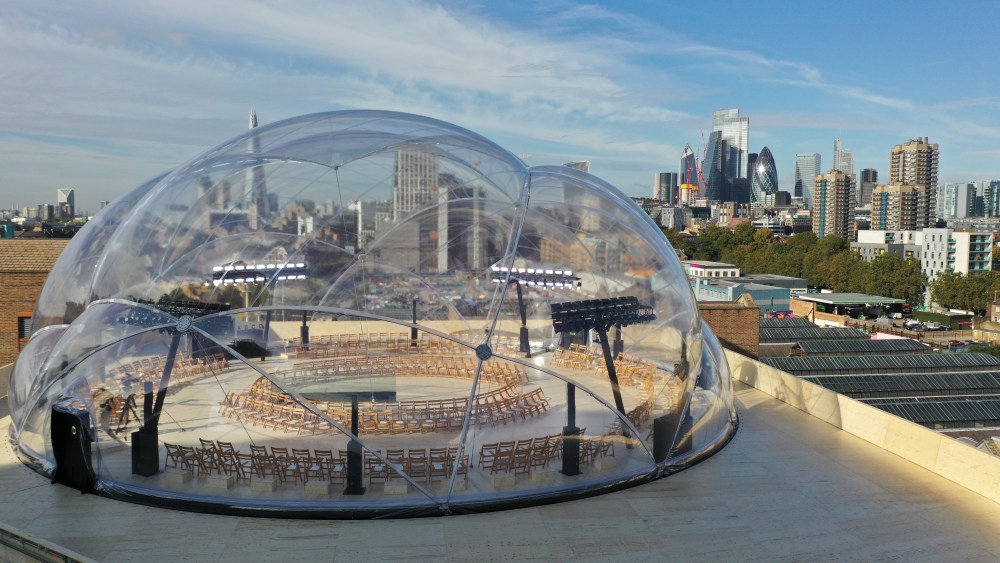
LONDON — The placid, partly sunny skies above Tobacco Dock in East London on Tuesday afternoon were no match for the drama of the Alexander McQueen show, which took the fickle — and often violent — weather of the British capital as inspiration for the spring 2022 collection.
The London sky often churns through four seasons in a day, and Sarah Burton‘s collection captured those mutating colors, light and dark moods for the brand’s first physical show in London since 2016.
Not surprisingly the venue was sky-high — the rooftop of a multistory carpark with the show space encased in a giant bubble, like a greenhouse from another planet. Burton said she wanted guests to feel like they were in the outdoors, absorbing all of the restless cloud movement and streaks of sun she’d been watching for months.
Related Articles
Inspired in particular by the mutating, often blustery, skies above the McQueen headquarters in Clerkenwell, with its contrasting views of St. Paul’s Cathedral and The Shard, Burton conjured stormy cloud prints for dresses, added puffed sleeves or bustles to tailored jackets, a shower of sequin rain to the edges of skirts, and raindrop embroidery to a sweatshirt.
You May Also Like
“Nature has this power and intensity and uncontrollability — it’s calm, dangerous and beautiful, offering different kinds of light and feelings and emotions. It is ever-changing,” said Burton, whose focus last season was on the mud, muck and water on the banks of the River Thames.
This season, the sky also served as a metaphor for this current phase of the pandemic.
“We’re not through it all yet, and we don’t know what’s coming next, so the sky represented the idea of constantly moving and shifting and adapting — it’s not really in our control and it’s similar to what we’ve been through. I wanted to look at how we weather the storm.”
Over the past 18 months, the McQueen team — like so many other brands — took lockdown in their stride, working from home and from the studio — when they could. Burton said being forced to work from home — and not do physical shows — taught her a lot.

“By not doing a show, you could really focus, and it led to a distillation,” said the designer, adding that she was humbled to see her team doing their jobs from home. “Seeing pictures of a dress by a washing machine, or with children there, it became about refining what was important,” she said, adding that it made her look ever closer at the needs of the people who wear the clothes.
Indeed, many of the looks on the runway were designed specifically for the models who walked in the show, and with whom Burton and her team have been working with for a while. She designed the accessories in that same spirit of everyday wear.
“The girls [in the show] are always very grounded — in boots or trainers,” said Burton, who also created a low “skeleton wedge” boot for spring because “people are used to not wearing heels.” She also softened up leather bags to resemble clouds.
While Burton said her team pulled together during lockdown, remote work isn’t ideal. “We just have to be together to create something, to touch the fabric, see how it moves, see the proportion. You have to be in the room together, sparking ideas — it’s a different energy.”
Burton added that the decision to show in London was a result of that coming together. McQueen, which is based in London but wholly owned by France’s Kering, usually shows during Paris Fashion Week. “We listened to the rhythm of our own studio, and how we’ve been working as a team, it made sense to do it here, to be here, and to do the show at this time,” she said.
Burton nodded to nature in other, quieter ways, too.
The company has been making strides in the sustainability space in the past months. Earlier this year, it became the first luxury label to work with Vestiaire Collective on the platform’s new Brand Approved program, which allows McQueen clients to sell their clothing to Vestiaire in exchange for credit notes to be spent in the McQueen boutiques.
The company has also been donating deadstock fabrics to universities, and working with stylists who encourage clients to don old season pieces. Last year, Harry Styles wore a look featuring McQueen deadstock fabrics made by a University of Westminster student.
For this collection, and past ones, Burton and her team worked with recycled poly-taffeta and poly-faille, while the sequins embroidered onto T-shirt dresses were sustainable.
It’s a work in progress and team McQueen isn’t touting its accomplishments yet.
“We’re passionate about it — we’re trying to make all the fabrics 100 percent sustainable. We’re developing wools with British mills, and pushing the people that we already work with to make these sustainable fabrics,” said Burton, adding that eventually, the use of sustainable fabrics in the McQueen collections “should be a given — so that you don’t need to talk about it.”