
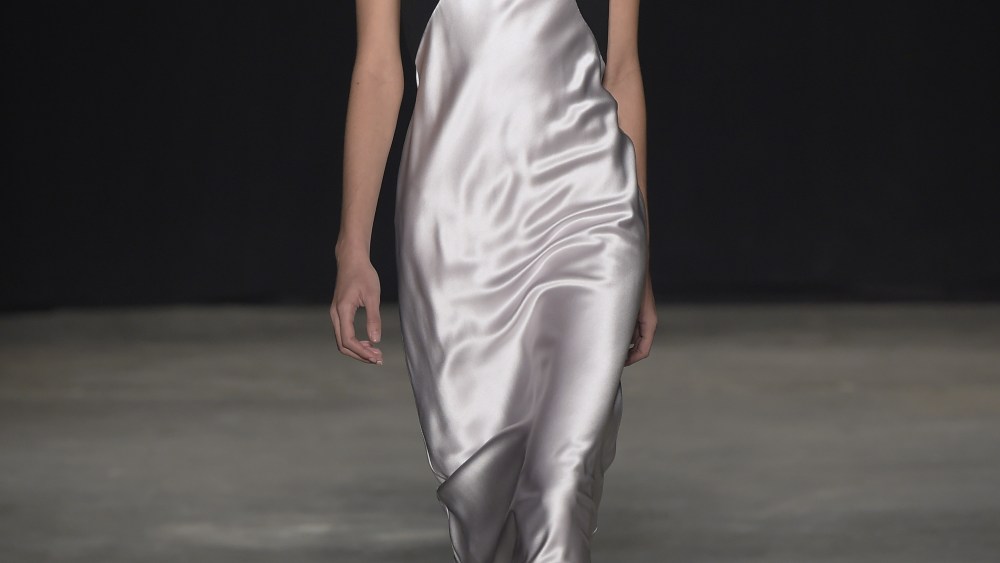
It didn’t quite feel like the old days (no matter what your particular “old days” are) — there were still far too many shows on the schedule for that. Yet the week definitely had a retro vibe. Not the clothes, though, of course there was some retro there as well — what fashion week is devoid? But this fashion week felt calmer than New York has in years — fewer shows, fewer celebrities, less extravaganza, less drama, even the traffic-stopping photo-op frenzy over the street-style set seemed less frenetic than that to which we’ve become accustomed. Yet the calm wasn’t that of resolution. Rather, it played out with an undercurrent of calm more anxious than Zen.
The moment found many designers in a contemplative mood, ruminating on factors ranging from the U.S. political situation to the very nature of fashion itself — what it means, what people want to wear and whether the obsession with streetwear is a passing trend or a permanent manifestation of the increasingly casual world in which we live, and where the notion of appropriate dressing seems as reactionary as spats or a bustle. I gotta be me, and if I’m most me in yoga pants and a hoodie for most situations in life, so be it. Then there are the retail channel wars with the all-out assault of e-commerce on brick-and-mortar, particularly the department store model, which is suffering dramatically.
On the brand side, the recent swirl of musical chairs continues: there were more designer departures — Riccardo Tisci from Givenchy; Clare Waight Keller from Chloé — which will see those brands at least (and possibly Versace, where good money says Tisci is headed) pushing the reset button. Fold in the movable-feast brigade. Rodarte’s Kate and Laura Mulleavy dumped New York this season and will conduct market appointments in Paris next week in advance of showing there for spring 2018; Proenza Schouler’s Jack McCollough and Lazaro Hernandez will do the same for spring, but kept their fall spot on the New York calendar and delivered a powerful swan song. A parallel westward migration — Tommy Hilfiger and Rebecca Minkoff — purported to fuel the consumer’s buy-now adrenaline. It did. All of which set the backdrop for fall in New York (except when it was spring, as at Ralph Lauren, where the designer staged one of his best shows in memory).
Perhaps the most dramatic example of fashion in transition came early in the week with Raf Simons’ debut at Calvin Klein Collection. It was great, an amalgam of American references worked with Simons’ decidedly European hand. Chief creative officer of the entire Calvin Klein brand, Simons has been handed the creative keys to the kingdom in a way his Collection predecessors, Francisco Costa and Italo Zucchelli, creative directors of the women’s and men’s respectively, were not. Given the scale of Simons’ role, one assumes both sides intend a long-term relationship.
Another big change: the onset of the Laura Kim-Fernando Garcia era at Oscar de la Renta. They follow Peter Copping, who, though hand-picked by the house founder to be his successor, saw his brief tenure take a terribly wrong turn, the details of which have stayed in house. The new designers struggled in their debut, indicating the challenges of trying to modernize traditional, lady-fied fashion.
Public School returned to NYFW after Dao-Yi Chow and Maxwell Osborne showed off-season to accommodate the needs of DKNY, and everyone knows how that went. Shaken but wiser to the ways of the fashion employment as opposed to self-ownership, they delivered a moving collection inspired by the idea of a borderless world; the two have often gone political on the runway, and this season found them especially so.
Ralph Lauren was similarly inspired, to very different effect. He titled his collection “Nomad,” channeling the concept into lovely, nonspecific exotica. “You’re not quite sure where she’s from,” he said. While the geographic origins of his lovely clothes may have been vague, the purpose in his approach could not have been more clear. Lauren showed in his women’s flagship on Madison Avenue, the walls of its first two floors covered in 100,000 orchids — an installation left intact through Monday, so clients could experience a bit of the insider allure of the show.
Such intimate strokes dominated the week. Some came via inspiration. Tory Burch referenced her own upbringing, using George Cukor’s witty film “The Philadelphia Story” as a way in. Joseph Altuzarra looked to Renaissance portraiture for his gem of a show. Narciso Rodriguez channeled the political dismay he feels into real, unfettered chic. “There’s too much fashion and too much noise, and I don’t think that’s appropriate today,” he said.
For the moment at least, “noise” and the extravagantly staged mega-event seemed at odds with the communal New York psyche. In fact, the biggest extravaganza of the season occurred outside the purview of NYFW — 3,000 miles outside, as Hilfiger took his buy-now exuberance on the road to Venice Beach, Calif. In New York, even Kanye West retreated from excess in a collection that read almost as a mea culpa. WWD’s Jessica Iredale wrote that compared with last season’s extreme folly, Yeezy Season 5 was “a picture of refinement.” And for his 10th anniversary outing, Jason Wu shunned bells and whistles — and cool, gritty surroundings — for a discreet return to the St. Regis Hotel, the site of one of his first big shows. “It’s very symbolic to me,” he said.
Among big names, Alexander Wang alone craved a showtime party atmosphere. He headed to Harlem and the RKO Hamilton Theater, an early 20th-century vaudeville-turned-picture house, its former grandeur now in the throes of serious decay. Many industry guests made the trek uptown expecting drama of the irritating sort at a show with no seats and a huge welcome mat out for Wang’s adoring Millennial fans. But KCD made it all terribly workable: easy entry, easy egress, good sight lines, for the press at least. The problem was that the space trumped the clothes. Who knows whether up close they were interesting? As shown, they projected generic cool-girl-in-basic-black.
Marc Jacobs also showed in a big old space, but to the tightest of audiences. His sought to strip down production quality for maximum effect while showing his feisty take on everyday clothes, inspired by the Netflix series, “Hip-Hop Evolution.” “This feels like a time to rethink not only what we say but how we say it,” Jacobs said, referencing the bare-bones approach. His set: two rows of folding chairs through which the models walked, sans musical accompaniment, in the otherwise barren Park Avenue Armory. Yet Jacobs being Jacobs, he turned that austerity on its ear outside, on the street, where two huge speakers blared music as the models took folding-chair seats of their own and photographed the exiting guests, who in turn photographed the models, with both sides being photographed by passers-by. Calm, it seems, has its limits, even during times of essential transition.