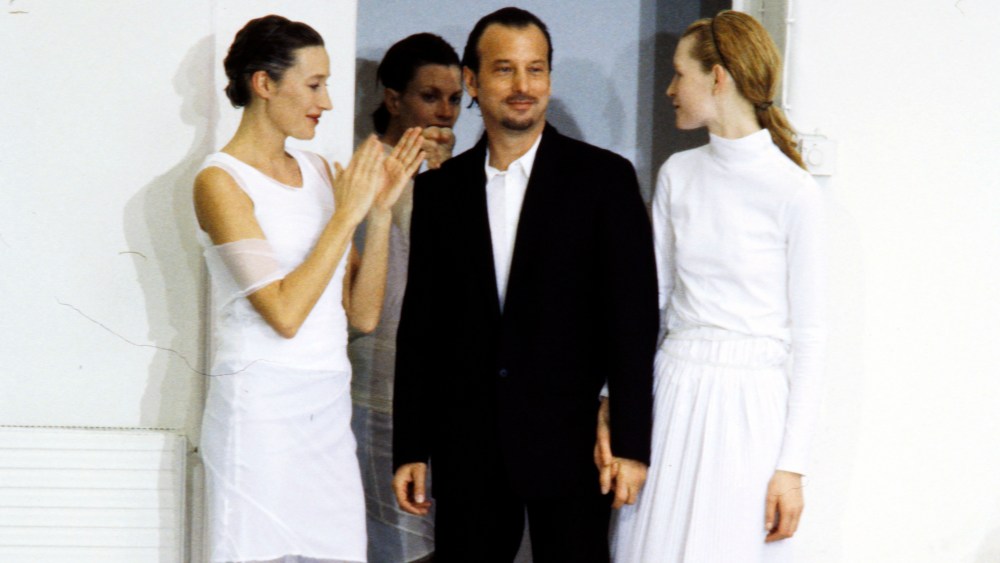
Describing a Helmut Lang collection as “folklore” might seem surprising, but it was the exactly how the Vienna-based designer touted his coed ready-to-wear lines in the mid-1980s. A decade later, Lang would evolve his storytelling, blending his mix of glamour with the stark minimalism that redefined fashion in the late 1990s. The brand’s influence remains iconic, and with the latest exhibition, Helmut Lang. Séance De Travail 1986-2005, a comprehensive retrospective opening at Vienna’s MAK Museum this month, there’s no better time to revisit some of the brands iconic collections.
Related Articles

Lang was already on WWD’s radar by 1986, when he was recruited to design the Calla ready-to-wear line previously overseen by Gianni Versace and produced by Zamasport, while still producing his namesake label. His aesthetic was the opposite of the high-energy, maximalism fashion reveled in at the time. But as WWD made note in 1991, Lang, who showed in Paris, showed promise. Four years later, his minimalist approach became a highlight.
You May Also Like
In 1998, Lang made a bold move to New York, where he shook up the global fashion calendar, presenting his show a week ahead of the European collections, leading the American industry to follow suit. The moment was a catalyst for a permanent change — America was, and still is, the official starting point for the seasonal fashion shows. New York influenced and expanded his stark, streamlined aesthetic. Basics like T-shirts, khaki and denim were elevated with oversize and sometimes obscure accessory choices with subtle touches of glamour, in a predominantly black and white palette, and reimagined as the “new” urban wardrobe.
Lang once told WWD in a headline making interview that, “New York is, in many terms — and not only fashion terms — the most important place to be, [its] the most urban place to be.”
He also pushed boundaries in how fashion communicated with its audiences. In what was considered a revolutionary fall 1998 collection, he went digital — showing online and via CD-ROM instead of hosting a traditional runway show. Buyers could still preview the collection in a showroom. The move positioned Lang as a trailblazer in using technology with fashion to reach a wider audience.
Lang moved forward expanding his brand in a joint partnership with the Prada Group in 1999. Prada fully acquired the brand in 2004. This move evolved the brand’s use of innovative fabrics, stand-alone boutiques, category licensing and his first fragrance through Procter & Gamble.
In the 2000s, a pop-culture-fueled Y2K era took center stage, and while Lang’s sleek avant-garde aesthetic still retained its audience in America, he returned to Paris in 2001 to show his collections. In 2005, Lang without warning, stepped away from fashion to concentrate fully on his art.
As his groundbreaking designs are once again in the spotlight, in a retrospective held at MAK Museum in Vienna, WWD and the Fairchild Archive take a look back at its coverage of Helmut Lang and the collections that shaped a lasting legacy in the fashion.