
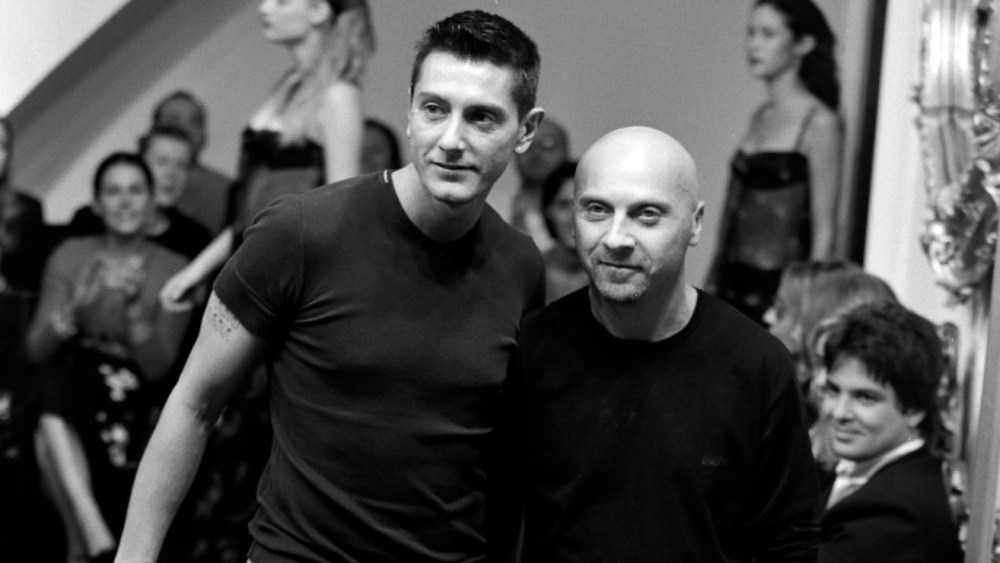
MILAN — The spotlight is on Dolce & Gabbana and its reorganization.
The news reported by Bloomberg on Thursday evening that Stefano Gabbana was leaving the Dolce & Gabbana Group shot throughout the industry until Friday morning, when the Milan-based fashion house issued a statement clarifying the cofounder’s position.
“Within a natural path of evolution of its organization and governance,” the group stated that Gabbana “resigned from his positions at Dolce & Gabbana Holding Srl, Dolce & Gabbana Trademarks Srl and Dolce & Gabbana Srl effective Jan. 1, 2026. The resignation has no influence whatsoever on the creative activities performed by Stefano Gabbana for the group.”
Related Articles
Speculation is swirling about the future of the managerial organization, including the role of chief executive officer Alfonso Dolce, the brother of cofounder Domenico Dolce, seen as potentially taking on the position of chairman. Following a rumor first reported by The Platform, corroborated by several market sources, former Gucci CEO Stefano Cantino is widely expected to succeed Alfonso Dolce, either in a co-CEO position or as sole CEO. A confirmation is expected next week.
You May Also Like
Prior to Gucci, which he exited in September last year, Cantino was a Louis Vuitton senior vice president of communications, recruited by then-chairman and CEO Michael Burke. Cantino’s scope on communications and events extended to retail touch points. Before that, he spent much of his 22-year career at Prada in various business development, merchandising and marketing roles, involved in everything from retail to industrial processes.
One financial source said Dolce & Gabbana, of which Gabbana reportedly owns 40 percent, has tapped Rothschild to renegotiate its debt of 450 million euros with banks including Intesa, BPM, Crédit Agricole, CDP and BNL, leveraging “extensive real estate assets and royalties’ revenues.”
In the statement, Dolce & Gabbana said that at the moment “it has nothing to declare since the negotiation with the banks is still ongoing.”
Market sources peg the company’s revenues at 1.9 billion euros.
In February, Gabbana was seen at the fall show of the brand in Milan, attended by Madonna, a longtime friend of the design duo. A month earlier, Madonna was tapped by Dolce & Gabbana to front the campaign for two new fragrances that expand its The One franchise. In a video flanking the images and directed by Mert Alas, Madonna also sings in Italian for the first time for its soundtrack. This and other fragrance relaunches, such as last year’s Light Blue franchise via a flanker with a new campaign featuring Theo James and Vittoria Ceretti, or the My Devotion scent, fronted by Katy Perry and Michele Morrone, helped consolidate fragrance as the biggest category and growth driver of the Dolce & Gabbana Beauty business.
As reported, after bringing its beauty business back in-house in 2022 — it was previously licensed to Shiseido — the Italian fashion house has invested significantly in growing the category and has seen significant sales gains under the lead of former LVMH Moët Hennessy Louis Vuitton executive Gianluca Toniolo. The firm ranked 45th in WWD Beauty Inc’s 2024 list of the top 100 beauty companies by sales, with estimated sales of 910 million euros at the time, up 35 percent versus 2023.
The brand has a makeup line and it will officially debut into skin care in September with the release of the antiaging “Ever Youth” line. It also has embarked on a significant rollout plan of dedicated stores, with a first unveiled last year in Jakarta, Indonesia, followed by Hong Kong and London’s Covent Garden, among others.
Domenico Dolce, the son of a tailor in Polizzi Generosa, Sicily, met Gabbana, then a graphic designer, in Milan in 1981 at the studio of Giorgio Correggiari, where he was first assistant to the late designer.
Since the founding in Milan as a ready-to-wear brand in 1985, Dolce & Gabbana has extended into a lifestyle dimension including the home, launched in 2021; kitchen appliance; food and beverage categories, among others, and market sources say the company is eyeing entering the hospitality business.
In 2012, Dolce & Gabbana also launched Alta Moda, couture collections presented through fashion shows in locations ranging from Rome to Venice and Taormina and Ortigia, Sicily. This further expanded into Alta Sartoria, Alta Gioielleria and Alta Orologeria Collections.
In March, EssilorLuxottica and Dolce & Gabbana announced the extension until 2025 of the production and global distribution licensing agreement of prescription frames and sunglasses for the brand. The license was first inked in 2004.
Milan-based consultancy Pambianco for years hailed Dolce & Gabbana as one of the top companies with the potential to go public in their “Quotabili” study. The Pambianco ranking analyzes the companies that have the economic, financial and positioning characteristics to be publicly listed in a time span of three to five years, regardless of whether a listing is in the plans of the firm.
However, the designers have long cherished their independence, which helped them take bold decisions, such as folding the successful D&G collections, launched in 1994, into the signature brand in 2011.