
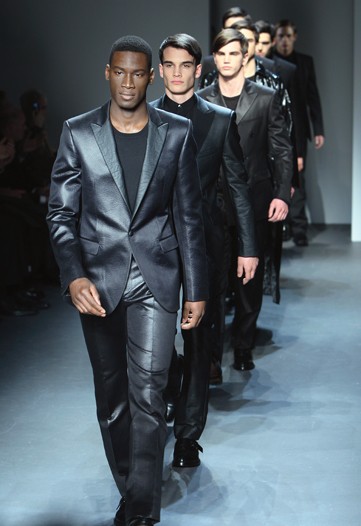
Just months after everyone washed and crushed and beat the last businesslike breath out of suits so no one would mistake you for a fat cat, business formal is…still dead. In its place is an unfolding contest between casual ease and sharp sophistication. Nowhere is this playing out more divisively than in tailoring, and largely along lines of national allegiance.
Round one: Pitti Uomo in Florence. This fair used to be ground zero for classic Italian sartorialism, but elegant sportswear has taken over and, more than ever, traditional clothing labels sought to reposition suits as separates. A lot of brands even offered knit blazers, as the context shifted from the board room to the dorm room and clubhouse.
Related Articles
“Sportif chic…can be worn on a man of all ages without looking out of place,” says designer Brunello Cucinelli, who has played a big role in blurring the boundaries between sportswear and tailoring. His ultrasoft jackets were to be worn with sweaterlike ease.
You May Also Like
On the Milan runways, designers became obsessed with brand heritage. For Burberry Prorsum, that meant a parade of military coats, and for Missoni, heaps of knitwear. Heritage has a commercial edge over fabulous fashion right now because it doesn’t smack of conspicuous consumption. Few people can tell if your Burberry trench is new or merely well preserved.
Ermenegildo Zegna, celebrating its centennial, saved its heritage tailoring statement until the fi nale, when models stormed the runway in expertly cut suits of a single fabric. Until that moment, cozy materials such as shearling, fl annel and boiled wool, along with denim, were used to craft relaxed looks.
Dolce & Gabbana’s cinematic extravaganza celebrated the hard-bitten romance of rugged Sicily. Relaxed tailored looks came in velvet or washed fl annels with frayed lapels. “The collection is a return to our roots: Sicilian heritage, sensuality and sartorial clothing,” says Stefano Gabbana.
Almost every time tailoring played a part in Milan, it continued in the vein of softness, unstructured with a natural, round shoulder. Giorgio Armani owns that style, of course, and in the moment when everyone touted heritage as a way to reassure and seduce consumers spooked by recession, the maestro delivered fl uidity and casual elegance.
Gucci’s Frida Giannini kept signature skinny suits around, but these took a supporting role in her revival of Gucci’s Seventies heyday. Picture fi ne-gauge turtlenecks, buttery suedes and heritage pieces such as equestrian print foulards and horsebit loafers.
“I really wanted to mix formal sportswear casualwear with evening in a very effortless way,” says Giannini. “For evening, there’s no black tuxedo, only special pieces like a blazer in astrakhan or silk velvet” with a lustrous microtexture.
And at Prada, a solid year of gray suits faded away as Miuccia Prada worked a Seventies-boy look from colorful, gawky proportioned separates, sweaters and coats. The season’s direction couldn’t have been more clear.
Until Paris.
Here, designers surged ahead with chic suits boasting strong shoulders and sharp outlines. Not stuffy or traditional, but absolutely not disheveled, either.
Viktor & Rolf kicked off the week with an outstanding runway debut. How refreshing it felt to see young men looking elegant—and not old-fashioned—in structured blazers, unorthodox evening jackets with sparkle or colored piping and carrot-shaped pants with banded hems.
The other designers in Paris pursued vastly divergent concepts. Louis Vuitton made references to Viennese arts; Dries Van Noten spliced Belgian modern, English heritage and Americana; Givenchy found the erotic in the ecclesiastic; Dunhill styled proper English tailoring for embarking on a glamorous journey, and Raf Simons used Velcro and snaps to animate slim, double-breasted suits.
Across the board, designers agreed on strong construction and angled shoulders. Even Ann Demeulemeester imposed structure on her darkly glamorous vision. The Edwardian bankers in John Galliano’s Sherlock Holmes–themed show radiated absolute Savile Row splendor.
The crowd favorite, once again, was Lanvin—a more earthbound, aggressive Lanvin than ever before. Sleeves were lopped off suits and seams left tattered, reinforcing a rich vagabond vibe. Power suits belonged in the streetwise mix, too, but with a backpack slung over.
The final round, New York, was a draw.
Calvin Klein Collection’s Italo Zucchelli has been committed to strong tailoring for years, rendering it with experimental fabrics that typically have a lot of structure, via bonding, for example.
“Strong tailoring is sharp, sleek and modern,” he says. “For Calvin Klein Collection, more precise tailoring conveys confi dence, enhances the shape of the body and fi ts perfectly with the overall brand aesthetic.”
Meanwhile, Ralph Lauren set out to offer men every kind of tailoring they could want from his multiple collections, from power-suit precision to clubhouse casual. The headliner among them was the reinvented sack suit, which lets a preppy young Polo customer breathe and bend with dignifi ed ease.
“Here you see a sack coat with no darts, an easy and natural look, a natural shoulder,” Lauren points out.
Where is a man to turn for clear guidance on this issue? Anywhere he desires. Italy and New York set the popular agenda and Paris dictates to fashion’s vanguard. So the real question is, what kind of man are you?