
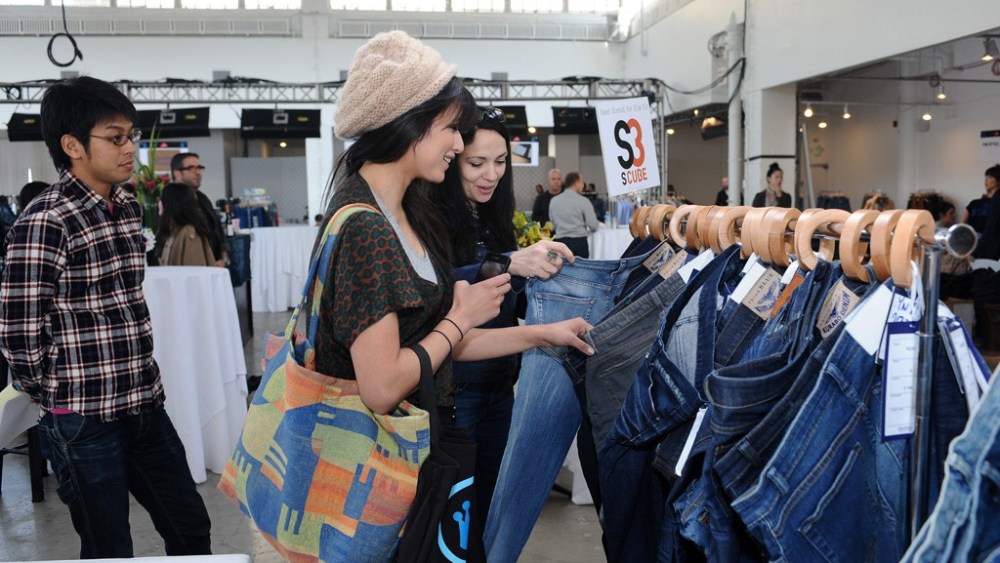
LOS ANGELES — Southern California’s denim designers continued to show their affinity for colored denim, ultrastretchy fabrics and novelty treatments as they shopped for textiles at the recent Kingpins trade show.
At the two-day expo that ended Jan. 11, designers from True Religion, Gap, J Brand, Agave Denim and other jeans makers arrived at Cooper Design Space here focused on spring 2013 offerings, with some making last-minute purchases for fall 2012.
Because the semiannual show was held two weeks earlier than usual to accommodate the Chinese mills that will close for the Chinese New Year on Jan. 23, the scheduling posed a conflict for some designers who didn’t attend as they prepared for the denim-centric Project trade show in New York that was scheduled to start Jan. 16. As a result, several of the 33 exhibitors said traffic was slow.
Related Articles
The New York edition of Kingpins began its two-day run at Center 548 Tuesday.
You May Also Like
Those attending the Los Angeles event perused developments from mills based in the U.S., India, China, Japan, Spain and other countries. Designers and manufacturers who wanted to continue the color trend had their pick of vendors.
Hong Kong’s Color Denim International made its debut at Kingpins with dyestuff that isn’t sulfur-based as conventional dyes are. Priced around $5 a yard, its fabric yields a brighter color but can be distressed and weathered like blue denim, said sales representative Baldwin Yih, adding that Color Denim can customize tints for clients. Moreover, Absolute Denim from Thailand offered denim that was prepared for dyeing, or PFD, with 3.5 percent Lycra for $3.90 a yard.
With stretch fabric, the issue of recovery came to the forefront. While more consumers are demanding superstretchy fabrics, textile makers increase the elasticity at the risk of decreasing the recovery for the fabric to return to its original form and not sag. “Recovery became more important as silhouettes got a lot more skinny and people needed elasticity,” said Chris Price, product director at New Orleans-based Blue Farm Textile Ltd., which used Lycra, T-400 and fabric blends to enhance recovery for its fabrics made in China and Taiwan. “They want to make sure, after the first wear, the product is going to hold up.”
Premium denim designers in Southern California were also sensitive to the minimum amount for fabric orders. While Bhaskar Denim in India, a first-time Kingpins exhibitor, requires a minimum of 10,000 yards, the Los Angeles-based merchandisers it met with wanted to place orders for as little as 1,500 yards.
Where the local designers couldn’t commit to big orders, they gravitated toward novelty. Spain’s RSP51 had a good reception for its metallic-coated stretch denim, selling for $8.39 a yard, in light blue, indigo and a PFD version. Knitdigo, a Taiwanese-based maker of textiles and finished garments, said its most popular products were a knit denim in a herringbone pattern ($8 a yard) and a cotton denim that had a polyester backing to help keep the wearer warm ($10 a yard). Japan’s Kurabo used a special finish with liquid ammonia to keep the fabric soft and reduce shrinkage when dyeing for a price of $6.60 a yard. Specializing in lightweight fabrics that can be made into leggings and shirting, CDY from Mexico brought a variety of denim weighing between 5 and 7 ounces at a cost of $3 to $4 a yard.
Adriano Goldschmied, executive vice president of product development at Citizens of Humanity and founder of GoldSign, said he liked the advances with ammonia finishes and the move to use Tencel on the warp of a weave to create a shine. Yet, the biggest challenge for him as a designer is to bring sustainability to the denim industry.
“What I’m looking for are good developments in recycling, but I didn’t find them,” he said. “I’m looking mostly for [recycled] polyester. What is key is a good hand. With recycled cotton, that is hard, almost impossible.”
Underscoring his efforts to try more sustainable techniques, Goldschmied participated in one of the demonstrations that Jeanologia did with its laser machine, which doesn’t use chemicals or water to produce novel finishes on jeans. Referring to the burning of an animal print onto a pair of red skinny jeans, he said, “laser isn’t only for [making] vintage jeans.”