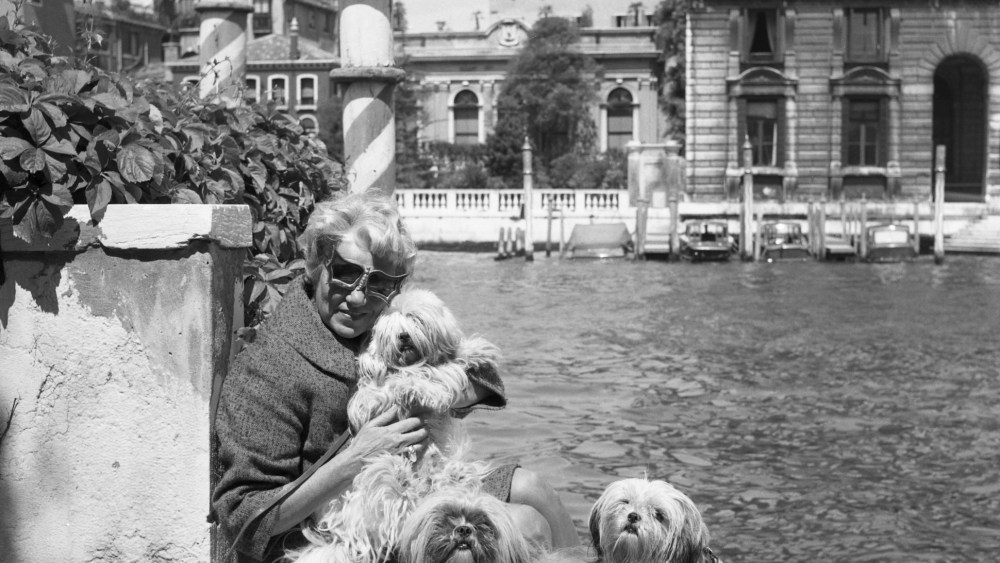
It’s 10 a.m. in Venice and the fog has just about lifted. The skyline of Giudecca island is just about visible from the salon of 93-year-old textile heir and entrepreneur Alessandro Favaretto Rubelli’s home. A smile spreads across his face as he remembers an old bygone neighbor, Peggy Guggenheim.
“She loved Venice and she loved gondoliers,” Favaretto Rubelli says, recalling hanging out with Guggenheim on a balcony of a house party he attended in the ’60s. “An old lady shouted ‘keep it down.’ But not Peggy, she kept chatting and talking about her life,” he muses.
Related Articles

Guggenheim’s Venetian chapter began when she arrived in the lagoon in 1948 to show her collection at the Venice Biennale along with American artists Jackson Pollock and Robert Motherwell. It was clear the New York City-born collector had a lot to offer the war-torn city.
You May Also Like
Later, locals would come to know her as a mysterious figure who roamed the canals by gondola, dressed like a modern dogaressa, her eyes masked by her iconic butterfly sunglasses and accompanied by her beloved lhasa apsos terriers.
The twice-divorced Guggenheim heiress was — despite her accomplishments — often shunned by the Venetian elite because she was American and an eccentric. In response, she created her own Venetian milieu, beginning with young artists like Emilio Vedova and Giuseppe Santomaso. Throughout her life, Guggenheim made it her mission to support emerging creatives like Tancredi Parmeggiani and Edmondo Bacci.
“She really brought a breath of fresh air in post-war Italy and post-war Europe, where there had been so much devastation, and was something quite extraordinary for Venice,” her granddaughter Karole Vail recalls, speaking from Palazzo Venier dei Leoni, which was once her grandmother’s legendary home overlooking the Grand Canal and which is now the Peggy Guggenheim Collection.
Vail, who has lived in Venice since 2017, serves as the collection’s director and continues to keep her grandmother’s legacy of discovery and preservation alive. In October, the collection presented the largest museum retrospective organized in Italy of the works of Marina Apollonio, one of the key figures of international Optical and Kinetic art, and a key figure supported and collected by Guggenheim. She visited the artist’s solo exhibition at the Galleria Barozzi in Venice in 1968 and commissioned Apollonio’s futuristic masterpiece “Relief no. 505,” which remains part of the museum’s collection.
Apollonio, along with Alberto Biasi, are the only “emerging” artists still living who had been supported by Guggenheim, Vail says. Apollonio met Guggenheim long before her art was ever purchased by the heiress. At seven years old, she remembers meeting this “serious” female figure with her father, Umberto Apollonio, a well-known art critic and essayist. The Trieste native recalls local children expressing their awe upon catching a glimpse of Guggenheim passing along the canal in her iconic regalia.
Later on, Apollonio got to know her “human” side. “She admired artists and she had this sensitivity toward the avant garde,” Apollonio says following the opening of her exhibit, “Beyond the Circle.” “I was in my 20s then and she really gave me confidence and made me want to forge ahead. It was a psychological boost,” Apollonio muses as she recalls the hardship involved in being a young artist and raising a family while supporting her artist husband’s career. “I wish my parents could see me now. They told me I would starve as an artist. Well, I didn’t,” she says.
Vail explains that Guggenheim pushed boundaries. When she arrived, she not only presented her own collection but also propelled Motherwell and Pollock onto an art scene that was still recovering from the destruction of the war. “They were slightly known in Europe but nobody had seen their work yet — we’re talking about the 1940s — so that was something fantastic to see their art on this side of the Atlantic in the great pavilion where Peggy showed her collection. I think a lot of people thought, ‘this is fantastic. What will Peggy do next?’”
According to Judith Mackrell’s 2017 book “The Unfinished Palazzo,” Guggenheim’s Venetian home, Palazzo Vernier, had always been an epicenter for the unexpected. The mysterious socialite Luisa, Marchesa Casati Stampa di Soncino made the property famous in the early 1900s with her lavish feasts, punctuated with monkeys and filled with begonias and parties, where her guests were served by waiters clad in brocade.
Guggenheim restored the palace to its glory. Vail points out that she also opened her home and museum to the public several times a week. “That was something very formidable and unusual but Peggy was really ready to share and share the collection,” she says.
Just down the road in a more modest setting, in a framers shop called Cornice Trevisanello, Guggenheim’s memory also lives on. In a cavernous space packed with wood offcuts filled with pencils and paints, Filippo Trevisanello says he was just a kid when he came across Guggenheim, who often worked with his father Aldo. Her garden, which was open to the public, was his favorite place to play hide and seek.
“This area was well positioned to accommodate a growing group of visionary artists who had constant exchange, new techniques and new figures and it was a way to grow together,” he says, noting Guggenheim’s relationship with the elder Trevisanello grew during an exciting era in the Venetian art world. Edmondo Bacci, a pillar of Spatialism, was part of Guggenheim’s inner circle, as were Giuseppe Santomaso and Emilio Vedova.
But behind the conviviality of Guggenheim’s art gatherings, her lunches at Antica Locanda Montin in Dorsoduro and her passion for statement jewelry and Fortuny gowns, her life was punctuated by tragedy. Her father, Benjamin, died on the Titanic and Peggy’s daughter, Pegeen Vail, an artist, in 1967 committed suicide induced by depression.
Long after Guggenheim died in 1979 at age 81, Favaretto Rubelli would step up to support the work of the woman who at first blush seemed boldly “American.” Rubelli, which was founded in 1889, is a Venetian textile-maker famous for its hand-loomed soprarizzo, or chiseled, silk velvet, a company that has also embraced contemporary art in its more modern collections.
In 2002, Rubelli joined Intrapresae, the corporate partnership program of the Peggy Guggenheim Collection, to support the museum, he explains, recalling the courtyard of a palace he once wandered into as an unexpected guest, there to meet the famous supporter of the arts and eccentric.
“The Guggenheim is the second most visited museum in the city,” he says of the reasons for his support. “She gave a lot to this city.”
Tips on Living Venice Like Peggy Guggenheim
Where to Eat
Locandina Montin, a family-run restaurant, which was a popular hangout of Peggy Guggenheim and other celebrities from the 1950s. Characterized by its calming garden and romantic trellis, the menu du jour is comprised of Venetian classics like sarde in soar (fried sardines soaked in a vinegar, raisin and onion marinade) or spaghetti all seppie (spaghetti with cuttlefish).
Fondamenta de Borgo, 1147, 30123 Venezia VE
What to See
Peggy Guggenheim Collection, located on the Grand Canal between the Accademia Bridge and the Church of Santa Maria della Salute.
Dorsoduro, 701, 30123 Venezia VE
Corniceria Trevisanello, Peggy Guggenheim’s trusted old framing shop tucked away along a small canal near The Guggenheim Collection.
Dorsoduro 662, Fondamenta Bragadin, San Vio, 30123 Venezia VE
Fortuny Showroom, which sits adjacent to the secretive Fortuny factory where only artisans are allowed to enter, is a sight to see. Inside the showroom, guests are welcome to make private appointments for residential or commercial projects. Inside the complex, the Fortuny Palazzina, the former home of the late Countess Elsie Lee Gozzi, Fortuny’s former owner, is also open for exhibitions and by private appointment.
Fondamenta S. Biagio, 805, 30133 Venezia VE (available by appointment only)
Fondazione Rubelli’s Rubelli Historical Archive is made up of more than 50,000 historic textile artifacts including mallets, threads, trimmings, as well as more than 1,000 paper copies and preparatory drawings that pay tribute to Rubelli’s and Venice’s rich textile tradition.
S. Marco, 3395, 30124 Venezia VE (by appointment)
Where to Drink
Harry’s Bar. The first and most famous, a hangout for every celebrity who ever visited Venice.
Calle Vallaresso, 1323, 30124 Venezia VE