
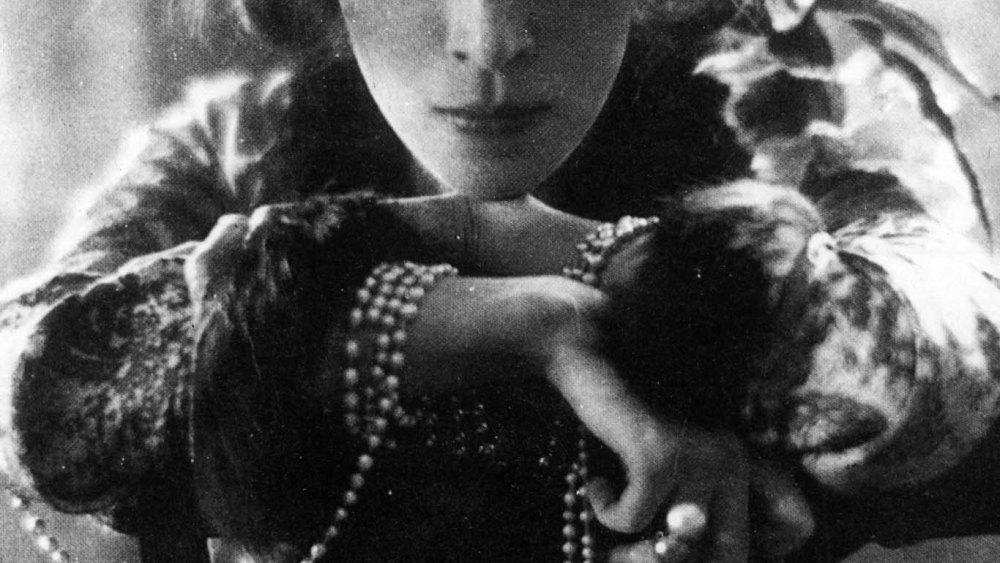
The Marchesa Casati famously said, “I want to be a living work of art,” and, for decades, she was. Born Luisa Adele Rosa Maria Amman, she lost her mother and father when she was respectively 13 and 15. She and her older sister, Francesca, were left fortunes that were said to make them the wealthiest women in Italy.
In 1900, she married Camillo, Marchese Casati Stampa di Soncino. They had one child, Christina Casati Stampa di Socino, but kept separate residences for their entire marriage. They legally separated in 1914.
But Marchesa Casati’s real life was as a patron of the arts, hostess and fashion eccentric extraordinaire. Creating indelible images through costume was a passion for her. She delighted in extraordinary clothes and exotic animals, including colorful parrots, greyhounds, a boa constrictor, tigers, ocelots and a monkey. She was very slender, with chalk-white skin; huge, kohl-rimmed green eyes, and red hair, and was dressed by Fortuny in the house’s signature pleated dresses, Vionnet in bias-cut slipdresses, Poiret in harem looks and Erté in stylized costumes draped in beads and furs.
Related Articles
When she lived in the Palazzo Venier dei Leoni on Venice’s Grand Canal, later occupied by the Peggy Guggenheim Collection, she walked her matched pair of pet cheetahs on diamond leashes around the Piazza San Marco, naked under full-length furs, while her black servants carried torches. She was said to wear live snakes as jewelry. With her love of avant-garde and recherché mises-en-scene, she was a natural fit for the Ballet Russes, and Serge Diaghilev wanted her to come for a performance, simply for the spectacle she would create, rather than as a dancer. Leon Bakst designed a series of exotic costumes for her, such as the Danse Indo-Persane, which consisted of slippers curled at the toes, a mash-up of blue-and-gold veils and a high, pearl-detailed headdress. She always spent lavishly on custom-made shoes, which she carried with her in a specially fitted trunk.
You May Also Like
The Marchesa Casati was famously painted, drawn or photographed by everyone from Giovanni Boldini to Augustus John, along with Paul César Helleu, Romaine Brooks, Cecil Beaton, Jean Cocteau, Kees van Dongen and Man Ray. She also served as a muse for writers, including her lover Gabriele D’Annunzio.
John Galliano’s 1998 spring Christian Dior collection was inspired by her, as was Alexander McQueen’s for spring 1997 and Karl Lagerfeld’s 2010 cruise line, launched on Venice’s Lido. The fashion collection Marchesa, launched by Georgina Chapman and Keren Craig and based on dramatic eveningwear, is named for her.
Substantial as her fortune was, Casati’s wild extravagance dissipated it. By 1930, she was $25 million in debt, a sum she couldn’t pay. Her belongings were auctioned and she went to London, where she lived relatively modestly until she died in 1957 at 76. But the images of the startling, decadent style of her heyday live on.