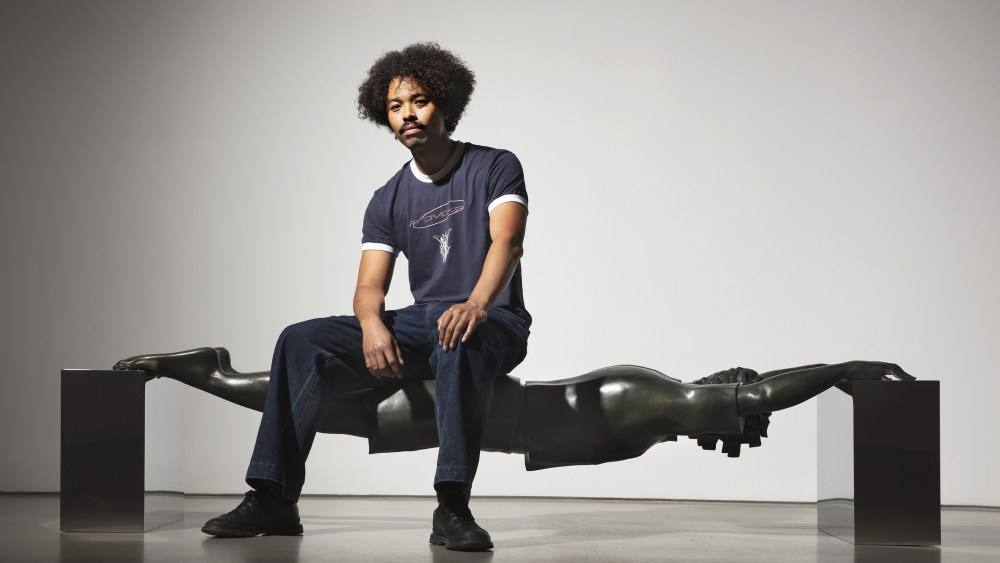
The titular piece of Alex Gardner’s debut exhibition with Perrotin gallery in New York challenges the cardinal rule of gallery-going: Do Not Touch the Art.
“I’ve been wanting to make a three-dimensional object for a long time, but I didn’t want to just take the imagery in the paintings and make it into an object,” says Gardner of “Psychic Stamina,” a bench that invites visitors to take a seat on the bronze figure stretched between two reflective pillars. The figure appears to resist gravity, while simultaneously serving as a support for visitors to take in Gardner’s series of figurative paintings installed around the first-floor gallery space. “When I had this concept it was like, oh, this is perfect because it can be functional.” (Last year, Gardner brought his imagery to another functional piece — a handbag — as a participant in the Dior Lady Art project.)
Related Articles
It’s two days before the exhibition’s opening and the gallery is closed to the public. But the bench still manages to welcome a few visitors while Gardner discusses his latest series of work.
You May Also Like

He directs his attention to the farthest wall from the gallery’s entrance, where the first and last paintings made for the exhibition hang a few feet apart. He began the series last summer with a low-contrast coral-tone painting depicting two figures lying on a bed; next to it is Gardner’s most recent work, an aqua-toned depiction of two figures in more active repose.
“Earlier this year I had no idea what the show was gonna be about. There’s always a moment halfway through where it kind of clicks and you start to see the path,” says Gardner, a native Californian who lives and works in Long Beach, Calif.
“I’ve been wanting to make more optimistic, escapist utopian work, but it’s just not in my nature no matter how hard I try,” he adds. “So I always try to do the balance of acknowledging the suffering, but then trying to create the beauty out of that,” he says. “The works are a physical manifestation of optimism — the very fact that I’ve made them in the first place. You have to believe that there’s meaning and something good will come of making it.”
The exhibition’s title, “Psychic Stamina,” speaks to Gardner’s positive approach, while making space for reality. “It’s kind of about stoicism and enduring the inevitable atrocities of life,” he says. “I was really thinking about the mental fortitude we need to not lose our minds right now, because we’re so inundated with the negativity on a constant basis, you know?”
While inextricably rooted to the moment they were created, the figures in Gardner’s paintings are suspended in a state of timelessness, a setting defined by the artist’s palette and proximity. Some of the figures appear solo or in detailed close-ups, such as in “Tiptoe,” which depicts a foot in relevé. But when multiple figures appear together, the relationship depicted is intentionally ambiguous. Gardner leaves the viewer to interpret the narrative. He similarly leaves details that often serve as a shorthand for distinctiveness — facial features and clothing — consistent, allowing the figures to be singular in the eye of the beholder.
“When you’re making figurative work, you’re like, why am I drawing a person that looks like this? Why are they wearing this? Why are they in this setting? It’s so politically loaded, and there’s cultural baggage,” he says. “I tried to eliminate all those things.”
Gardner’s latest series introduces a new figure to the canon, perhaps his least ambiguous — a child. Gardner is himself a “new-ish” father. “I feel like nothing represents optimism and hope for the future more than a child,” he says.
For viewers interested in narrative context, his titles provide a loose emotional road map. The exhibition’s initial painting, a seemingly peaceful image of two figures in a low-contrast color palette, is complicated by its title: “Do Not Disturb (5 Star Hotel in Hell).” An image of two clasped hands is titled “Friends With the Bouncer,” and the painting hung in the gallery’s lobby, which depicts a figure holding a child, is “All I Trust Is My Trust Fund.”
“It’s my chance to bring an element of humor to all the works,” says Gardner of his titling process. “The title is really important because it’s like the cherry on top — and it can also make or break paintings. It can kind of ruin a painting by reducing it too much.”
Gardner’s use of color serves a similar purpose of shifting the emotional resonance. Some works that appear monochromatic from across the room reveal a more pronounced spectrum upon closer viewing; while others contain a more stark contrast — the coral outline of his figures against a blue backdrop appear to glow, the effect almost kinetic.
“They’re all meant to be seen really up close as well as from far away,” he says of his paintings. “Because I’m layering different colors on top of each other, when they get put next to each other, the relationships change.”
While spatial proximity serves as a marker for the figures in his paintings, Gardner’s own relationship to his work is impacted by temporal distance. But for now, he’s focused on the present moment.
“This is the part that I should be enjoying right now,” he says, glancing around the room. “The opening goes so fast, and then it’s just over. You’re alone again in your room.”