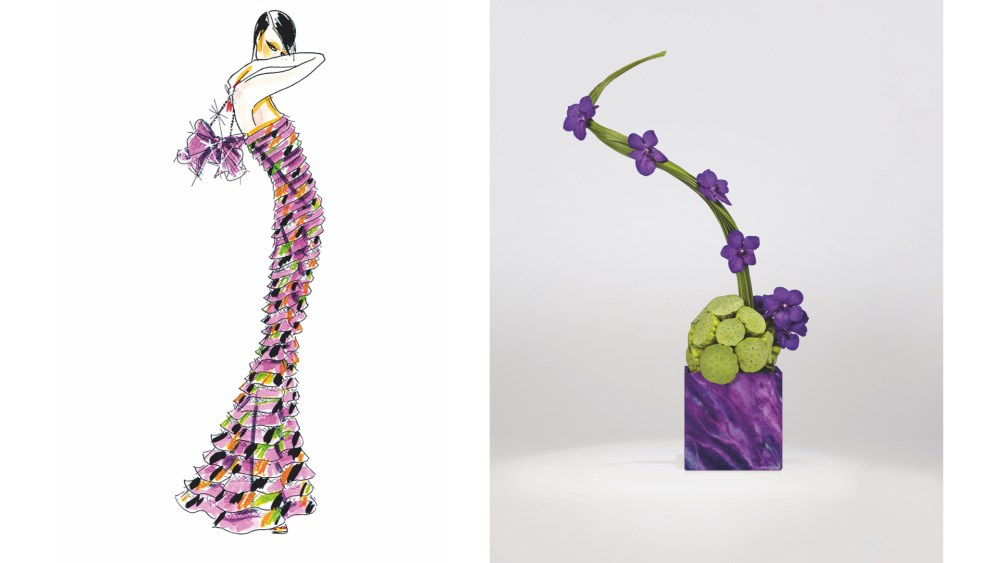
“Flowers should never wilt,” believes Giorgio Armani.
That is only one of the designer’s soundbites on the topic of flowers, around which he has built a brand and a business, Armani/Fiori, established in 2000 with the opening of the Armani/Manzoni 31 store in Milan and also present in Dubai, Kuwait City and Hong Kong.
Celebrating 25 years of Armani/Fiori, one of several anniversaries for the designer this year — from the establishment 50 years ago of his namesake company to 20 years of his Privé couture line — WWD Weekend explores the extension of his vision and style through his own words and those of Nicola Munaretto, head of Armani/Fiori since 2005.
Related Articles
Armani’s style and a specific aesthetic are consistent and cohesive across the board, from his fashion to his furniture and interior designs and to the flower arrangements. Flowers, he says, suggest harmony. “A harmony of shapes and colors, but also of nature and culture, of wild beauty and creativity,” the designer writes in “Armani Fiori,” a book dedicated to this project and published by Rizzoli in 2023.
You May Also Like
“Working with flowers, or around flowers, is exciting, for the creativity and vitality of nature shines through in all its glory, in turn inspiring human creativity. I like the idea of disciplining the exuberance of botany, yet allowing that exuberance to take hold of me. It is always a dialogue, enriching and full of surprises.”

He admits that “when you think of Armani, you don’t think of flowers first and foremost, and this is probably not wrong. In my view, flowers are an acquired taste, an achievement of adulthood. I have vivid memories of the fields of flowers in which we played as children, and clear images of the sense of awe that the blossoms created in all of us, marking the rhythm of the passing seasons with their colors and scents.”
His style was for years informed by rigor, so much so that early on in his career, he “rejected color as a facile and stereotyped notion of femininity, which included floral prints,” working with neutral colors — the “greige” beige and gray blend he became famous for — and with more masculine and geometric designs.
When he started traveling, he discovered that flowers were “a welcome novelty,” as was color, recalling how one summer in the Sicilian island of Pantelleria, where he’s long owned a home, the inflorescence of a colorful cactus against the dry landscape suggested that he should “explore a softer, even more frivolous expression” of his style, as “rigor and frivolity do not exclude each other in any way.”
Armani then started exploring floral compositions to redesign his homes and as part of the development of a lifestyle concept. The arrangements are paired in the book with his gowns and his furniture and the accordance is seamless.
Flowers have become a staple in his home and in his studio, but also in the environments he creates. He reveals a penchant for the lotus flower, and for orchids, described as “so mysterious.”
Given his belief that his “most pronounced character trait” is marked by the duality between rigor and sentiment, reason and passion, he says he feels “a strong affinity with the Japanese way of approaching nature, of mastering its apparent chaos,” referring to the influence ikebana, the art of arranging flowers in abstract compositions, has on him.
“I love streamlined, extremely sharp lines and shapes: compositions where the types of flowers and greenery are limited, reaching the maximum abstraction of only one type of flower and only one type of green. And I like geometry: both in the cuts of the leaves and in the vases, which always have regular shapes such as cubes and spheres, with asymmetries that make everything so moving and elegant, so vibrant and pure,” he states.
The scent of flowers is what strikes the designer more, since they trigger memories — roses, for example, remind him of his childhood in Piacenza during the month of May.
Here, Munaretto reveals how the floral compositions pass Armani’s test and how Armani/Fiori is becoming even more international:
WWD Weekend: I read in the book that, not surprisingly, harmony is a requirement for Giorgio Armani also in the case of the floral arrangements. How do you achieve this?
Nicola Munaretto: Harmony is a key element in floral compositions, achieved through the simplicity of forms and the combination of natural elements that seamlessly blend with design objects.
WWD Weekend: I know the designer requires his stores to be sprayed with his favorite scents, I believe one of his Privé fragrances. Could you tell me how he views the scent of flowers and how you accommodate this with your own visual arrangements?
N.M.: For Armani/Fiori, Mr. Armani has always insisted that stores be infused with an intense and distinctive fragrance, Bois d’Encens available in a Privé fragrance but also as a room fragrance from Armani/Casa. However, when it comes to the scent of flowers, he has never imposed specific requirements — his focus remains primarily on the aesthetics of the compositions and the careful selection of blooms. That said, he deeply appreciates the evocative power of floral scents, which have the ability to awaken memories and stir emotions. The fragrance of peonies and jasmine, for example, is particularly dear to him and surrounds the garden of his Broni residence.
WWD Weekend: On a personal note, how did you start your profession?
N.M.: I grew up in a family of florists, learning the craft from a young age. Meanwhile, I pursued a degree in economics, and later, after a period of working in my family’s business, I had the opportunity to embark on this experience with Armani/Fiori.
WWD Weekend: How did you begin working with Armani/Fiori? What were the main guidelines you were given?
N.M.: I started in 2005 as the store manager of Armani/Fiori Manzoni. At that time, the store had already been open for five years and had a well-defined identity. The greatest challenge for me was embracing an established style while adapting my skills and expertise to a new creative vision.
WWD Weekend: How has Armani/Fiori changed over the years?
N.M.: Over time, Armani/Fiori has grown from a floral corner in Via Manzoni into a fully fledged business, with boutiques in prestigious locations worldwide. Beyond retail, it has also expanded into floral arrangements for major events, further establishing its presence in the luxury space.
WWD Weekend: Who are the main customers of Armani/Fiori? What are they looking for?
N.M.: Armani/Fiori caters to a diverse clientele — those looking to gift or acquire a floral composition for their home, individuals planning events, luxury hotels seeking floral designs for their spaces, as well as restaurants, private studios and high-end boutiques wanting to enhance their interiors with our arrangements. All of our establishments, such as the restaurants or the Armani/Hotels around the world, are adorned with Armani/Fiori arrangements.
WWD Weekend: In the book, the floral arrangements are shown next to Mr. Armani’s garments. Can you tell us how the two categories interact? And how they interact with Armani/Casa?
N.M.: Floral compositions are often influenced by the trends of our fashion collections, with the color palettes of the flowers echoing each show’s theme. Likewise, floral themes frequently appear in prints and patterns within the collections, creating a dynamic interplay between fashion and nature. The connection with Armani/Casa is equally important — floral elements complete the living environment, harmonizing with the aesthetic of the furnishings. Armani/Casa fabric and wall-covering prints frequently incorporate natural motifs such as leaves and flowers, reflecting the brand’s signature style. Similarly, the vases and decorative objects of Armani/Fiori follow the same design principles of Armani/Casa, characterized by refined forms and understated elegance.
WWD Weekend: Oriental touches are frequent in the Armani collections and I gather they are recurrent in the floral arrangements, too. What can you tell us about this?
N.M.: The aesthetic of Armani/Fiori is deeply inspired by Eastern influences, particularly from Japan — a country that has long fascinated Mr. Armani. The use of geometrically arranged leaves and the essentiality of the compositions are undoubtedly reminiscent of Japanese artistry.
WWD Weekend: Are there certain flowers that are absolutely never employed? If so, why?
N.M.: There are no flowers that are strictly excluded — it always depends on how they are incorporated into the arrangement. However, certain flowers and natural elements are favored due to their significance to Mr. Armani, such as orchids, lotus flowers, peonies and bamboo, which are often central to our designs. From my experience, I know he does not favor yellow flowers in general.
WWD Weekend: Are you working on any particular arrangement that you can discuss?
N.M.: We are expanding our retail presence with the opening of new boutiques, ensuring that our floral compositions become accessible to an even wider international audience. We are currently working on opening a temporary shop within Selfridges and are developing other plans in Asia.