Fondazione Prada’s latest exhibition, “Role Play,” is especially timely, interrogating individuality and playing with gender tropes and stereotypes.
Running until June 27 at the foundation’s Osservatorio site in Milan’s Galleria Vittorio Emanuele II, the exhibition comprises a selection of photographic, video and performance works by 11 international image-based artists, and explores the notions of the search, projection and invention of possible alternative identities, whether authentic or idealized.
“I’ve always been fascinated by the confluence of performance, narrative and photography — ‘languages’ often embraced by role play, and I knew that there were wonderful projects by artists whose work I love and who mostly came of age in the 20th century that explored various personae,” says Melissa Harris, who curated the exhibition, citing artists ranging from Claude Cahun, Sophie Calle and Marcel Duchamp to Samuel Fosso, John Kelly, Lucas Samaras and Cindy Sherman, among others.
Related Articles
“It occurred to me that for the most part, these artists were women, and/or people of color, and/or gay, and I started to consider their desire to create some ‘other,’ some alter ego, and the performative nature of it all,” Harris says. “I thought it would be super interesting to explore the theme — to see if it is still a subject or a process that engages artists now, and if so, how? I assumed artists would still find role play compelling because of the evolution of social media and the public way we live our lives, and also because of the growing sense of alienation we understand that younger generations have experienced over the past 20 or so years. But I truly didn’t know.”
You May Also Like

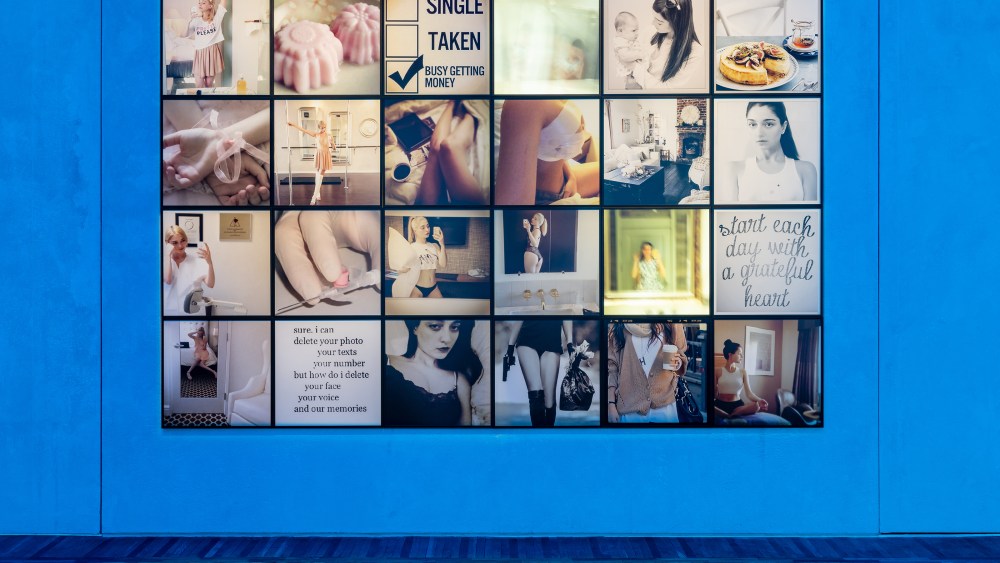
“Excellences and Perfections,” 2014.
Courtesy of the artist and Deborah Schamon Courtesy of the artist and Deborah Schamon
Harris discovered “a very rich” theme that embraced online gaming, cosplay, Instagram, imaginary dialogues and worlds and stereotyping, to name a few. “I was thrilled. I started the research before COVID[-19], but these two years have strangely intensified the resonance of the theme — the anonymity of mask-wearing, the virtual, at times isolated, nature of our lives through Zoom. It has been a period of enormous reflection on our very being — as communities and as individuals,” she explains.
Harris believes role playing has helped liberate artists “to gender-bend and time-travel and envision their selves in myriad ways, in turn reflecting on their very is-ness — even when that is in flux. An alter ego, persona, or avatar may be aspirational; it may relate to one’s personal and cultural history and sense of otherness; it may be a form of activism, or a means of maneuvering through entrenched, even polarized, positions toward empathy: putting oneself in another’s shoes.”
Photography, she continues, is “one of the most suitable visual languages to investigate otherness” and the diffusion of online social communities and virtual platforms, the developments of the metaverse and the emergence of digital avatars “have intensified the urgency to explore self and others through role-playing, reinforcing our obsession with alternative selves.”
“Role Play” features works by artists Meriem Bennani, Juno Calypso, Cao Fei, Mary Reid Kelley and Patrick Kelley, Beatrice Marchi, Darius Mikšys, Narcissister, Haruka Sakaguchi and Griselda San Martin, Tomoko Sawada, Bogosi Sekhukhuni, and Amalia Ulman in an installation by creative agency Random Studio.
Examples include the 2019 “Typecast,” a satirical portrait series by documentary photographers Sakaguchi and San Martin, “addressing the lack of diversity in the U.S. entertainment and film industry. While ethnic minorities constitute nearly half of the U.S. population, only 14 percent of leading roles have been played by people of color. To highlight this reality and reflect on racial bias perpetuated by media representation, they photographed actors embodying the typecast roles offered frequently and parts they aspire to play,” according to Fondazione Prada.
Argentinian artist Amalia Ulman in “Excellences and Perfections (2014)” investigated how everyday life in social media is revisited through the careful use of sets, props, and communication strategies.
Chinese artist Cao Fei focused on the cosplayer in the 2004 video by the same name through “a surrealistic plot to give its protagonists the ability to traverse the city at will and to engage in combat within their imaginary world. They expect their costumes will grant them true magical power, enabling the wearer to transcend reality and put themselves above all worldly and mundane concerns,” said Fondazione Prada.
Chiara Costa, head of programs at Fondazione Prada, praises Harris’ “expert approach and original gaze toward photography and the contemporary visual languages,” underscoring her expertise as editor-at-large of the Aperture Foundation and editor in chief of the Aperture magazine “contributing for 10 years to the development of the most interesting photographic researches.” Harris also curated the “Surrogati. Un amore ideale [Surrogates. An ideal love]” exhibition at Fondazione Prada in 2019.
“Role Play” will also be shown in a second version at Prada’s Aoyama Herzog & de Meuron building in Tokyo from March 11 to June 20.